Houseplant · Crassulaceae
Jade Plant
Crassula ovata
Give it bright light and a dry-out between waterings, and the jade plant becomes the quiet, sculptural anchor a well-kept room keeps coming back to.
Full sun
50–75°F · 10–24°C
USDA 10–11
1–6 ft · 0.3–1.8 m
Overview
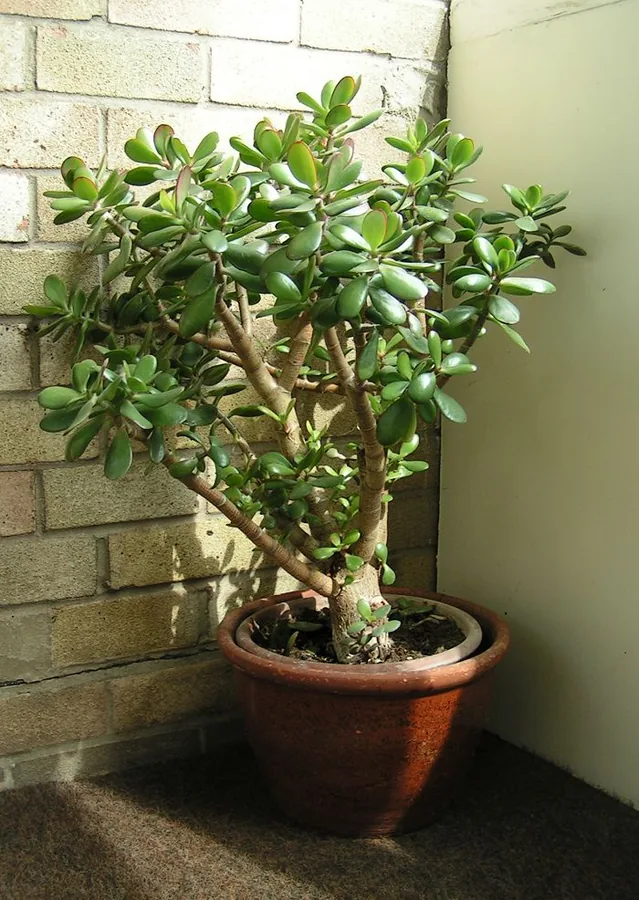
The jade plant is a succulent from southern Africa that has settled into homes as a calm, sculptural fixture rather than a fussy one. It carries its own water in thick leaves and a stout woody trunk, so it holds its shape through a busy, imperfect household routine. Set on a bright sill and left to itself, it slowly takes on the look of a small tree that grounds a corner.
Growth is unhurried, and that suits how a jade lives in a space. A single plant can stay for decades and rise to 1 to 6 feet (30 to 180 cm) indoors, thickening into a gnarled, bonsai-like form that reads as a considered choice on a shelf or entry table. Its folk names, money plant and lucky plant, lend it a quiet story to tell guests, though its real appeal is how effortless it is to live with.
The one thing that undoes the look is a soggy pot. Nearly every jade lost was watered too often, not too little, so drainage is where styling meets survival. Get the watering and drainage right and the plant asks for little else while it holds a room together.
Care
The short version: set it in bright light with some direct sun, pot it in a gritty fast-draining mix, and water only once the soil has dried out completely. Keep it warm, feed it lightly through the growing season, and resist the urge to overwater.
Light
Jade looks its best in bright light with several hours of direct sun, so a south-facing window is where it belongs in a room. Placed too dim and the stems stretch and lean, going pale and leggy as they angle toward the glass and lose their tidy line.
Water
Water it deeply, then wait until the soil has dried out completely before the next drink, easing right back in winter. Overwatering is the surest way to lose a jade, while too little only softens the leaves, which fill back out after a good soak.
Soil
Pot it in a gritty cactus or succulent mix that drains fast, always in a container with drainage holes so the room-side display never sits wet. A slightly acidic pH of 6.0 to 6.5 suits it, and the loose, sandy texture keeps water from pooling at the roots.
Temperature
Ordinary room warmth is ideal, roughly 50°F to 75°F (10°C to 24°C). Keep it clear of cold drafts and never let it sit below 50°F (10°C), a chill that can trigger a sudden, unsightly leaf drop.
Humidity
This is a dry-climate plant that prefers low humidity and dislikes damp, stuffy air, which makes it an easy fit for most living rooms. No misting is needed, since normal household air is more than enough.
Feeding
Feed it monthly through spring and summer while it is growing, then let it rest for winter. A balanced or low-nitrogen succulent fertilizer diluted to half strength is plenty, since jade grows slowly and asks for little.
Pruning
Pinch or prune in spring to shape fuller, tree-like growth and to remove leggy or weak stems that spoil the silhouette. Jade tolerates hard pruning well, and each piece you trim roots easily as a cutting for another corner.
Repotting
Repot it every 2 to 3 years in spring, or once roots push through the drainage holes and the plant turns top-heavy. Move it into a pot just a size up with fresh gritty mix, choosing a vessel that carries the look, and ease off water for a week or so.
Size & spacing
Indoors a jade reaches 1 to 6 feet (30 to 180 cm) tall with a spread of about 1 to 3 feet (30 to 90 cm), enough to hold a corner or crown a table. It grows slowly, so give it a stable, heavy pot that keeps the thickening top upright and looking deliberate.
Troubleshooting
Almost every jade concern traces back to water and light, the same two things that keep it looking its best. Soft, mushy growth signals too much water, while a wrinkled or stretched plant is quietly asking for a drink or a brighter spot. Match what you see below and the plant is usually back in shape before its place in the room is lost.
Soft, mushy stems and yellowing at the base
When the base of a display jade turns soft, dark, and yellow, the culprit is root and stem rot brought on by water left standing around the roots. A base that has gone mushy will not recover in place, so the graceful save is to cut back to firm tissue and let the wounds dry, or begin anew from a sound cutting. From then on, let the soil dry out completely before the next watering and the plant keeps its poise.
Fix:
- Stop watering immediately and allow the soil to dry out
- Remove the plant, cut away rotted roots and tissue, and let cuts callus
- Repot into fresh, fast-draining gritty mix
- Propagate healthy stem or leaf cuttings if the base is lost
Leaves dropping all at once
A jade that suddenly sheds is registering stress from a sudden change in light, temperature, or watering, often the aftermath of a redesign or a change of room. Retrace the recent disruption, whether a new spot, a cold draft, or a swing from dry to soaked. Return it to one settled position and rhythm, keep it clear of cold below 50°F (10°C), and let it find its footing at its own pace.
Fix:
- Stabilize location, light, and watering routine
- Protect from cold drafts and temperatures below 10°C
- Allow the plant to acclimate gradually to new conditions
Wrinkled, shriveled, or drooping leaves
A jade that looks softer and less sculptural than usual, its leaves flexible over dry soil, is simply underwatered, having spent the reserve it keeps in those leaves. Offer a full, generous watering until it runs from the base, then return to watering only when the leaves begin to soften. Within a day or two the plant regains the plump, poised silhouette that earns its place on a shelf.
Fix:
- Water thoroughly until it drains from the bottom
- Resume a regular dry-out watering cycle
- Move out of excessive heat if leaves continue to shrivel
Stretched, leggy stems with gaps between leaves
Stems that lengthen and lose their tidy tree-like line, with leaves spaced far apart, mean the plant is set too far from good light, a state called etiolation. Move it to a bright south-facing window with a few hours of direct sun, turning it now and then so its form stays balanced from every angle. The stretched growth will not tighten again, yet a considered prune of the leggy stems restores the compact, sculptural shape a styled room wants.
Fix:
- Move to a brighter spot with several hours of direct sun
- Rotate the plant periodically for even growth
- Prune leggy stems to restore a compact shape
Toxicity
Style the jade plant into a spot cats and dogs cannot reach. The ASPCA lists it as toxic to both, and a pet that chews the leaves can vomit, turn lethargic, walk unsteadily, and develop a slowed heartbeat. The exact toxin has never been identified, so a high shelf or a closed room is the elegant safeguard. People are essentially fine sharing a space with it.
Toxic to
Cats · Dogs · Horses · Rabbits · Livestock · Birds
Safe for
People
Cats Moderate
A cat that chews the leaves tends to vomit and grow dull and listless. Watch for an unsteady, wobbly walk, and after a larger bite, a heartbeat that runs slower than usual.
Dogs Moderate
A dog that samples jade generally vomits and turns quiet and low on energy. Some become unsteady on their feet, and a slowed heartbeat can follow a bigger mouthful.
Horses Caution
Horses are not a documented target, yet the toxin behind jade's effect has never been named. Until that is settled, the sensible choice is to place the plant well beyond their reach.
Rabbits Caution
No dependable record describes how jade affects rabbits, and a succulent like this has no role in their diet regardless. Treat it as off-limits and prevent any nibbling.
Livestock Caution
Grazing animals have not been studied against this plant, and with the active compound still unknown, the safe course is to fence it away from goats, sheep, and cattle.
Birds Caution
No one has confirmed what jade does to birds, though a curious parrot will chew almost anything it can reach. Keep it clear of cages and perches to be safe.
People Low
People are essentially in the clear, and jade is not regarded as a hazard to handle or keep about the house. It is not food, though, so there is no reason to taste it, and small children are best kept from putting leaves in their mouths.
Helpline numbers

United States
ASPCA Animal Poison Control: (888) 426-4435 (fee applies)

United Kingdom
Animal PoisonLine: 01202 509000 (fee applies)

Australia
Animal Poisons Helpline: 1300 869 738
Varieties
Beyond the everyday jade sit a few cultivars grown for unusual leaf shapes and colors that shift the mood of a display. These are the ones worth seeking out.
'Gollum'
Its leaves grow as slender tubes finished with reddish suction-cup tips, giving the plant a coral-like presence on a shelf.
'Hobbit'
Its leaves curl and roll back into small trumpet shapes on a plant that stays more compact than 'Gollum', ideal for a tight tabletop.
'Hummel's Sunset'
Its golden-yellow foliage picks up red margins that deepen under bright light and cooler temperatures, adding warm color to a sunny sill.
'Variegata' (Tricolor)
Each leaf is streaked with creamy white and green and often flushes pink at the edges, a softer look for a considered room.
How to propagate
Few plants are as easy to multiply for the rest of the house as a jade. A single dropped leaf or a trimmed stem will root with barely any help, which is how one plant quietly furnishes several rooms.
Leaf cuttingsEasy
Spring or summer during active growth · 2 to 4 weeks to root, several weeks more to form plantlets
A single leaf is enough to begin the next jade for another room. Take a healthy one in spring or summer while the plant is growing, let the cut end dry and callus for a few days, then lay it on or barely into gritty mix. Roots come in 2 to 4 weeks and small plantlets take several weeks more, so it is the slow but nearly certain way to fill out a collection.
Stem cuttingsEasy
Spring or summer during active growth · 2 to 3 weeks to root
For a display-ready plant sooner, a stem cutting is the way. Take one during the spring or summer growth window, let the cut callus for several days, then set it into dry succulent mix. Roots arrive in about 2 to 3 weeks, and it settles faster than a leaf because it starts life as a piece of stem.
Myths
The jade plant is the true money plant that brings wealth, the same one sold as a trailing vine.
Money plant is a folk name shared by several unrelated species. Jade is a succulent, while the trailing vine sold under that name is usually a pothos or a Pilea, so the two are not close relatives at all. The name comes from folklore, not from any plant that actually grows wealth.
Jade plants are perfectly safe to keep in a home with pets.
The ASPCA lists jade as toxic to cats and dogs, and the curious detail is that no one has identified the exact compound at work. A pet that eats it can vomit, turn lethargic, walk unsteadily, and develop a slowed heartbeat. Style it into a spot well out of reach of cats and dogs.