Houseplant · Asparagaceae
Agave
Agave americana
Set it in full sun and gritty, fast-draining soil, leave the watering can on the shelf, and agave rewards a hands-off room.
Full sun
50–86°F · 10–30°C
USDA 8–11
6–10 ft · 1.8–3 m
Overview
Agave brings sculpture to a room, a succulent of the dry country across Mexico and the American Southwest, shaped by the work of storing water against long droughts. Each plant settles into a wide rosette of fleshy, blue-green leaves finished with a hard, needle-sharp tip, and a mature specimen reaches about as wide as it stands tall. A pot keeps that scale in check, which is how it earns a place indoors or on a sunlit patio.
Few plants ask for less. It wants strong light and a gritty mix that drains in seconds, and beyond that it prefers the company of benign neglect to any fussing. The one indulgence it will not tolerate is wet feet, since soaked roots turn quickly, most of all across a cool winter.
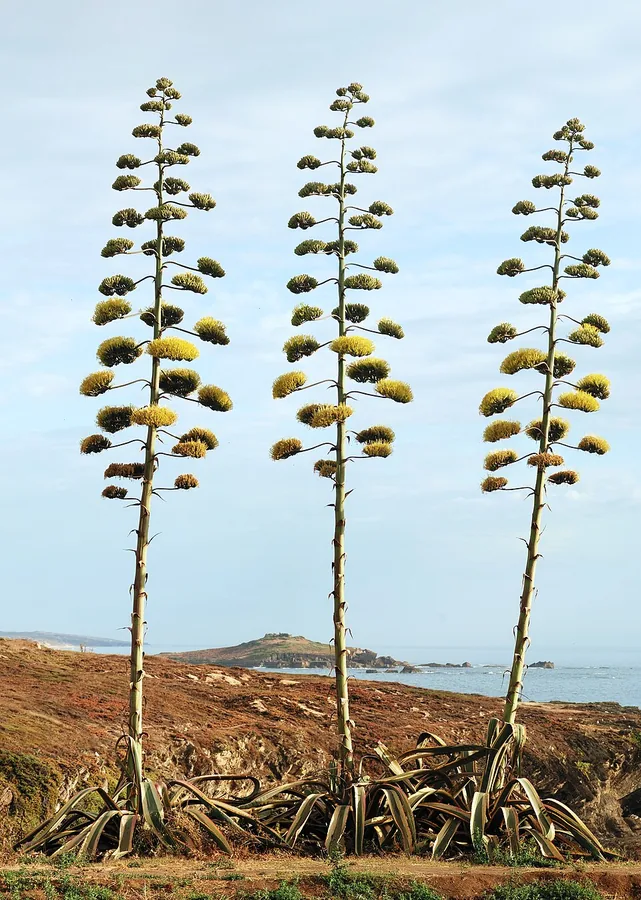
Agave is monocarpic, so the central rosette blooms a single time, lifts a towering stalk after a decade or two, and then takes its leave. Long before that finale it sends offsets out around the base, so the plant carries on through its pups as the parent gracefully bows out.
Care
The short version: full sun, a gritty mix that drains fast, and water held back until the soil is bone dry. Keep it warm and frost-free, feed it seldom, and reach for gloves whenever you handle it, given the sharp spines and irritant sap.
Light
Agave longs for full sun, the brighter the better, content even in a spot that blazes from dawn to dusk. It manages in partial sun or bright indirect light, yet a dim corner leaves it pale and drawn. Bring it into strong light by slow degrees so the leaves keep their composure and never scorch.
Water
Water it through, then let the soil dry out completely before the next pour, an interval that often runs to weeks. Built for drought, the plant carries a dry spell with ease and a wet one badly. When the soil's state is in question, wait, for soggy roots turn fast.
Soil
Give it a gritty, sharply drained sandy or cactus mix that ushers water straight through. A pH of 6.0 to 7.5 suits it well, anywhere from slightly acidic to slightly alkaline. The single thing the mix must never do is hold water.
Temperature
Agave keeps its ease between 50°F and 86°F (10°C to 30°C). It carries real heat without strain but resents cold paired with damp, so hold it frost-free and on the dry side through the winter.
Humidity
A child of dry country, it prefers low humidity and wants no misting at all. Heavy, still air does it no kindness, so allow it room and let the air move freely across the leaves.
Feeding
Agave seeks almost nothing at the table. A dilute, low-nitrogen cactus and succulent feed once or twice through spring and summer is ample, and many plants flourish on none at all. Too generous a hand only coaxes soft, weak growth.
Pruning
Little here calls for your hand. Clear away the lower leaves once they turn dead, shrivelled, or marred, cutting close at the base, and put on thick gloves and eye protection beforehand, with the spine, the toothed edges, and the stinging sap all in mind.
Repotting
Move it on only every 2 to 3 years, or once it is plainly crowded, since agave takes no pleasure in disturbance. Watch for roots pressing through the drainage holes or pups crowding the surface, then raise it a single pot size into fresh gritty mix.
Size & spacing
In the ground a mature plant rises to 6 to 10 feet (1.8 to 3 m) and spreads about as far, so grant it generous room and keep the spined leaves clear of any path. A container holds it smaller and slower, the way most indoor growers compose its scale.
Troubleshooting
Nearly every misstep with agave returns to water or light. Give it too much of the first and the roots rot; offer too little of the second and the plant pales and stretches thin. Find the match below and respond early, while a remedy can still restore it.
A softening base and a rosette losing its poise
What presents here is root and crown rot, and the cause is almost always moisture that lingers, whether from generous watering or a mix that holds it close. Cold, damp winters deepen the trouble. Set the watering aside, lift the plant, and pare away each soft, blackened section with a clean blade; once the wounds have dried to a callus, settle the rosette into a bone-dry gritty mix.
Fix:
- Stop watering immediately
- Unpot and cut away all soft, rotted tissue with a clean blade
- Let the cut surfaces callus, then repot in dry gritty cactus mix
- Withhold water until new root growth resumes
Pale, lengthening leaves leaning toward the glass
Kept in shadow, agave reaches and pales after the light it lacks, an unwinding known as etiolation. The new leaves arrive soft and slack, and the sculptural, close-knit rosette loosens and forfeits its symmetry. Carry it to the brightest place the room offers, full sun where you can, and let that intensity return in slow stages so the leaves never scorch.
Fix:
- Move to the brightest available spot, ideally full sun
- Reintroduce direct sun gradually to avoid scorch
Cottony white drifts and brown studs tucked in the leaf joints
Those drifts and studs are mealybugs and scale, quiet residents of the sheltered seams where leaf meets center, and they favor an indoor plant already under strain. Lift them away with a cotton swab steeped in 70 percent isopropyl alcohol, then return each week to look until none reappear. Give the plant a room of its own while the work goes on, so the rest of the collection stays untouched.
Fix:
- Wipe insects off with a cotton swab dipped in 70 percent isopropyl alcohol
- Repeat weekly until clear
- Isolate from nearby plants
Bleached scorch marking the sunward leaves
These pale patches are sunburn, written across leaves pushed into harsh direct light before they could acclimate, or left exposed through a heatwave; a long dry spell browns the tips besides. Lift the light by degrees across a week or two rather than overnight, lay a veil of shade over the fiercest afternoon hours, and tidy away only the tissue that has died for good.
Fix:
- Increase light gradually rather than abruptly
- Provide light shade during the most intense afternoon sun while acclimating
- Trim only fully dead tissue
Toxicity
Nothing about agave amounts to a systemic poison, and the ASPCA's toxic plant list passes it by entirely. The real cautions are bodily ones. Its sap carries calcium oxalate and saponins with the power to scald and blister skin or inflame a chewing mouth, and each leaf is tipped by a rigid, dagger-like spine whose toothed margins can sink a deep puncture. Keep gloves within reach, shield the eyes, and place it where neither pets nor children can wander.
Toxic to
Cats · Dogs · Horses · Rabbits · Livestock · Birds · People
Cats Mild
Should a cat bite a leaf, expect drooling, pawing at the mouth, or a little vomiting, with stinging where sap meets skin or eyes. The greater concern, though, is the sharp tip and the puncture it can leave.
Dogs Mild
A leaf chewed by a dog brings drooling and a touch of stomach upset, while sap on skin or in the eyes irritates. It is the stiff leaf spines, ready to puncture, that carry the real risk of injury.
Horses Caution
Agave poses no internal poison to a horse, yet a curious mouthful of leaf delivers mild irritation to the mouth and stomach by way of the sap. The defining hazard stays the rigid terminal spine, able to drive a deep puncture wound.
Rabbits Caution
Calcium oxalate and saponins in the sap inflame a rabbit's mouth and gut, so this is no plant for browsing. Keep it well beyond reach, for the irritant sap as much as for the sharp spines.
Livestock Caution
Cattle, goats, and sheep meet no systemic poison here, though the irritant sap leaves the mouth sore and the stomach unsettled. For grazing animals the toothed margins and spear-tipped leaves are the true peril.
Birds Caution
The record holds no account of systemic poisoning in birds, but the sap still irritates, so beaks and feathers are best kept clear of it. A pet bird is far likelier to be wounded by a spine than by anything tasted.
People Caution
Where it touches, the sap can scald, blister, and redden skin, and a chewed fragment leaves the mouth and gut mildly inflamed. Take up gloves and eye protection, because the spear-like point and toothed margins wound far more people than the sap will.
Handle with thick gloves and eye protection: each leaf ends in a very sharp, rigid terminal spine and the margins carry hooked teeth that can cause deep puncture wounds or eye injury, and the irritant sap can blister skin.
Helpline numbers

United States
ASPCA Animal Poison Control: (888) 426-4435 (fee applies)
Poison Control: (800) 222-1222



Canada
Poison Centres: 1-844-764-7669
Varieties
Past the plain blue-green species, a few agave forms surface again and again, treasured above all for the way pale variegation patterns the leaves. These are the ones worth holding in memory.
Agave americana 'Marginata'
Wide creamy-yellow margins trace its blue-green leaves and lend the whole rosette a finished, framed edge.
Agave americana 'Mediopicta Alba'
A single creamy-white band travels down the heart of every blue-green leaf like a painted line.
Agave americana var. expansa
It reads as the plain species at greater scale, looser in habit and broader in its reach.
How to propagate
Agave increases with little effort, since the plant raises its own pups around the base and does the work unbidden. Seed is on offer too, though it tempts almost no one.
Offsets & pupsEasy
Spring to summer during active growth · Several weeks to a few months to root
The graceful way to increase agave is through the pups it raises of its own accord. Through the spring and summer growth, ease a rooted offset from the parent's base, allow the cut to dry into a callus, and set it in dry gritty mix, where it takes root across several weeks to a few months. The main rosette is monocarpic and fades after its once-in-decades bloom, yet the pups carry the line onward without pause.
SeedModerate
Spring in warm conditions · Several months to over a year to reach a handling size
Seed offers a slower path, one few gardeners choose to walk. Sow fresh seed over a gritty mix in the warmth of spring, then yield to patience, for a seedling may want several months to over a year to grow large enough to handle. Offsets are quicker and kinder to the timetable, which is why seed remains the rare indulgence.
Myths
Agave is simply a sort of aloe, as the name American aloe hints.
In truth the two part company at the family level, agave in the Asparagaceae and aloe in the Asphodelaceae, with no close kinship between them. Their plump rosettes echo one another, and the likeness ends right there. American aloe is no more than a misnomer.
Its century plant name promises a full 100 years before the bloom.
Agave does flower a single time, after which the main rosette dies, but the moment tends to arrive at about 10 to 25 years, well short of a century. The century plant name is folklore that has outpaced the facts.