Houseplant · Cactaceae
Old Lady Cactus
Mammillaria hahniana
Give it bright sun, gritty soil, and a dry winter rest, and this woolly little cactus crowns itself with pink flowers.
Full sun
45–84°F · 7–29°C
USDA 9–11
4–12 in · 10–30 cm
Overview
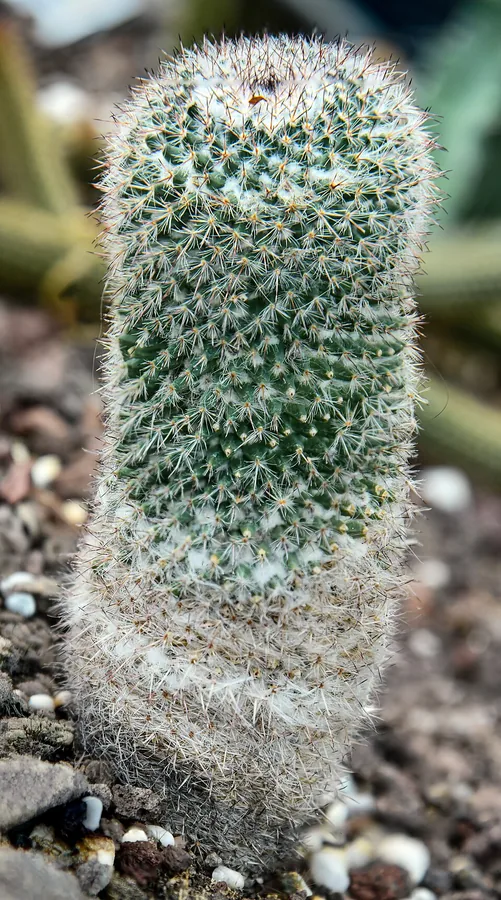
The old lady cactus reads like a small piece of sculpture, a round desert plant wrapped in soft white hairs with the look of a powdered head. It hails from the dry hills of northeastern Mexico and keeps a restrained scale, reaching only 4 to 12 inches (10 to 30 cm) tall before it gathers into a clump of offsets. That compact, slow habit makes it a natural for a sunlit windowsill or a grouping of small pots on a bright shelf.
Its charm turns on a seasonal moment. Come spring a mature plant rings its crown with pink to purplish-red flowers, the display that earns it the affectionate name birthday cake cactus. Give it a sunny spot and a proper cool winter pause, and that bloom becomes a yearly event to look forward to across a room.
For all its poise, it lives by one rule: it will not sit in damp soil. Overwatering undoes most plants, so the whole art is sharp drainage and an unhurried hand between drinks. Get the setting right and it slips into the background of daily life, asking almost nothing in return.
Care
The short version: set it in bright direct light, pot it in a gritty fast-draining mix, and water only once the soil has dried out completely. Pull back through winter for a cool, dry rest, and the plant answers with a season of spring flowers.
Light
Set this cactus in full, direct sun, ideally at a south- or west-facing window where it gathers several hours a day. It manages in bright indirect light, but short it on sun and it stretches tall, pales, and loses the flowers that make it worth displaying.
Water
Wait until the soil has dried completely, then water it through and pour off anything left standing in the saucer. Keep it sparing in summer and nearly dry through the cool winter rest. Water pooling at the roots is the surest way to lose the plant.
Soil
Pot it in a gritty, sharply drained cactus mix so water passes straight through. A pH from 6.0 to 7.5 suits it well. The texture counts far more than the exact figure, since loose, fast-draining grit is what spares the roots from rot.
Temperature
It settles in anywhere from 45°F to 84°F (7°C to 29°C) across the year. A cooler stretch in winter, down toward the low end, is what cues the spring flowers, so resist keeping it warm and cosseted all year long.
Humidity
Low household humidity is exactly the mood this desert plant favors, so there is no figure to chase. Dry air suits it beautifully, while damp, stagnant corners only invite rot and pests.
Feeding
Feed once a month across the spring and summer growing season with a dilute low-nitrogen cactus fertilizer such as 5-10-5. Set the feeding aside through winter while it rests, since a dormant cactus takes nothing from it.
Pruning
This cactus asks for no routine pruning. Simply lift away spent flowers and remove offsets when you mean to propagate or thin a crowded clump. Always wear thick gloves or use folded paper, since the spines and bristles have a bite.
Repotting
Repot it every 2 to 3 years in spring, or whenever the clump outgrows its pot. Watch for roots slipping through the drainage holes, offsets pressed to the rim, or soil that dries almost the moment you water it.
Size & spacing
Look for a compact plant just 4 to 12 inches (10 to 30 cm) tall that slowly widens into a clump up to 20 inches (50 cm) across as offsets gather at the base. Its slow, tidy habit lets it hold a graceful spot even on a crowded windowsill.
Troubleshooting
Nearly every issue with this cactus begins at the roots or reveals itself as stretched, flowerless growth that loses its shapely form. Learn to read the early signs and you can act before rot settles in. Find the match below, then respond while the correction still counts.
A softening, browning base and a plant that begins to lean
When the base turns soft and discolored and the plant starts to slump on its shelf, the culprit is root and basal rot, nearly always from too much water or a mix that stays damp at the roots. Set the watering aside, ease the plant from its pot, and trim away every soft, blackened part with a clean blade. Let the sound tissue or offsets callus for a few days, settle it back into a dry gritty mix, and water only sparingly until it feels at home again.
Fix:
- Stop watering immediately
- Unpot and cut away all soft, rotted tissue with a clean blade
- Let healthy tissue or offsets callus for several days, then repot in dry gritty cactus mix
- Resume watering only sparingly once re-established
White cottony tufts or a fine webbing across the plant
A little cottony white settling into the wool spoils the tidy look and usually means mealybugs, while fine webbing over dull, speckled growth points to red spider mites that thrive in warm, dry rooms. Move the plant off on its own, away from the rest of the collection, then touch the mealybugs with a cotton swab dipped in 70 percent isopropyl alcohol. Rinse the mites off and follow with insecticidal soap or horticultural oil, returning each week until it looks pristine once more.
Fix:
- Isolate the plant from others
- Dab mealybugs with a cotton swab dipped in 70 percent isopropyl alcohol
- Rinse off mites and treat with insecticidal soap or horticultural oil
- Repeat weekly until the infestation clears
No flowers, or pale, stretched growth that loses its poise
A plant that tilts toward the glass and draws itself up tall and thin has lost the sculptural roundness that makes it a centerpiece, a light-starved condition called etiolation. When the spring ring of flowers fails to arrive, it usually reflects a winter spent too warm and damp rather than cool and dry. Give it a bright south- or west-facing window, honor a cool, dry pause around 45°F to 55°F (7°C to 13°C) with little water through the season, then return to its usual rhythm come spring.
Fix:
- Move to a bright south- or west-facing window with several hours of direct sun
- Give a cool, dry winter rest around 7 to 13°C with minimal water
- Resume normal watering and feeding in spring
Toxicity
For a home shared with pets and children, the verdict is welcome: this cactus carries no toxin, and the ASPCA lists its close relatives as non-toxic to cats, dogs, and horses. The catch is purely physical. Beneath those soft white hairs sit fine spines and bristles that lodge in skin, paws, and mouths, so give it a spot out of easy reach and handle it with a steady hand.
Safe for
People · Cats · Dogs · Horses · Rabbits · Livestock · Birds
Cats None
A cat that samples this plant faces no poisoning at all. The one caveat is the fine spines and bristles, which can stick in the mouth, tongue, or paws and turn genuinely uncomfortable, so a high shelf beyond pouncing range keeps both cat and plant looking their best.
Dogs None
There is nothing toxic here to trouble a curious dog. A nose or mouth full of those fine bristles is the sole concern, leaving sore, prickled skin that may want tweezers to clear.
Horses None
A horse may share its surroundings with no toxic effect whatsoever. Should it mouth the plant, bristles can lodge in the muzzle and lips, an uncomfortable moment rather than a poisonous one.
Rabbits None
A rabbit faces no chemical danger from this cactus. The dense spines make it an unappealing nibble in any case, and the only real trouble is any that catch in the mouth or fur.
Livestock None
Cattle, goats, and sheep take no poisoning from this cactus. The bristles and spines can irritate the mouth if an animal grazes it, which is why it earns its place on a windowsill behind glass rather than out in a paddock.
Birds None
The plant holds nothing toxic for a bird. A pet bird might still catch a fine spine while exploring, so it looks best displayed where beaks and feet cannot reach.
People None
Handling it, and even tasting it, brings no poison at all. The fine hairs and spines are the single drawback, breaking off in skin with ease, so keep thick gloves or folded paper on hand whenever you move or restyle it.
The main hazard is physical rather than chemical: the dense white hairs, bristles, and fine spines can lodge in skin, paws, and mouths. Handle with thick gloves or folded paper and keep the plant out of reach of pets and children.
Varieties
The species settles into two accepted subspecies, distinguished mostly by their hair and spines. These are the two names you are most likely to see on a label.
Mammillaria hahniana subsp. hahniana
This is the classic form most collections favor, draped in long white hairs and crowned each spring by a wreath of pink to purplish-red flowers.
Mammillaria hahniana subsp. woodsii
Once held as its own species, this accepted subspecies sets itself apart through its spination and a lighter, more sparing veil of hair.
How to propagate
Growing the collection out from one plant is half the pleasure, and there are two ways to do it: lift the offsets it makes on its own, or take the slower path from seed.
Offsets & pupsEasy
Spring to summer during active growth · About 4 to 8 weeks to root after callusing
The graceful way to grow the collection is to lift an offset from a mature clump, since the plant produces them freely. Twist or cut one away in spring or summer while it is growing, let the cut callus for a few days, then set it into dry gritty mix, where it roots in about 4 to 8 weeks and becomes a small companion pot of its own.
SeedModerate
Early spring, sown warm at about 19 to 24°C · Several months to a year or more to reach a handleable size
Seed is the slower, more contemplative route, a project for the patient. Scatter seed across a gritty surface in early spring, hold it warm at around 66°F to 75°F (19°C to 24°C) and humid, and allow several months to a year before the seedlings are large enough to handle and pot on.
Myths
Cacti thrive on neglect and need almost no water.
The tough little sculpture on the shelf still asks for attention. Through the growing season it wants a thorough soak each time the soil has dried out completely, since letting it go dry too long leaves it shrunken while standing water at the roots leads to rot. A generous drink followed by a full dry-out is the rhythm that keeps it looking its best.
Old lady cactus is poisonous to pets.
There is no need to banish it from a household with animals. Mammillaria cacti carry no toxin, and the ASPCA lists close relatives as non-toxic to cats, dogs, and horses. The only real hazard is the spines and bristles, which can lodge in skin, paws, and mouths.