Vegetable · Fabaceae
Runner Bean
Phaseolus coccineus
A tall support, full sun, and steady water turn the runner bean into a living wall of summer color that crops until frost.
Full sun
Every 3–7 days
50–77°F · 10–25°C
65–75 days
Overview
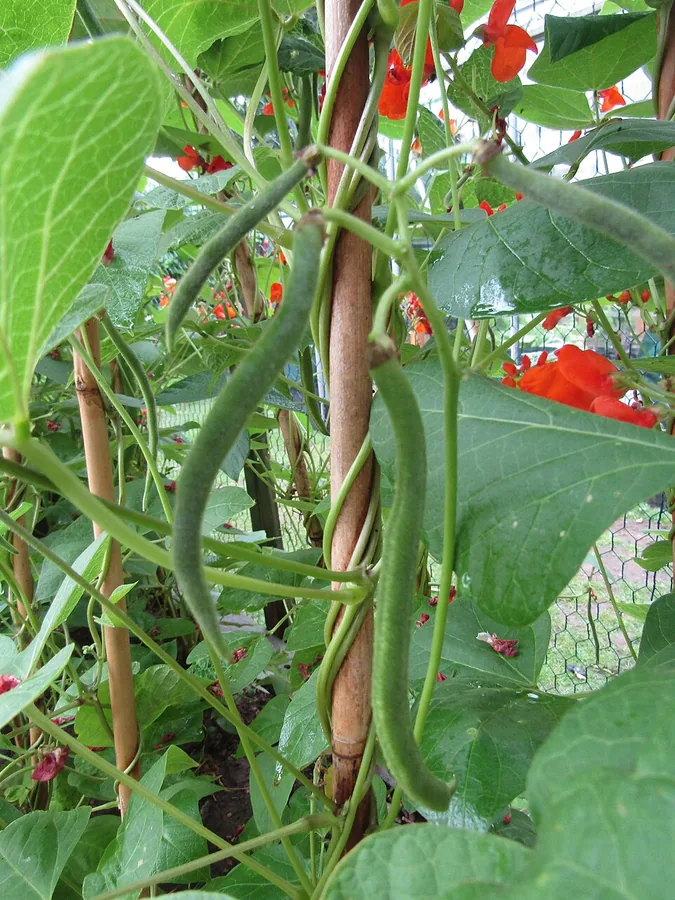
Few edibles carry a garden the way the runner bean does. It climbs fast and twines itself upward, grown for its display of flowers as readily as for its long pods, and it belongs to the bean family. In mild zones 7 to 11 the fleshy roots persist through winter and it returns as a perennial, though most gardens simply plant it fresh each spring. Set against a tall support, it rises 6 to 10 feet into a green vertical feature that anchors the plot.
From early summer to the first frost the vines stay in flower, in scarlet, white, or a painted wash of pink and white that suits whatever palette a garden is after. The blooms bring bees and hummingbirds into the space, giving a corner of the yard real movement and life. Behind the show, the flowers become green pods for the table, picked young for the kitchen and left to mature only when a shell bean is wanted.
As a fixture, it asks little of a daily routine. The plant makes its own nitrogen, so feeding barely enters the picture, and once a support is in place the climbing takes care of itself. What it rewards is cool summers and even watering, the two conditions that keep the flowers on the vine through the season.
Care
The short version: give runner beans a sunny position and a tall support to climb, keep the fertile, well-drained soil evenly moist at about 1 inch of water a week, and feed only lightly, since the plants supply their own nitrogen.
Light
Runner beans belong in full sun, with no place on the shady side of the garden. Open light is what drives the quick climb and the long season of flowers, so give them the brightest, most open position available.
Water
Keep the soil evenly moist and count on roughly 1 inch of water a week, most of all while the vines are in flower and setting pods. Lighter, sandy ground drains faster and wants topping up more often. Steady watering is what holds the flowers through a warm stretch and keeps the display intact.
Soil
A fertile, well-drained loam at pH 6.0 to 7.0 gives them the footing they want. A little compost turned in before sowing sets the stage, and the deep roots take care of the rest.
Temperature
They keep their poise between 50°F and 77°F (10°C to 25°C), and a cool summer suits them best. Once the heat rises above that, the flowers begin to drop before they can set, and the show pauses until conditions ease.
Humidity
Everyday outdoor humidity around 40% to 70% is all they call for, so nothing needs adjusting. A little spacing between plants, enough for air to drift through, is the only real consideration.
Feeding
Feeding stays in the background here, since the plants make their own nitrogen. A light 5-10-10 at planting covers it, and heavier feeding only trades pods for a surplus of leaves.
Pruning
There is little pruning to keep up with. Once a vine tops its support, pinching out the growing tip encourages branching and more pods, and clearing away spent pods keeps the planting looking and cropping well.
Repotting
This is not a plant for containers. It settles best sown directly in the garden at the foot of a tall support, where it has room to climb.
Size & spacing
The vines rise 6 to 10 feet (1.8 to 3 m) while keeping a slim base, spreading only 12 to 24 inches (30 to 60 cm) across. A sturdy tall support and a little space for air to move are all the planting needs.
When to plant
Timing sets the rhythm of the season. Once the last spring frost has cleared and the soil settles at 50°F to 60°F (10°C to 16°C), sow direct, and the first young pods arrive about two months on, carrying the harvest through to frost.
Northern hemisphere
Southern hemisphere
Typical months for a temperate climate: start earlier in warm zones, later where spring frosts linger.
- Sow: Optional: 2-3 weeks before the last spring frost in biodegradable pots to avoid root disturbance.
- Plant: After the last spring frost, once soil is at least 50-60°F (10-16°C).
- Harvest: Flowers from early-to-mid summer until frost; harvest young pods (10-15 cm / 4-6 in) about 65-75 days after sowing.
Hardiness
USDA hardiness zones: 7–11
Temperature: down to -18°C
Troubleshooting
A runner bean tells you how it is faring through its flowers, its pods, and its leaves. Learn to read those three, and a small setback rarely turns into a lost season. The notes below match each sign to its remedy.
Flowers fall in the heat before pods form
The disorder is blossom drop, and heat drives it. When the days climb past 80°F to 90°F (27°C to 32°C), pollen stops working and the flowers let go before setting. Keeping the roots cool and evenly watered, with a little afternoon shade through a heat wave, carries the planting until the weather turns and pod set resumes.
Fix:
- Keep soil evenly moist and mulch to moderate root-zone temperature
- Provide light afternoon shade during heat waves
- Wait for cooler weather, when pod set typically resumes
Leaves go lacy or curl and distort
Leaves worked down to lace with yellow grubs beneath them signal the Mexican bean beetle, while curled new growth thick with soft insects signals aphids. Removing beetles, larvae, and orange egg masses by hand handles the first, a strong spray of water clears the aphids, and insecticidal soap stays in reserve for a heavy outbreak. Regular checks, row fabric over young plants, and a welcome for lady beetles keep the planting clean.
Fix:
- Hand-pick beetles, larvae and egg masses
- Dislodge aphids with a strong spray of water
- Apply insecticidal soap to heavy infestations
Pods turn tough and stringy on the vine
Left too long, pods grow over-mature and take on the fibers and strings that trade tenderness for toughness. Picking them young at 4 to 6 inches (10 to 15 cm), with a look over the plants every 2 to 3 days, keeps them at their best. Any that slip past still earn their place shelled for fresh or dried beans.
Fix:
- Harvest pods young, at 10-15 cm (4-6 in)
- Pick every 2-3 days to catch pods at peak tenderness
Toxicity
This is a plant that sits easily in a household. The cooked pods and beans belong on the table, and the growing vine poses no threat to pets or livestock sharing the garden. The one reservation is raw mature beans, which hold a lectin called phytohaemagglutinin that can unsettle a stomach, so cook dried seeds through and keep them from a curious cat or dog.
Toxic to
Cats · Dogs
Safe for
People · Horses · Rabbits · Livestock · Birds
Cats Caution
A cat is not counted at risk here, and most pass the plant by without interest. The point to watch is raw mature beans, whose lectin can leave a cat with vomiting or diarrhea after a few, so dried seeds are best kept out of reach.
Dogs Caution
Runner beans are no listed poison for a dog, yet one that swallows raw dried beans may suffer a stomach upset from the same lectin. Cooked pods and beans sit well, so only the raw mature seeds call for care.
Horses Safe
A horse grazing alongside faces nothing of concern from the plant. As with any legume, large amounts of raw dried beans are better avoided, though the growing vine itself is harmless.
Rabbits Safe
Rabbits can browse the foliage with no ill effect. The raw mature seeds are the thing to withhold, carrying the same lectin seen elsewhere, while leaves and young pods remain fine.
Livestock Safe
Cattle, goats, and sheep come to no harm from the living plant. The single caution is a quantity of raw dried beans, which belong cooked rather than served uncooked.
Birds Safe
Backyard birds and poultry are at ease around runner beans. Bulk raw dried beans are the exception, hard as they are on the gut, while the pods and foliage cause no trouble.
People Safe
For the household, cooked pods and beans are a welcome and safe part of the kitchen. Raw mature beans are the exception, holding phytohaemagglutinin, so dried seeds always want a thorough cooking before the table.
Raw or undercooked mature (dry) seeds contain phytohaemagglutinin, a lectin that can cause nausea, vomiting and diarrhea if eaten in quantity; cook seeds thoroughly. Young pods, cooked, are safe.
Helpline numbers

United States
ASPCA Animal Poison Control: (888) 426-4435 (fee applies)

United Kingdom
Animal PoisonLine: 01202 509000 (fee applies)

Australia
Animal Poisons Helpline: 1300 869 738
Varieties
A handful of runner beans stand out, sorted by flower color and by whether the appeal is the plate, the display, or both. These are the names to reach for when planning a planting.
Scarlet Emperor
A time-honored scarlet-flowered heirloom that comes in around 75 days and keeps long green pods arriving in generous flushes.
Painted Lady
An ornamental standout grown for its red-and-white bicolor blooms every bit as much as for its beans.
White-flowered (e.g. 'Czar' / 'Albus')
A versatile type with white flowers and large white seeds, at home as a fresh pod and as a shell bean.
Companions
Runner beans shine in the Three Sisters planting, climbing the corn for support and feeding nitrogen back to it and the squash sprawling below.
Plant near
corn: In the Three Sisters planting, corn stalks give the climbing beans a natural support while the beans fix nitrogen for the corn.
squash: Part of the Three Sisters; sprawling squash shades the soil and deters pests while the beans climb the corn and fix nitrogen.
How to propagate
Bringing runner beans into a garden takes almost nothing. The seed goes straight into warm soil and comes up on its own, with no coddling required.
SeedEasy
Direct-sow outdoors after the last spring frost once soil reaches at least 50-60°F (10-16°C). · Germinates in 7-14 days; begins flowering about two months after sowing.
Set the seeds 1 to 1.5 inches (2.5 to 4 cm) deep at the foot of a tall support, once the frost has passed and the soil has warmed to 50°F to 60°F (10°C to 16°C). They surface in 7 to 14 days and come into flower about two months later, so there is little to gain from starting early, though a sowing 2 to 3 weeks ahead under cover is an option. Where winters stay mild, the tuberous roots can be lifted in fall and held over for an earlier crop the following year.
Myths
Runner beans are poisonous and best left uneaten.
Cooked young pods are an ordinary vegetable that gardens and kitchens have relied on for generations. The only genuine concern is raw or undercooked mature dry seeds, which carry phytohaemagglutinin and can bring on a stomach upset. Cooked through, the dried beans are entirely safe.
Runner beans need generous nitrogen to crop well.
Like every legume, they draw their own nitrogen from the air by way of Rhizobium bacteria in the roots, so they ask little in the way of feeding. A heavy hand with nitrogen buys leaves rather than beans, since the lush growth comes at the pods' expense.