Ornamental · Juncaceae
Corkscrew Rush
Juncus effusus 'Spiralis'
Keep its roots wet and never dry, and corkscrew rush brings a season of twisting green coils to a quiet corner.
Full sun
Every 1–3 days
USDA 4–9
12–18 in · 30–46 cm
Overview
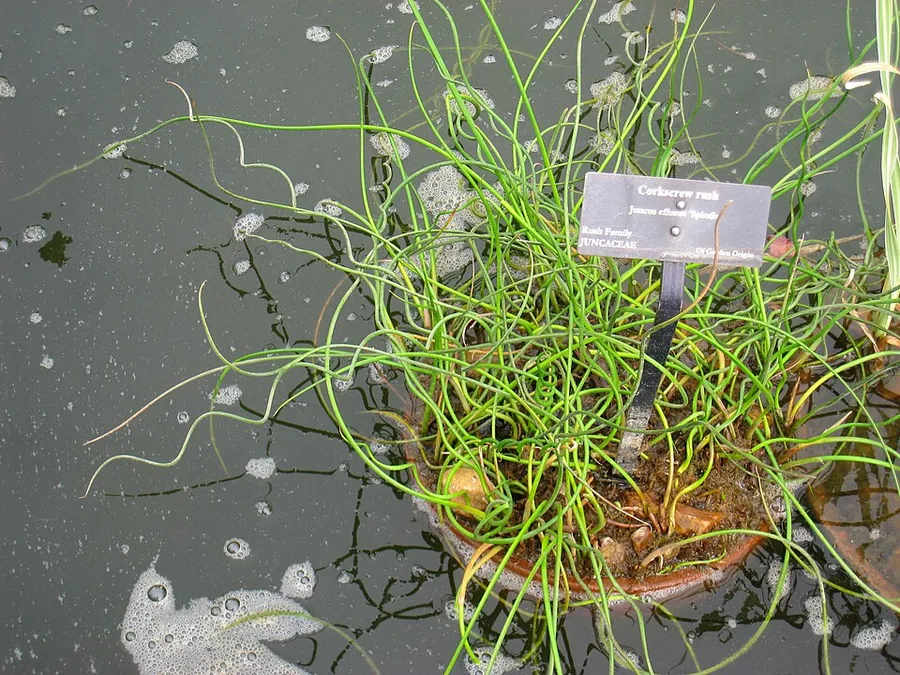
Few plants make a room feel composed and a little playful at once, and corkscrew rush manages both. Its spiraling stems read as living sculpture, a green flourish that draws the eye without crowding a space, and they earn it its name on sight. It is a rush, not a grass or a sedge, and it lends a planting a sense of motion that feels considered rather than busy.
What it asks of a home is water, and that single need shapes where it belongs. This is a bog and pond-margin plant at heart, so it settles happily into a water feature's edge, a damp courtyard corner, or a handsome pot set in a saucer of water on a kitchen sill. Pair it with a simple ceramic vessel and let its coils do the talking against a clean surface.
It suits a relaxed, low-effort routine, a cold-hardy perennial that keeps its curls through much of the year and folds easily into the rhythm of a household. The one styling note is its habit of throwing up plain straight stems from its wild parent. Tidy those away as they appear and the spiral character stays the star of the arrangement.
Care
The short version: full sun to part shade, soil that never dries out, and a wet or boggy spot where it can sit in plain view all season. Tidy away any straight reverted stems, and divide the clump every few years to keep the look crisp.
Light
Set corkscrew rush in full sun for the best, tightest curls, though it carries partial sun and partial shade without complaint, which opens up shadier corners of a courtyard or sill. More light reads as denser, more sculptural spiral growth.
Water
This is the detail that shapes everything: the soil must never dry out. Keep it consistently moist to wet, or simply rest a potted plant in a saucer of water as part of its setting. It is content in boggy ground and even in standing water up to a few inches over the crown, so glance at the moisture every day or two in warm weather.
Soil
It settles into rich, constantly moist to wet soil and is unfussy about texture, taking clay, loam, or sand in stride. A generous pH range from 6.0 to 8.0 suits it, and it looks at home in bog conditions or shallow standing water at a feature's edge.
Temperature
Corkscrew rush is dependably tough, holding its own from -29°F to 100°F (-34°C to 38°C). That range lets it overwinter outdoors in much of the country, so an outdoor arrangement keeps its presence year after year.
Humidity
Ordinary room humidity is plenty, with no figure to manage. What it cares about is wet roots rather than damp air, which makes it a forgiving fit for an indoor corner or an outdoor terrace alike.
Feeding
It is a light feeder, in keeping with its low-key character. A single light spring application of a balanced general-purpose or aquatic-plant fertilizer carries it through the season, and a heavier hand offers nothing in return.
Pruning
Upkeep stays light and quiet. Through the season, comb out or trim away dead and straight reverted stems to keep the corkscrew silhouette clean, then cut tatty or old clumps to the ground in late winter to early spring for a fresh start.
Repotting
Plan to divide or repot every 2 to 3 years, or whenever the center of the clump dies out. A bare middle, a crowded crown, or fewer new spiraled stems are your cues that the arrangement wants renewing.
Size & spacing
Clumps settle at about 12 to 18 inches (30 to 46 cm) tall and roughly as wide, a tidy scale for a tabletop or a pond edge. Give each plant a matching 12 to 18 inches (30 to 46 cm) of room so the coils can be seen in full.
When to plant
Corkscrew rush is a hardy perennial that returns each year on its own, so there is no seed-starting calendar to build a routine around. Settle new plants into their spot in spring once frost has passed, enjoy the loose summer flowers as a quiet bonus, and divide established clumps in spring whenever the display wants refreshing.
Northern hemisphere
Southern hemisphere
Typical months for a temperate climate: start earlier in warm zones, later where spring frosts linger.
- Plant: Spring after frost danger passes
- Harvest: Inconspicuous yellowish-green to brown flowers in loose cymes, summer (roughly June to September)
Hardiness
USDA hardiness zones: 4–9
Temperature: down to -34°C
Troubleshooting
Corkscrew rush asks little and rarely falters, and the few signs it shows are easy to read across a room. Dry soil and straight reverting stems cover most of what comes up. Match the sign below and step in early, while the fix is still effortless.
Stems browning and crisping as the plant fades
When the coils brown and the whole piece starts to look tired, dry soil is almost always behind it, and it is the surest way to lose the plant. A rush belongs to bog and pond margins, so the moment the ground dries the stems crisp and slump, and the sculptural effect goes with them. Move it to wet soil at once, settle a container into a tray of water, and trim the spent stems once the form recovers.
Fix:
- Move to consistently moist or wet soil immediately
- Stand container in a saucer or tray of water, or place at a pond/bog edge
- Keep soil saturated; the plant tolerates standing water up to a few inches over the crown
- Trim out dead browned stems once moisture is restored
A dead, hollow center ringed by healthy growth
Given a few years, an established clump will die out from the middle as the crown crowds itself, leaving a live outer ring framing a hollow center that breaks the tidy mound. Restore the shape by lifting the whole clump in spring, removing the spent heart, and replanting the strong outer pieces. Make this a quiet ritual every few years and the planting keeps its poise.
Fix:
- Lift and divide the clump in spring
- Discard the dead central portion and replant vigorous outer divisions
Straight green stems pushing up among the curls
The stiff vertical stems creeping into the display are reversion, the plant easing back toward its straight wild parent, common rush. Since the spiral is a selected form, a clump will quietly send up rigid stems and dull the sculptural look you planted it for. Edit them out at the base as they appear to keep the silhouette clean, and if a clump reverts in earnest, divide it and replant the most tightly curled pieces.
Fix:
- Cut or pull out the straight reverted stems at the base as they appear
- Remove reverted growth promptly and repeatedly to keep the corkscrew appearance
- If a clump reverts heavily, divide and replant the most strongly spiraled portions
Toxicity
For a home shared with animals, corkscrew rush is an easy conscience: it is not poisonous to pets, livestock, or people. It never appears on the ASPCA toxic-plant lists. A pet that chews the wiry stems might bring up a little fiber, but that comes down to texture, not any toxin.
Safe for
People · Cats · Dogs · Horses · Rabbits · Livestock · Birds
Cats None
A welcome choice for a home with cats, since the stems carry no poison. A cat that investigates the wiry stems might cough up a little fiber, but that is a matter of texture rather than anything harmful.
Dogs None
Equally at ease in a household with dogs. A determined chewer may catch a quick gag on the fibrous stems, yet nothing in the plant is poisonous.
Horses Safe
No concern for horses. Rushes of this sort line the wet pasture edges horses graze, and they hold no toxin.
Rabbits Safe
Untroubling for rabbits. The tough, fibrous stems read more as a chew toy than a meal, with nothing in them to harm a rabbit.
Livestock Safe
Of no concern to cattle, goats, or sheep. Native rushes appear across damp grazing land and move through livestock without incident.
Birds Safe
Safe in the company of birds. Rushes belong to the everyday fabric of wetland habitat and carry no poisoning risk for them.
People Safe
Not poisonous to people, children among them. It is an ornamental rather than something for the table, so there is no edible part to share, but a curious nibble does no harm.
Generally safe around pets and people; pets that nibble the stems may occasionally vomit from the fibrous material, but the plant is not poisonous.
Varieties
A handful of named corkscrew rush selections reach nurseries, differing mostly in scale, curl, and color, which gives you room to suit one to a particular spot. These are the ones worth knowing.
Juncus effusus (common rush / soft rush)
This is the unadorned wild species with upright green stems, and corkscrew rush is the curling form drawn from it, the same plain stems 'Spiralis' keeps drifting back toward.
'Unicorn'
A University of British Columbia introduction, it carries a little more height at about 18 inches with tighter curls and a deeper green than the everyday spiral.
'Big Twister'
Chosen for drama, this one offers larger, more pronounced curling stems that twist harder than the standard form.
'Blonde Ambition'
A compact, variegated option in blonde-gold, it keeps to about 6 to 9 inches tall while spreading to roughly 18 inches wide.
How to propagate
There is one graceful way to make more corkscrew rush for a grouping or a second vessel, and it is quick and dependable once the timing is clear.
DivisionEasy
Spring · A few weeks to a couple of months
Multiplying it for a sweep of pots or a pond edge calls for spring division. Lift the clump, ease the rhizomes apart, and set the most strongly spiraled divisions into soil kept wet. A new division takes a few weeks to a couple of months to settle. Leave seed alone, since seedlings tend to come up straight rather than curled and lose the look you wanted.
Myths
Corkscrew rush is an ornamental grass.
It is often filed alongside ornamental grasses, yet it is no grass at all, it is a rush in the family Juncaceae. An old line settles the question neatly: rushes are round with solid, pithy stems, grasses are hollow and jointed, and sedges have edges with triangular stems. The distinction is worth knowing when you place it among true grasses in a border.