Shrub · Aristolochiaceae
Dutchman's Pipe
Aristolochia macrophylla
A fast living screen that drapes a porch in a wall of overlapping leaves and brings the pipevine swallowtail.
Full sun
Every 5–10 days
USDA 4–8
20–30 ft · 6.1–9.1 m
Overview
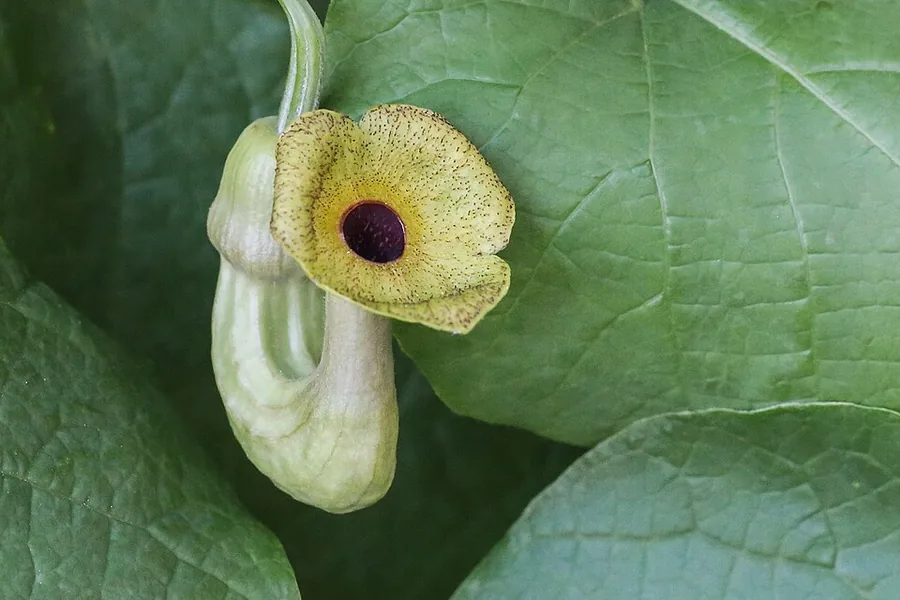
Few plants reshape an outdoor room as quickly as Dutchman's pipe. Trained over a porch, an arbor, or a pergola, its overlapping heart-shaped leaves close into a dense green screen within a season or two, turning an exposed seat into a shaded, private retreat. The small pipe-shaped flowers it is named for stay tucked among the foliage in late spring, a quiet detail on a vine that earns its place through architecture rather than bloom.
It also brings life to the space it furnishes. As the main host for the pipevine swallowtail, the vine draws butterflies into the garden, and the caterpillars that feed on its leaves store the plant's own toxin against the birds. Site it where morning coffee or an evening glass belongs, and the screen comes with movement and wings as part of the setting.
For all its presence, it stays purely decorative, and that line matters. Every part holds aristolochic acid, a compound that harms the kidneys and causes cancer in people, so it belongs in the landscape and nowhere near the table. Given a strong frame to climb and a yearly trim, it holds its handsome shape over a terrace for years.
Care
The short version: set it in full sun to part shade, keep its rich soil steadily moist, give it a sturdy support worthy of the space it will fill, and cut it back hard each late winter so the screen stays elegant rather than unruly.
Light
Dutchman's pipe settles happily into full sun to part shade, and the brighter the position, the fuller and more luxuriant the screen it draws across a frame. A deeply shaded corner thins the cover and leaves weak, sparse growth, so a sunlit aspect rewards the space with real presence.
Water
Keep the soil consistently moist, since this vine has no patience for dry ground and a thirsty screen quickly loses its lush look. Water it through dry spells, soaking the roots roughly every 5 to 10 days as it establishes. A layer of mulch keeps the moisture in and the foliage looking its best.
Soil
Give it rich, well-drained loam worked through with plenty of organic matter, the kind of fertile bed that keeps a living screen looking generous. PH is no concern, since it takes anything from 6.0 to 8.0, so the focus stays on moisture and richness rather than chemistry.
Temperature
This is a remarkably resilient plant, comfortable across a sweep from about -29°F to 95°F (-34°C to 35°C). That cold-hardiness is what lets it return as a perennial vine even in northern gardens up into zone 4, holding its place season after season.
Humidity
Ordinary outdoor air is exactly right, so there is no humidity to manage for the look of it. Steady moisture at the roots does far more for the screen's appearance than anything in the air around the leaves.
Feeding
A light feed in spring with a balanced fertilizer or some compost worked in at the base keeps it generous without excess. This vigorous native asks little, and a rich bed will often carry the planting on its own.
Pruning
A firm cutback in late winter keeps the fast, heavy growth in check and the screen tailored rather than tangled. It accepts a hard prune with ease, so there is no need for caution, and thinning crowded stems keeps the whole composition airy.
Repotting
This is a vine for the open ground, not a container subject, so repotting rarely enters the picture. A young plant waiting in a nursery pot should simply move into the garden before its roots circle and water runs straight through.
Size & spacing
Plan for a generous presence, since it climbs to 20 to 30 feet (6 to 9 m) and spreads 15 to 20 feet (4.5 to 6 m) across. A single vine dresses a large arbor on its own, so place one well rather than crowding several into the scene.
When to plant
Dutchman's pipe asks almost nothing of the calendar, which suits a garden meant to be lived in rather than managed. Hardy across zones 4 to 8, it can be started from seed in late winter to early spring after a cold spell or sown outdoors in fall, then set out in spring once frost has passed and the soil works. The small pipe flowers arrive quietly in late spring, around May and June, as the screen fills toward summer.
Northern hemisphere
Southern hemisphere
Typical months for a temperate climate: start earlier in warm zones, later where spring frosts linger.
- Sow: Late winter to early spring (seed needs cold stratification); can also direct sow outdoors in fall
- Plant: Spring after last frost, once soil is workable
- Harvest: Late spring (May to June), with small pipe-shaped flowers hidden among the foliage
Hardiness
USDA hardiness zones: 4–8
Temperature: down to -34°C
Troubleshooting
A settled Dutchman's pipe rarely disrupts the scene it creates, and the few issues that surface are matters of scale and placement rather than illness. A look at the foliage and the frame usually points the way, and most concerns ease with a decisive prune or a better-chosen spot. Even the chewed leaves that might worry a host are, in this case, a welcome sign.
The vine outgrows its space and overwhelms the structure it dresses
What reads as a problem is really an overgrown vigorous vine filling its role with enthusiasm, climbing 20 to 30 feet and laying on a heavy screen of leaves faster than most trellises can carry. A hard cutback in late winter renews the framework and clears the tangle, while a substantial arbor or pergola chosen from the start keeps the whole scene composed. A flimsy support simply sags or bends beneath the weight and spoils the line.
Fix:
- Prune hard in late winter to reduce size and renew the framework
- Provide a sturdy, substantial support (heavy trellis, arbor, pergola, or strong wires) rated for a heavy woody vine
- Thin tangled stems to improve airflow and keep the screen tidy
Sparse, listless foliage and growth that never fills in
A Dutchman's pipe that turns thin and weak is usually signaling that the soil has gone too dry for a plant with no tolerance for drought. Deep shade and poor, hungry ground dull it further. Restore the lush look by keeping the bed steadily moist under mulch, working in compost, and giving it full sun to part shade for the densest, most graceful screen.
Fix:
- Keep soil consistently moist; mulch to conserve moisture
- Site in full sun to part shade for best density
- Improve soil with compost/organic matter
Foliage nibbled ragged by dusky, orange-flecked caterpillars
Those are pipevine swallowtail caterpillars, and their feeding is part of the plant's charm rather than a flaw in the display. As their main host, the vine offers leaves from which the larvae draw aristolochic acid to keep birds at bay. Leave them undisturbed, since a healthy screen grows back after they finish, and a few extra vines let the garden keep both the butterflies and full cover.
Fix:
- Do NOT spray or remove the caterpillars - leaf feeding is desirable, not a pest problem
- Tolerate the chewing; a vigorous, established vine readily recovers from defoliation
- Plant extra vines if you want both butterflies and full leaf cover
Toxicity
However graceful it looks over a terrace, this plant belongs strictly in the garden, never the kitchen. Every part carries aristolochic acid, a serious kidney toxin and a proven human carcinogen, so it must never be eaten or brewed into a remedy. A casual nibble may only upset a pet's stomach, yet no part is safe for people or animals, so keep children and grazing livestock comfortably clear of it.
Toxic to
Cats · Dogs · Horses · Rabbits · Livestock · Birds · People
Cats Toxic
A cat that nibbles the leaves may drool and vomit, but the danger that matters is the aristolochic acid, which damages the kidneys, so keep cats from chewing any part.
Dogs Toxic
A dog chewing the foliage can drool and bring up its stomach, and the same kidney-harming compound is at work, so treat any real meal of the plant as a vet call.
Horses Toxic
Horses should never browse this vine, since the aristolochic acid that runs through every part is a kidney poison, so fence it well away from where they graze.
Rabbits Toxic
Keep rabbits away from the leaves and stems, since the toxin offers them no safe dose and there is no edible part to share.
Livestock Toxic
Cattle, goats, and sheep face the same kidney damage from the aristolochic acid in the foliage, so keep this vine out of pastures and away from fence lines they can reach.
Birds Toxic
The whole plant is unsafe for birds to eat, with one striking outdoor exception, where pipevine swallowtail caterpillars store the toxin and turn it against the birds that would prey on them.
People Caution
This vine belongs in the garden, never the pantry or the medicine shelf. Its aristolochic acid is a documented kidney toxin and a recognized carcinogen in people, so it should never be simmered into a tincture, tea, or home remedy, and hands deserve a wash once the pruning is finished.
Grow as an outdoor ornamental only. Never consume any part and never use it in teas, tinctures, or herbal remedies - aristolochic acid causes irreversible kidney damage and cancer. Keep pets and children from eating the leaves, stems, fruit, or roots; wash hands after pruning.
Helpline numbers

United States
ASPCA Animal Poison Control: (888) 426-4435 (fee applies)
Poison Control: (800) 222-1222



Canada
Poison Centres: 1-844-764-7669
Varieties
A handful of pipevines pass under the Dutchman's pipe name, and the one you choose shapes both the weight of the screen and the wildlife it welcomes. These are the ones worth knowing before you plant.
Aristolochia macrophylla (syn. A. durior)
This is the classic native Dutchman's pipe, carrying very large smooth heart-shaped leaves that overlap into a dense shade screen, with small pipe-shaped flowers, yellowish-green with brownish-purple lobes, tucked among them.
Aristolochia tomentosa (woolly Dutchman's pipe)
A smaller native cousin from the central and southern states, it wears woolly hairs across its leaves and stems and serves the pipevine swallowtail just as well as the larger species.
Aristolochia littoralis / A. elegans (calico or elegant Dutchman's pipe)
Pass over this showy non-native, which acts as an egg-trap where female pipevine swallowtails lay eggs but the larvae starve rather than feed, and choose the native species wherever the butterfly lives.
How to propagate
Expanding a planting is an easy pleasure with Dutchman's pipe, whether you enjoy the slow craft of seed or want a quick copy of a vine already gracing the garden.
SeedModerate
Sow in fall outdoors or stratify and start in late winter/early spring · 1-2 seasons to a well-rooted young vine; several years to mature size
Dutchman's pipe sets seed freely and a cold spell improves germination, so sow it outdoors in fall or stratify it and start in late winter to early spring. Expect a young, well-rooted vine within a season or two, and several years before it reaches its full, screening size.
Stem cuttingsModerate
Take softwood/semi-ripe cuttings in late spring to summer · 1-2 months to root, then grow on
For a faithful copy of a vine already in the garden, take softwood or semi-ripe cuttings from late spring through summer. They root in a month or two, after which they are grown on before being planted into their place.
LayeringEasy
Spring to summer · One growing season for rooted layers
The easiest route is layering, since the long flexible stems root wherever they rest on moist soil. Pin one down from spring through summer and it delivers a rooted plant in a single growing season.
Myths
Those caterpillars chewing through the foliage are pests that call for spraying or removal.
Those are pipevine swallowtail larvae, and this is their host plant. They draw aristolochic acid from the leaves to make themselves distasteful to predators, so the chewing is exactly the part the vine is meant to play. Leave them be and let a vigorous screen regrow its own leaves.
If butterflies flourish on the vine, surely it is harmless enough to eat or steep.
The very compound the caterpillars rely on, aristolochic acid, is a strong kidney poison and a Group 1 human carcinogen. It causes irreversible kidney damage and urinary tract cancers. No part of this plant is ever safe to eat or use as a remedy.
Any pipevine, native or not, helps the pipevine swallowtails.
Some non-natives, such as the calico flower A. littoralis, work against the butterfly. Females lay eggs on them, but the larvae usually fail to survive. Plant the native pipevines, A. macrophylla or A. tomentosa, to truly feed the swallowtails.
Sources
- NC State Extension Gardener Plant Toolbox
- Missouri Botanical Garden Plant Finder
- NC State Extension Gardener Plant Toolbox
- ASPCA Animal Poison Control (Toxic and Non-Toxic Plants list)
- University of Florida IFAS Extension (Featured Creatures, Pipevine Swallowtail Battus philenor)
- NIH/NCBI PMC (Systematic Overview of Aristolochic Acids: Nephrotoxicity, Carcinogenicity, and Underlying Mechanisms)