Ornamental · Plantaginaceae
Foxglove
Digitalis purpurea
Speckled bells stacked along a soaring stem bring quiet drama to a shaded corner, though all of it, root to flower, carries poison.
Partial shade
Every 3–7 days
USDA 4–9
2–5 ft · 0.6–1.5 m
Overview
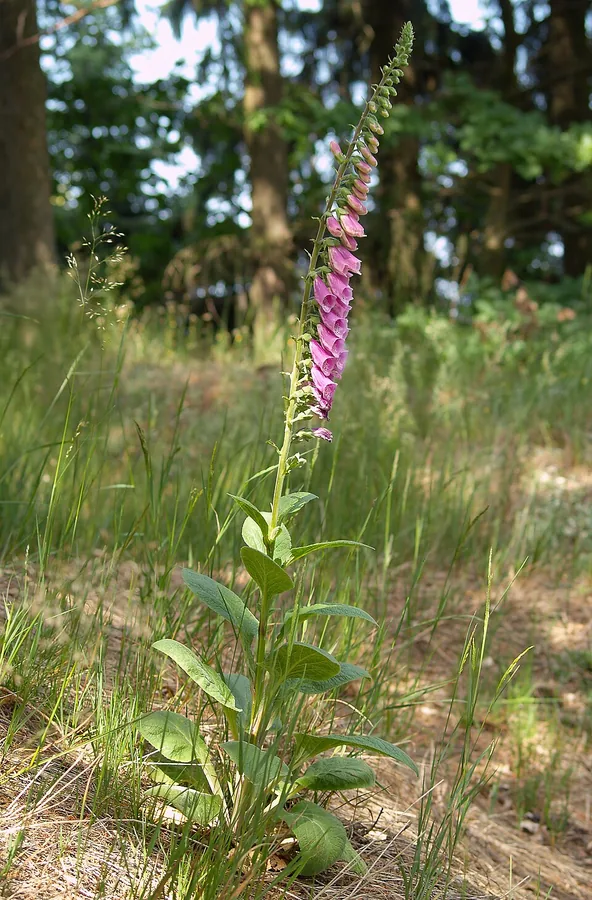
Foxglove reads as pure vertical architecture in a planting, its speckled tubular bells stacked up one side of a tall stem that bees love to disappear into. It comes into its own at a shaded border or a woodland-edge setting, given acid-leaning soil and reliable moisture, and its palette shifts by strain from wild purple to soft white, cream, and rose.
Think of it as a biennial by nature. Year one is understated, just a low rosette biding its time; year two delivers the spire, the seed, and then a graceful exit. Leave a spike or two to ripen and the planting renews itself, drifting gently through a bed season after season.
All that poise carries a caveat worth respecting. Foxglove is the plant that gave medicine digitalis, and every part is toxic to people and animals alike, which makes it a choice for borders set well apart from children, pets, and grazing animals.
Care
The short version: give foxglove a partial-shade setting, soil kept evenly moist with water every 3 to 7 days, and acidic, compost-enriched ground at a pH of 5.0 to 6.0. Easy-going and sculptural in a border, it is nonetheless poisonous to people and pets, so style it into a spot children and grazing animals never wander.
Light
The plant is happiest in partial shade, the soft dappled light of a woodland margin, which also flatters it in a border. Full sun suits it only where summers run cool and moist; in warmer places, an afternoon spell of shade keeps the spires standing rather than wilting.
Water
Consistency is everything here: keep the soil evenly moist, watering every 3 to 7 days as the weather dictates, and never let it parch, since drought thins the flowering. A layer of mulch is the elegant shortcut to holding that moisture.
Soil
Foxglove favors rich, moist, well-drained soil generous in organic matter and tilted toward acidic, at its best around a pH of 5.0 to 6.0. Fold in compost when planting and pass on the lime to preserve that acidity.
Humidity
There is no humidity target to fuss over; open-air conditions suit it fine. What truly counts is generous spacing and airflow, because stagnant, damp air among crowded leaves is what ushers in powdery mildew.
Feeding
This is a light feeder, nothing demanding. Compost worked into rich soil, or a balanced fertilizer across the growing season, is all it asks to power those spires.
Pruning
Deadhead the faded spikes once they finish to prompt a second flush and curb self-seeding, while leaving a few to seed if you want the group to carry on. Cutting the stalks down to the basal leaves before seed forms can coax the plant into a short-lived perennial.
Size & spacing
In flower the plant stands 2 to 5 feet (61 to 152 cm) tall and fills 12 to 30 inches (30 to 76 cm) across, a strong vertical accent in a bed. Set plants about 18 inches apart so air circulates and the foliage dries.
When to plant
A foxglove border rewards patience across two seasons. Seed is surface-sown in late spring or cast outdoors in late summer, seedlings move out once frost has gone, and the statuesque spikes appear the following May and June to headline the display.
Northern hemisphere
Southern hemisphere
Typical months for a temperate climate: start earlier in warm zones, later where spring frosts linger.
- Sow: Late spring; surface-sow because seed needs light to germinate, do not cover
- Plant: Transplant or thin seedlings to about 18 inches apart after the last spring frost; can also be direct sown in late summer for bloom the following year
- Harvest: Spring to summer (May to June), with a tall one-sided flower spike in the second year
Hardiness
USDA hardiness zones: 4–9
Temperature: down to -34°C
Troubleshooting
For all its elegance, foxglove is refreshingly low-drama, though a close, humid corner can invite a few fungal blemishes and the usual garden insects. A regular glance at the foliage and crown lets you address anything early, well before it spreads through the planting.
Wilting, a rotten stem base, and a plant that keels over
When a plant sags and its base goes soft before toppling, crown rot from soggy, badly drained soil is the culprit; a discolored, mushy crown sitting in wet ground confirms it. Lift and destroy the casualties, put the drainage right before replanting, and steer clear of low pockets where water lingers. Once that crown turns soft, the plant is beyond rescue.
Fix:
- Remove and destroy affected plants
- Improve soil drainage before replanting
- Avoid planting in low, waterlogged spots
White powdery bloom or dark speckling across the leaves
A white, dusty bloom points to powdery mildew, while sharp brown or tan spots read as a leaf spot fungus; both move in when plants crowd together and the air sits still. Pick off the marked leaves, open the spacing to about 18 inches apart, and water low at the base so the foliage stays dry. It amounts to only a setback.
Fix:
- Remove and discard affected leaves
- Improve air circulation by proper spacing (about 18 inches apart)
- Avoid overhead watering and wetting foliage
Small insects massed on new shoots, or leaves chewed to lace
Two different offenders may be at work. Sap-drinking aphids and mealybugs gather on the tender new growth, while Japanese beetles and slugs chew the leaves ragged. Scan the stems and leaf undersides for the little ones, then watch for beetles, slime trails, and irregular holes. A firm jet of water clears aphids, beetles and slugs come off by hand, and insecticidal soap handles anything stubborn.
Fix:
- Knock off aphids with a strong spray of water
- Hand-pick Japanese beetles and slugs
- Treat persistent infestations with insecticidal soap
Sparse blooms and a generally stressed look
Thin flowering paired with a tired, drooping look through hot, dry spells usually traces back to drought stress as the ground dries. Water steadily to hold the soil evenly moist and mulch to lock that in; because a parched root run simply curbs the blooms, dependable watering protects the show. Purely cosmetic.
Fix:
- Water consistently to keep soil evenly moist
- Mulch to conserve soil moisture
Toxicity
Behind the beauty lies a firm caution: this is a dangerous plant. The cardiac glycosides that yielded the heart medicine digitalis are present throughout, and even a little can set off vomiting and a heartbeat that turns life-threatening. Every grazing and household creature is at severe risk, cats and horses, dogs and livestock, rabbits and birds, and people have been sickened after mistaking the foliage for an edible herb. Style it into the garden by all means, but only where children, pets, and grazing stock cannot reach it, and never let cut spikes linger in vase water within reach.
Toxic to
Cats · Dogs · Horses · Rabbits · Livestock · Birds · People
Cats Severe
Cats: a single nibble is enough to matter. The cardiac glycosides prompt salivating and sickness, then an erratic or sluggish heartbeat that may halt the heart altogether, so any chewing warrants an immediate call to the vet.
Dogs Severe
Dogs: swallow any part and a dog can be sick, develop loose stools, and slide into weakness as the heartbeat grows unstable; with collapse and even death on the table, an urgent vet trip is warranted.
Horses Severe
Horses: whether met in the pasture or eaten dried in hay, foxglove poisons a horse gravely, triggering colic, a lurching gait, and a heartbeat that gallops or falters toward heart failure.
Rabbits Severe
Rabbits: those same cardiac toxins hit a rabbit hard, leaving it slack, uninterested in food, and genuinely at risk of abrupt heart failure, so the leaves must stay out of reach.
Livestock Severe
Livestock: cattle, sheep, and goats fall ill from the plant whether fresh or dried in hay, with salivation, digestive distress, weakness, and lethal rhythm disturbances; drying removes none of the danger.
Birds Severe
Birds: the cardiac glycosides are dangerous to birds too, so poultry and pet birds belong nowhere near any part of it.
People Caution
People: no part of foxglove is edible, and people have been poisoned after taking its leaves for comfrey. Eating any, or even drinking water that held cut spikes, can spark vomiting and a perilous heartbeat, so keep it far from children's reach.
Keep all parts of the plant away from pets, children, and livestock; wash hands after handling and do not allow any part to be eaten.
Helpline numbers

United States
ASPCA Animal Poison Control: (888) 426-4435 (fee applies)
Poison Control: (800) 222-1222



Canada
Poison Centres: 1-844-764-7669
Varieties
The wild form holds to purple, yet cultivated strains open up the palette, and several were selected to flower in year one. A handful stand out when composing a border.
Foxy
Foxy is the compact one, holding around 2 to 3 feet in white, cream, and rose, and it frequently flowers its debut year from seed.
Camelot
Camelot blooms in its first year, coming into flower the same season when sown in autumn ahead of the following spring.
Dalmatian
Dalmatian, a first-year-flowering series, was bred to bloom in year one from seed instead of waiting out a second season.
Temple Bells
Temple Bells is a dwarf selection whose yellow tubular blooms are brushed with brown markings.
How to propagate
Foxglove starts from seed, and the single detail that matters is that the seed will not sprout without light.
SeedEasy
Surface-sow indoors in late spring or direct sow in the garden in late summer/spring after frost danger passes · Forms a basal rosette the first year and flowers the second year; first-year-flowering cultivars can bloom about 5 months from an early indoor sowing
Growing foxglove from seed is easy, with a single quirk: light is what sets the seed sprouting, so it should rest on the surface and never be covered. Sow indoors in late spring, or scatter it outdoors in late summer or spring once frost has passed, then thin the young plants to about 18 inches apart. Most spend the first year as a leaf rosette and flower in the second, though first-year-flowering strains can flower about 5 months from an early indoor sowing. Leave a handful of spikes in place and it will reseed itself freely.
Myths
Foxglove is the origin of modern heart medicine, so surely a little is harmless, maybe even good for you.
It is perfectly true that the heart drug digitalis traces back to foxglove, yet the plant itself, untreated, is lethal. There is no safe household dose: strength varies dramatically leaf to leaf, and a mere trace can throw the heartbeat into a fatal pattern. Pharmacy digitalis is purified and dosed to the microgram; the border plant offers no such precision.
Foxglove always runs to exactly two years of life before it dies.
The two-year rhythm is typical, a rosette first, a spike the following season, though it is hardly a rule. Several cultivars flower in their first year, and if the stalks are trimmed before seed develops, a plant may persist as a short-lived perennial.