Ornamental · Plantaginaceae
Snapdragon
Antirrhinum majus
For cool-season color with a vertical line, snapdragons bring spires of bloom to a spring or fall border.
Full sun
USDA 7–10
0–3 ft · 0.2–0.9 m
Overview
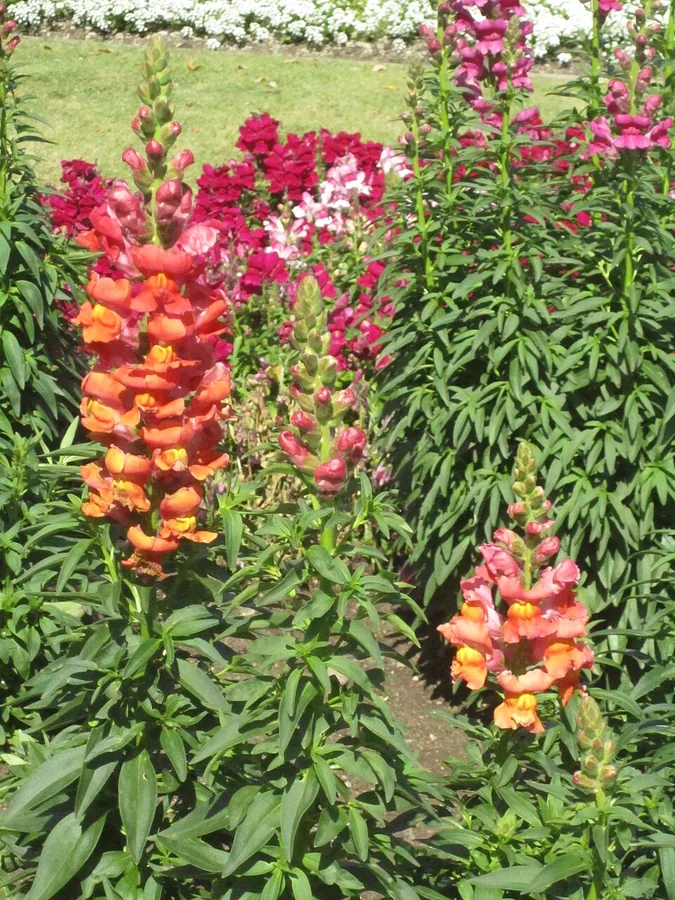
Few flowers set a scene like the snapdragon, its tall spires drawing the eye upward in a spring or fall border. The blooms open in nearly every color except true blue, so a planting can read soft and pastel or bold and saturated depending on the mood a garden calls for. Part of the genus Antirrhinum, it earns its name from the way each flower opens and closes at a pinch, a small delight for anyone passing by.
This is a cool-season performer, most at home in the mild light of spring and fall, and it lives fast rather than long. Grown as an annual in most gardens, it settles easily into a seasonal planting scheme rather than a permanent one. Its range of heights makes it flexible: low forms edge a path with a tidy line, mid-height types anchor the body of a border, and the tall spires cut beautifully for a vase indoors.
Set in full sun with rich, evenly moist soil, snapdragon slips into an easy weekly routine of a little deadheading and not much else. Because the flowers are safe and even edible, it suits a family garden or a kitchen-window arrangement without a second thought. The one thing to plan around is summer, when heat quiets the display until cooler weather brings it back.
Care
The short version: give snapdragon full sun, rich and evenly moist soil that drains well, and a steady habit of deadheading to keep the spires rising. Style it into a spring or fall scheme, since summer heat pauses the color.
Light
Snapdragon reads best in full sun, where the spires stand tall and hold their color. Give it a bright, open position, since a shaded spot leaves the plant stretched and sparse, and the vertical effect falls flat.
Water
Keep the soil evenly moist, as snapdragon has little tolerance for drought and shows it fast. Watering at the base, rather than over the top, keeps the foliage dry and the planting looking clean while holding rust and Botrytis at bay.
Soil
Plant into rich, well-drained soil at a near-neutral pH, the kind of ground that stays moist without turning heavy. That balance keeps the plant furnished and the border looking its best through the cool season.
Humidity
Average
Feeding
One feeding of all-purpose fertilizer in spring, as growth begins, carries these cool-weather plants through the display. There is no need to keep feeding, which keeps the routine simple and the planting effortless.
Pruning
Deadheading spent flowers is the small weekly gesture that keeps fresh spires coming and the display long. Clearing away any tired or damaged growth at the same time keeps the planting tidy and open to the light.
Size & spacing
Heights run from 6 to 36 inches (15 to 91 cm), which is what lets snapdragon work as an edge, a filler, or a focal spire. Setting plants 6 to 10 inches (15 to 25 cm) apart keeps the planting airy and the foliage healthy.
When to plant
Snapdragon keeps a cool-weather calendar. Plant it out in early spring once frost has passed, or in fall where winters stay mild around USDA zone 8 and warmer, and it carries color through the gentle stretches of spring and autumn before summer heat calls an intermission.
Northern hemisphere
Southern hemisphere
Typical months for a temperate climate: start earlier in warm zones, later where spring frosts linger.
- Plant: Early spring after the last frost, or in fall in mild zones (about USDA zone 8 and warmer)
- Harvest: Blooms in cool weather of spring and fall (and summer in cool climates); flowering slows in summer heat
Hardiness
USDA hardiness zones: 7–10
Temperature: down to -18°C
Troubleshooting
Most snapdragon setbacks come down to damp, crowded plantings or the wrong moment in the season. Look to the lower leaves and stems first, where rust and mold make their entrance. Match what you see below and step in early to keep the display intact.
Yellow spotting above, dark dust beneath the leaves
This is snapdragon rust, the disease that most often mars the display, and it spreads when leaves stay wet for 6 to 8 hours in cool 55°F to 70°F (13°C to 21°C) weather. A warm spell above 80°F (27°C) slows it down. Remove and bag the marked leaves, keep the leaves dry, and lean on rust-resistant cultivars to keep a planting looking its best.
Fix:
- Remove and bag affected leaves
- Apply a labeled systemic fungicide if severe
Warped yellow leaves with gray beneath
Downy mildew tends to arrive already present on new plugs, so distorted, yellowing leaves with gray spores underneath are often bought rather than grown. There is no rescuing an infected plant, so lift it and dispose of it. Give new arrivals a careful look before they join the scheme, skip overhead watering, and leave room for air.
Fix:
- Remove and destroy infected plants
Tan cankers where plants sit too close
The culprit is Botrytis gray mold, which settles in when humidity is high and air hangs still around a crowded planting. Cut out the affected stems and any soft, decaying tissue, then thin things so air can pass through freely. Watering at the base keeps the foliage dry and takes the shine off the mold.
Fix:
- Remove and destroy infected plant parts
- Improve air circulation
The display fades once summer heats up
Snapdragon is a cool-season plant with little appetite for heat or drought, so the flowers thin and stop once temperatures hold above about 80°F (27°C). This is season, not sickness. Cut the plants back and keep the soil moist, and many will return to color as autumn cools the garden.
Fix:
- Cut plants back and keep them watered; they may rebloom as temperatures cool
Toxicity
For a home with pets or children, snapdragon is an easy yes: the ASPCA lists garden snapdragon as non-toxic to cats, dogs, and horses, and the flowers are edible for people. It can take a place anywhere in the garden or on the table without a worry.
Safe for
People · Cats · Dogs · Horses · Rabbits · Livestock · Birds
Cats Safe
The ASPCA lists garden snapdragon as non-toxic to cats, so a curious taste does no harm.
Dogs Safe
Snapdragon is safe for dogs, and a nibbled leaf or bloom is nothing to worry about, though a large helping of any plant can unsettle a stomach for a day.
Horses Safe
Horses can graze beside a snapdragon planting without risk, as the ASPCA notes no toxicity for them.
Rabbits Safe
Rabbits take no harm from the foliage, so a plant within their reach fits easily into the garden.
Livestock Safe
Cattle, goats, and sheep tolerate snapdragon without trouble, since it holds no known toxin for grazing animals.
Birds Safe
Birds that visit the blooms or seed face no toxic threat from snapdragon.
People Safe
The flowers are edible and often appear as a garnish, though they can taste bitter, and the plant is safe to keep around children.
Varieties
Snapdragons are grouped mostly by height, and that height is what decides where each one belongs in a planting. These are the classes to know as you plan the look.
Dwarf (such as Floral Showers, Snapshot)
Compact at 6 to 10 inches, these low forms trace a neat line along a path or fill a container with color.
Medium (such as Liberty Classic, Snaptastic)
At roughly 12 to 22 inches, these mid-height types give a border its body and sit comfortably among other plants.
Tall or Rocket (such as Rocket, Potomac, Madame Butterfly)
Rising 24 to 60 inches, these tall spires are grown for cutting and bring long, elegant stems to an arrangement.
Trailing (such as Candy Showers)
Rising about 6 inches and spilling to roughly 12 inches, these trailing forms are made to soften the edge of a hanging basket.
How to propagate
Snapdragon is grown almost entirely from seed, started in cool weather for a spring or fall display.
SeedModerate
Sow in cool weather for spring or fall display · Several weeks from germination to transplant size
Snapdragon is raised almost entirely from seed, sown in cool weather for a spring or fall display. The seedlings need several weeks to reach transplant size, so an early start keeps the scheme on schedule. Pinching the tips of the young plants encourages fuller, branching growth and a greater show of flower spikes.
Myths
Snapdragons are lasting perennials that return to the garden each year.
In practice, Antirrhinum majus is a short-lived tender perennial that most gardeners treat as an annual. It reappears only in mild climates, roughly USDA zone 7 and warmer, where soft winters spare the crown, so most plantings are best planned season by season.
Snapdragons are unsafe to plant near pets.
The ASPCA lists garden snapdragon as non-toxic to cats, dogs, and horses, so it can sit anywhere animals wander. The flowers are edible for people as well, which makes it as welcome on the plate as in the border.
Snapdragons put on their best show in high summer.
They are cool-season bloomers, at their most beautiful across spring and fall. When summer heat arrives, the color slows or stops until milder weather returns it to the garden.