Ornamental · Onagraceae
Fuchsia
Fuchsia × hybrida
Offer it cool shade and steady moisture, and the fuchsia dangles its two-tone, drop-shaped flowers from spring to fall.
Partial shade
Every 2–4 days
59–70°F · 15–21°C
USDA 10–11
Overview
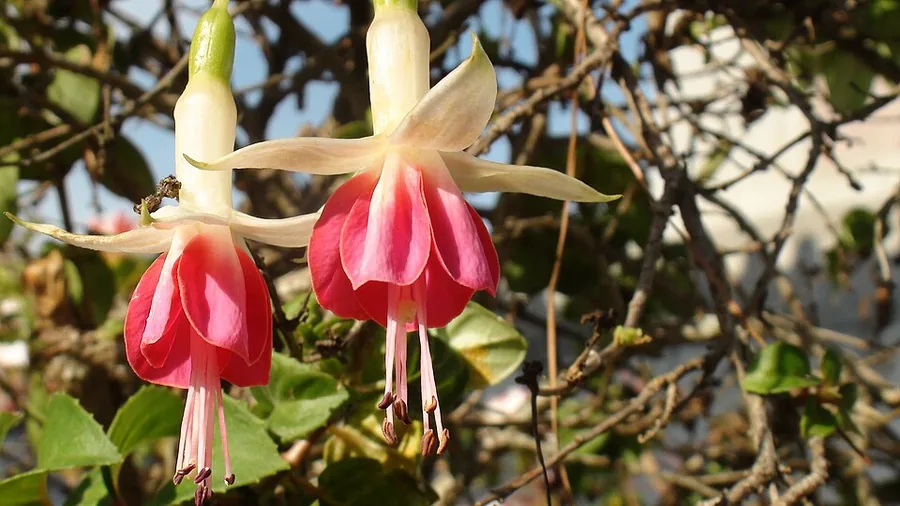
Little else in a planting reads quite like a fuchsia at its peak. The pendant flowers, so often set in two contrasting colors, swing from the stems like tiny earrings, which is precisely how the plant collected its old name of lady's eardrops. Most garden fuchsias are hybrids raised for that display, whether trained tall on a patio or left to pour from a basket by the door.
At heart this is a plant for shade. Fuchsia looks its best tucked into a cool, part-shaded spot and turns sullen in the heat, so it repays the corner of a courtyard or a north-facing terrace that stays out of the fierce afternoon light. Give it that setting and the flowers carry on from spring straight through fall.
In most gardens the fuchsia is treated as a season-long annual or brought under cover for the winter, though the hardy sorts can hold their place in the ground where the cold stays mild. Whichever suits your space, this is a thirsty, hungry plant, and it returns the care with months of color at eye level or overhead.
Care
The short version: a cool spot in part to full shade, soil held evenly moist and never left bone dry, a balanced feed every two weeks across the growing season, and cover from harsh afternoon sun and wind.
Light
Set a fuchsia in part to full shade, and the cooler the corner the better. It will take bright indirect light in stride, but a hot afternoon sun scorches the leaves and halts the flowers, so a sheltered, shaded position is the one to look for.
Water
Hold the soil consistently moist and never allow it to dry out, since a fuchsia wilts quickly the moment it goes thirsty. Baskets and containers dry out fast and call for frequent watering along with a spot out of the drying wind. Taper the water in fall to guide the plant gently toward dormancy.
Soil
Give it rich, moisture-retentive loam generously mixed with organic matter. A faintly acidic pH of 5.5 to 6.5 suits it, and a soil that stays damp without going waterlogged keeps the roots content.
Temperature
Fuchsia asks for cool conditions, ideally 59°F to 70°F (15°C to 21°C). Once the average daily temperature crosses 76°F (24°C) the flowers stop, so summer heat is the one factor really working against you.
Humidity
The plant prefers a moist feel to the air, somewhere near 50% to 70% humidity. Dry rooms leave it stressed and invite spider mites, so a sheltered, slightly humid nook serves it far better than an open, sun-baked one.
Feeding
Fuchsia is a heavy feeder. Offer a soluble, balanced complete fertilizer every two weeks all through the growing season to keep that steady procession of flowers arriving.
Pruning
Pinch out the new shoots once they carry two full sets of leaves to steer the plant into branching and filling out, then set the pinching aside about a month ahead of the first frost. With the hardy sorts, cut them back in mid-March once the risk of a freeze has gone.
Repotting
Lift potted fuchsias into fresh mix each spring. Roots winding around the pot, soil that dries almost the instant you water, and growth that stalls all signal the plant has outgrown where it sits.
Size & spacing
Most reach 1.5 to 3 feet (46 to 91 cm) tall and spread 12 to 24 inches (30 to 61 cm) across. Leave each one enough space for air to circle the leaves freely, which holds rust and mildew off.
When to plant
Fuchsia keeps time by the cool of the air rather than the peak of summer. Root your cuttings indoors in early spring, move plants outside after the last frost once the nights hold above freezing, and count on flowers from spring through fall, with a quiet spell when midsummer heat arrives.
Northern hemisphere
Southern hemisphere
Typical months for a temperate climate: start earlier in warm zones, later where spring frosts linger.
- Sow: Cuttings rooted indoors in early spring; seed germinates in 21-28 days at 70-75°F
- Plant: After the last spring frost when nights stay above freezing
- Harvest: Spring through fall, slowing in summer heat
Hardiness
USDA hardiness zones: 10–11
Temperature: down to -1°C
Troubleshooting
Most fuchsia setbacks come down to heat, or to a short list of familiar pests and one or two fungi. Keep an eye on the flowers and the undersides of the leaves, where the earliest hints show. Compare what you find with the notes below and step in before it takes hold.
Warped, swollen tips with knobby galls and a red cast to the leaves
The cause is the fuchsia gall mite, a pest far too small to spot that twists the growing points and flowers into thickened, misshapen galls. Snip away and destroy every affected piece, then treat with horticultural oil or insecticidal soap every 2 to 3 weeks. Keep the plant apart from the rest and wipe down your tools, hands, and clothing, since this mite travels readily between plants.
Fix:
- Remove and destroy all infested plant parts
- Apply horticultural oil or insecticidal soap at 2-3 week intervals
- Isolate infested plants and clean tools, hands, and clothing
The show pauses when the season turns warm
Fuchsia keeps company with cool weather, and its flowering simply switches off once the average daily temperature climbs past 76°F (24°C). Nothing is failing; the plant is riding out the heat. Shift the container to a shadier, cooler corner, keep the soil evenly moist, and the display returns as autumn eases the temperatures back down.
Fix:
- Move containers to a cooler, shadier location
- Keep soil evenly moist
- Provide protection from hot afternoon sun and wind
Rust-toned dust gathering beneath the foliage
Those powdery spots are fuchsia rust, a fungus that takes hold on the lower leaf surface while the top may carry yellow blotches. Pick off and destroy the marked leaves, thin the plant so air can pass through it, and aim the watering can at the roots rather than the foliage.
Fix:
- Remove and destroy affected leaves
- Improve air circulation
- Avoid wetting foliage when watering
Tacky leaves, a black film, and a puff of small white flyers
Whiteflies are the likely visitors, rising in a cloud the moment you brush the foliage and leaving a sticky honeydew that darkens into sooty mold. Aphids and spider mites can act the same way, the former curling the leaves and the latter dusting them with fine webbing. Hose the plant down with plain water, follow with insecticidal soap or horticultural oil, and repeat to interrupt the breeding cycle.
Fix:
- Rinse foliage with water
- Apply insecticidal soap or horticultural oil
- Repeat applications to break the life cycle
Toxicity
This is the easy part: fuchsia is safe from every angle. The ASPCA lists it as non-toxic to cats, dogs, and horses, no part of the plant holds a poison, and the small dark berries are even edible for people. It can go anywhere in a home or garden without a second thought for pets, livestock, or inquisitive children.
Safe for
People · Cats · Dogs · Horses · Rabbits · Livestock · Birds
Cats None
The ASPCA places fuchsia squarely on its non-toxic list, so a cat that samples a leaf or a hanging flower is in no danger. Any plant eaten in quantity can leave a cat briefly queasy, but nothing here is poisonous.
Dogs None
Cleared by the ASPCA for dogs. The foliage and even the berries pass through without harm, though a dog that helps itself to a large helping of leaves might have a soft stool or two.
Horses None
Nothing about fuchsia troubles a horse. The plant holds no compound that affects them, so a stray nibble at a basket hung within reach comes to nothing.
Rabbits None
A rabbit is welcome to graze on fuchsia. Both the leaves and the flowers are harmless, and the little berries are edible as well.
Livestock None
Goats, sheep, and cattle sharing space with fuchsia have nothing to fear. Not a single part of the plant carries a toxin that would bother them.
Birds None
Birds are glad to take the ripe berries, and the plant is no threat to them. Wild ones often clear the fruit off the stems before anyone else reaches it.
People None
The whole plant is harmless to people, and the small dark berries make a real edible treat, mildly sweet with an occasional peppery note. Wait until they are fully ripe for the fullest taste.
Varieties
Garden fuchsias run to hundreds of named hybrids, yet they settle into a few families worth recognizing before you shop.
Gartenmeister
A triphylla hybrid carrying coral-red tubular flowers above dark bronze-green foliage, and it shrugs off summer warmth more gracefully than most in the family.
Hardy fuchsia (Fuchsia magellanica types)
Sturdier, shrubbier plants that can hold their place in the border and see out milder winters right where they stand.
Trailing or basket types
Cascading forms whose stems tumble over a basket's edge, a different look from the upright shrubs that hold at 1 to 2 feet (30 to 60 cm) tall.
How to propagate
Fuchsia is easy to increase, and a cutting is the one dependable way to keep a hybrid exactly as you found it.
Stem cuttingsEasy
Spring or late summer using softwood cuttings about 6 inches long · Roots typically form in 2-4 weeks
Take softwood cuttings about 6 inches (15 cm) long in spring or late summer, and roots appear in 2 to 4 weeks. For fuchsia this is the route to choose, because the hybrid cultivars don't come true from seed and only a cutting keeps the exact flower and shape of the parent.
Myths
Fuchsia berries are poisonous to people and pets.
Quite the reverse. The ASPCA records fuchsia as non-toxic to cats, dogs, and horses, and those dark little berries are safe and edible for people, carrying a gentle peppery sweetness once fully ripe.
Fuchsias grow best in full sun.
Fuchsia is a plant of shady corners, not open sun. It gives its finest bloom in part to full shade with cool temperatures, and a hot afternoon position undoes it, because heat above 76°F (24°C) closes the flowers down completely.