Houseplant · Apocynaceae
Hindu Rope Hoya
Hoya carnosa 'Compacta'
Give it bright light and a light touch with water, and this curly-leaved wax plant becomes a fixture for years.
Bright indirect
50–75°F · 10–24°C
USDA 10–12
2–3 ft · 0.5–1 m
Overview
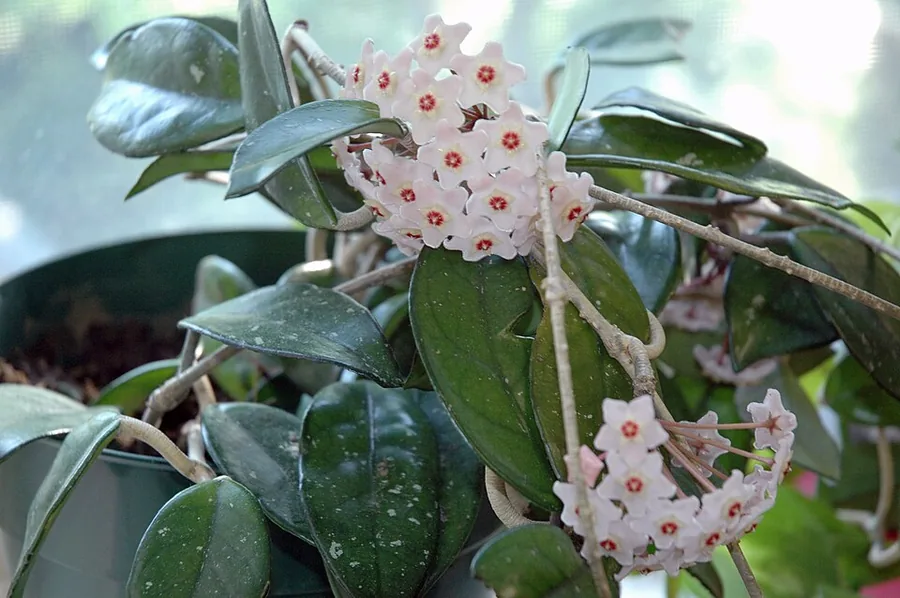
The Hindu rope hoya is a wax plant with real presence, its leaves curling and folding back on themselves into thick, rope-like trails that draw the eye across a room. A naturally occurring mutation of the everyday Hoya carnosa, it keeps that plant's easy temperament while cutting a far more sculptural figure. Hung by a sunny window or set on a high shelf, the trailing stems soften a hard edge and give a corner something to talk about.
It is a slow grower, and that unhurried pace makes it a plant you settle in with rather than replace. It lives for years in one pot, becoming a quiet constant in a room, and mature specimens reward the household with clusters of star-shaped, sweetly scented flowers. Those blooms return from short woody spurs the plant keeps and reuses, so the same spots come back into flower season after season.
It suits a relaxed, low-fuss home, asking to be looked at more than tended. The twisted leaves store their own water, which makes it forgiving but easy to overwater for anyone heavy with the can. Bright light, a fast-draining mix, and a hands-off approach to repotting fit neatly into a busy weekly routine.
Care
The short version: bright indirect light with a little direct sun, a fast-draining mix, and water only once it has dried out. Feed monthly through the growing season, keep it warm and humid, and leave the old flower spurs alone.
Light
Set it where it catches bright indirect light with a little direct sun, the position that draws out its flowers. It manages in partial sun or partial shade, but a dim corner leaves it slow and rarely in bloom, less of a feature for the room. Keep it clear of harsh midday sun, which can scorch the leaves.
Water
Let the mix dry out between waterings and lean toward too little rather than too much. The plump, water-storing leaves keep their own reserves, which makes this cultivar quick to rot, so ease off further in winter when growth slows and the room cools.
Soil
Pot it in a loose, fast-draining mix that is loam-based and rich in organic matter, such as potting soil cut with orchid bark and perlite. It is easy about pH, at home anywhere from 6.0 to 8.0. Above all, the water needs to move through fast.
Temperature
Keep it in the range of 50°F to 75°F (10°C to 24°C), the comfortable warmth most living spaces already hold. It dislikes cold drafts, so keep it clear of chilly windows and doorways through winter.
Humidity
This plant favors high humidity, a touch more than most rooms offer. A tray of damp gravel beneath the pot or a spot in a steamy bathroom answers that, and the extra moisture also keeps spider mites at bay.
Feeding
Feed monthly from spring through autumn while it is in active growth, using a dilute liquid feed. A formula higher in nitrogen and potassium, such as a 2:1:2 or 3:1:2 NPK, tips it toward flowering.
Pruning
It needs next to no pruning and dislikes being cut back hard, so in late winter or early spring take out only weak or crowded shoots. Above all, never cut off the bare flower spurs after blooming, because new flowers form again on those same old stalks.
Repotting
Repot rarely, since this plant resents the disturbance and is content in the same pot for years, which suits a settled room. Wait for clear signs it is rootbound, like roots pushing out the drainage holes, growth stalling, or the pot drying out unusually fast after a watering.
Size & spacing
Over many years of slow growth, the trailing stems reach 1.5 to 3 feet (50 to 100 cm) long, with a spread of 4 to 20 inches (10 to 50 cm). Give it a hanging pot or high shelf so the rope-like growth has room to spill and frame the space.
Troubleshooting
Most of what goes wrong with a Hindu rope comes back to watering or light, the two things a room's placement quietly decides. The thick leaves mask both thirst and rot, so read the signs below early and step in before a small fault settles into the display.
Soft, blackening stems and mushy roots
This is root rot, and it arrives quickly on a Hindu rope because the plump leaves already carry their own water, so a soggy pot pushes the plant past what it can hold. Set the watering can aside, let the mix dry, then lift the plant out, trim away every brown, soft root, and settle it into fresh fast-draining mix. If the damage runs deep, take a few healthy cuttings so the display can be started again.
Fix:
- Stop watering and let the soil dry out
- Unpot, cut away rotted roots, and repot into fresh fast-draining mix
- Take healthy stem cuttings as insurance if rot is advanced
Cottony patches, sticky film, or fine webbing on the plant
The deep leaf folds quietly shelter mealybugs, scale, and spider mites, so look over the undersides and crevices before they settle in. Touch the cottony mealybugs and bumpy scale with a cotton swab dipped in isopropyl alcohol, then treat the whole plant with insecticidal soap or neem oil and repeat until the last of them has gone. Since mites cannot abide moisture, lifting the humidity keeps the display clean.
Fix:
- Dab mealybugs/scale with a cotton swab dipped in isopropyl alcohol
- Treat with insecticidal soap or neem oil, repeating as needed
- For spider mites, use insecticidal soap/neem and raise humidity
Handsome foliage, but the blooms never arrive
The usual culprit is too little light, since a Hindu rope wants a bright position with a little direct sun before it will flower for the room. The second is a well-meaning trim of the bare flower spurs, which are the very parts that rebloom. Move it to a brighter corner, let every spur stay, and give a young plant time, because many hold off until they are two or three years old.
Fix:
- Move to a brighter spot with bright indirect light plus some direct sun, but avoid scorching midday sun
- Stop removing the bare flower stalks - leave all spurs/peduncles in place
- Be patient with young plants until they mature
Leaves turning shriveled, wrinkled, or limp
When the curled leaves soften and crease, the mix has usually gone bone dry far too long. A generous soak until water runs from the drainage holes restores their poise, and the leaves plump back within a day or two. Keep the watering rhythm even across the growing season rather than letting it lurch from flooded to parched.
Fix:
- Water thoroughly until it drains, then resume letting the top dry between waterings
- Keep watering consistent through the growing season
Toxicity
Reassuring for a household with pets: the Hindu rope hoya is non-toxic and safe to live alongside animals and children. Both the ASPCA and NC State Extension clear the wax plant for cats, dogs, and horses, so it earns a place even in a busy family room. The milky sap is only a little sticky, so wash your hands after pruning.
Safe for
People · Cats · Dogs · Horses · Rabbits · Livestock · Birds
Cats None
A cat can share the room with it in peace, since the ASPCA lists this wax plant as non-toxic to them. Should one work through a good deal of any houseplant it might feel briefly off, yet the plant itself brings no real danger.
Dogs None
Dogs belong in the same room just as safely, with the ASPCA marking the wax plant non-toxic for them. A large mouthful might bring nothing more than mild, passing stomach upset.
Horses None
NC State Extension tags Hoya carnosa as non-toxic to horses, so there is no poisoning risk should one graze on it.
Rabbits None
No toxic compounds are reported in this plant, so a rabbit may sample a leaf without harm. As with any rich houseplant, keep the tastes modest and its digestion stays settled.
Livestock None
Grazing animals meet no toxicity from the wax plant. The thick, waxy leaves make unappealing forage and stay safe even if browsed.
Birds None
Pet birds may perch and pick at it with no toxic effect. Nothing in the plant would harm a bird that takes a bite.
People None
It holds nothing poisonous for people, though it earns its place for looks rather than the table. The milky sap turns a little sticky, so wash your hands once the pruning is done.
Non-toxic, but ingestion of any houseplant can occasionally cause mild GI upset; the sap is mildly sticky/milky
Varieties
The Hindu rope is a single named cultivar of the wax plant rather than a range of looks, so there is just one distinctive form to bring home.
Hoya carnosa 'Compacta'
This is the Hindu rope plant itself, a naturally occurring mutation of Hoya carnosa whose leaves curl and fold on themselves into rope-like strands along a slow-growing vine.
How to propagate
A Hindu rope multiplies easily into a second plant for another corner, by one of two simple routes: root a cutting, or let a trailing stem root itself where it rests.
Stem cuttingsEasy
Spring or early summer · Roots in about 2-3 weeks
In spring or early summer, take a semi-ripe stem or tip cutting that includes a node, then stand it in water or moist mix where it roots in about 2 to 3 weeks, ready to start a second pot for another corner. The stems also send out roots along their length on their own, so one can be pinned down and layered without ever cutting it free.
Myths
Cut off the bare flower stalks once the blooms have faded.
Those bare stalks, known as spurs or peduncles, are the exact places the next flowers will appear. Leave every spur in place, because trimming them away quietly forfeits future blooms.
The Hindu rope plant is its own species called Hoya compacta.
Kew's plant database records Hoya compacta as a synonym rather than an accepted species. The Hindu rope is really the cultivar Hoya carnosa 'Compacta', a naturally occurring mutation of the parent wax plant.