Houseplant · Apocynaceae
String of Hearts
Ceropegia woodii
Let it spill from a high shelf in bright light, and the hearts trail on for years.
Bright indirect
59–86°F · 15–30°C
USDA 10–12
3–12 ft · 0.9–3.7 m
Overview
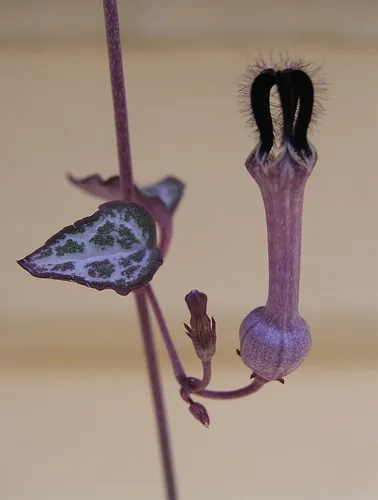
String of hearts arrives from southern Africa, a trailing tuberous vine built for a high perch rather than a tabletop. Its slender heart-strung stems give it both its romance and its names, rosary vine and chain of hearts among them. In a room it earns its place cascading from a shelf, a mantel, or a hanging pot, the strands lengthening to several feet and leading the eye upward as they go.
Part of its appeal is how little it asks of a busy household. Because it banks water in its leaves and stems, it slots into a hands-off routine and forgives the week you forget it, though it will not tolerate a waterlogged pot. Set it somewhere bright in a gritty, quick-draining mix and it holds its shape through spring and summer with next to no attention, the kind of plant that looks deliberate without demanding your calendar.
Two conditions carry the whole look: bright indirect light and a dry spell between waterings. Too little light and the trailing lines thin out and lose their polish; too much water and the roots fail. Get the pairing right and you have a long-lived, sculptural presence that layers beautifully with other plants and slips into almost any room.
Care
The short version: a bright indirect spot, a free-draining cactus or succulent mix, and water only after the soil dries out completely, pulling back further as winter dormancy sets in.
Light
Place it in bright indirect light, as bright as the room offers short of harsh midday sun. A west- or south-facing window keeps the trailing lines compact and their marbling crisp, which is what makes the plant read as intentional. In a dim corner it loses that definition, growing pale and stretched.
Water
Water is where restraint pays off. Let the soil dry out completely, then water well, since the plant keeps its own reserves and suffers in a pot left wet. Through winter dormancy it wants almost nothing, so ease the routine right back.
Soil
Set it in a free-draining cactus or succulent mix, sharpened with coarse sand or perlite so water passes straight through. It takes a broad pH from 6.0 to 8.0, which leaves drainage, not chemistry, as the thing that matters for a healthy display.
Temperature
It settles into ordinary room warmth, 59°F to 86°F (15°C to 30°C), the same comfort range as the household around it. Keep it above 60°F (16°C) in winter and away from cold drafts and open doors, since frost is beyond it.
Humidity
Everyday indoor air is all it needs, and low humidity suits it without any special staging. There is no misting ritual to keep and no target to chase, which keeps it low-maintenance in any room.
Feeding
Across spring and summer, offer a light feed of half-strength balanced houseplant fertilizer no more than once a month. Set feeding aside through winter, when the plant rests and asks for nothing.
Pruning
Trim any vine that grows long or thin to bring the plant back to fuller, bushier growth and a tidier silhouette. Keep the cuttings rather than binning them, since each roots readily into a new plant for elsewhere in the house.
Repotting
It prefers snug roots, so repot only when you have to and let it stay in a favorite container longer. The cues are roots filling the pot, soil that dries almost as soon as you water, and growth that has stalled.
Size & spacing
35–144 in (90–365 cm) tall
Troubleshooting
The look falters for one of two reasons: too little light or too much water. Read the trailing lines and the soil, and either lapse is easy to catch before it spoils the display. Find the symptom below and address it early.
Yellowing leaves and soft, mushy stems at the base
Yellow leaves over soft, mushy stems are the mark of root rot from overwatering, the failure that quietly ruins an otherwise handsome plant. Soil kept wet turns the lower stems mushy and the roots brown and soft. Stop watering, let the mix dry fully, and move the plant into a free-draining cactus or succulent mix, cutting away every rotted piece. If the rot has spread, keep a few healthy cuttings or tubers as a safeguard for the display.
Fix:
- Stop watering and allow the mix to dry out completely
- Repot into a free-draining cactus/succulent mix and remove rotted tissue
- Take healthy stem cuttings or tubers as backup if rot is advanced
Sticky film, distorted growth, or insects along the trails
A sticky film or twisted new growth points to aphids, mealybugs, or scale settling in. Look along the stems and leaf undersides for white cottony tufts, small raised bumps, or clusters of soft-bodied insects. Lift them off with a cotton swab dipped in isopropyl alcohol, treat with insecticidal soap, and keep the plant apart from the rest of the room until it clears.
Fix:
- Wipe off pests with a cloth or cotton swab dipped in isopropyl alcohol
- Treat with insecticidal soap as needed
- Isolate the plant to prevent spread
Bare, stretched trails with the hearts spaced far apart
Stretched trails with widely spaced hearts almost always mean too little light, and the effect reads as thin and unpolished rather than lush. The foliage pales and the strands run long with little to show. Move the plant to a brighter window with bright indirect light, then trim the leggy lengths so denser growth can restore the fullness.
Fix:
- Move to a brighter spot with bright indirect light, such as a west- or south-facing window
- Trim leggy growth to encourage denser branching
Toxicity
For a home shared with pets or children, string of hearts sits comfortably on the non-toxic and safe list alongside cats, dogs, and everyone else. The milky sap can leave sensitive skin a little itchy, so wash your hands after taking cuttings, but a passing nibble is nothing to disrupt the room over.
Safe for
People · Cats · Dogs · Horses · Rabbits · Livestock · Birds
Cats None
String of hearts counts as non-toxic, so a cat that samples a heart or two comes to no harm. A large mouthful of any houseplant could still prompt some brief drooling or an unsettled stomach, but nothing that should worry the household.
Dogs None
Dogs are comfortable company for this trailing vine. It holds no known toxin for them, though a chewed stem may cause mild, short-lived digestive upset, as any plant that isn't food can.
Horses None
Horses are not at risk from this plant either. It stays indoors as a small potted vine, kept well away from them, and nothing inside it could cause them harm.
Rabbits None
Rabbits keep good company with string of hearts, whose leaves are not poisonous, so a stray bite brings no harm. Keeping the strands out of reach mostly protects the plant.
Livestock None
Livestock face nothing dangerous in this potted indoor vine, which stays far from any field. It contains nothing toxic to them.
Birds None
Pet birds can settle in beside this vine without hazard, as it holds nothing poisonous to them. The odd sampled leaf is no cause for concern.
People None
String of hearts presents no genuine risk to people. Its milky sap can leave sensitive skin faintly itchy, so rinse your hands once the cuttings are done, and it is not a plant to eat.
As with any houseplant, discourage pets and children from chewing the foliage, and the milky sap of Apocynaceae plants may cause mild irritation in some individuals.
Varieties
The plain species does most of the decorating, yet one named form appears often enough to recognize on a shelf.
Ceropegia woodii 'Variegata'
A variegated form brushed with pink, cream, and green that grows more slowly than the plain species, prized for the softer palette it lends a shelf.
How to propagate
Few plants extend themselves through a home so willingly. Every trailing length is the start of another plant for a second room or a gift, whether you take a cutting, root a single bead, or layer a stem still joined to the parent.
Stem cuttingsEasy
Active growing season (spring to summer) · A few weeks to root, especially with bottom heat
Stem cuttings are the simplest route to a second plant. Taken through the active growing season across spring and summer and set into a free-draining mix, they root within a few weeks. A little bottom heat underneath moves things along faster.
Offsets & pupsEasy
Active growing season · A few weeks once in contact with soil
The vines carry small aerial tubers, the bead-like tubercles behind the name rosary vine. Rest one on the soil during the growing season and it roots by itself, raising a new plant within a few weeks to place wherever the room needs it.
LayeringEasy
Active growing season · A few weeks
Layering avoids cutting anything at the outset. With a trailing stem still joined to the parent, pin it so its tubercles meet the soil, allow a few weeks of active growth for roots to take, then separate the new plant.
Myths
String of hearts wants constant watering to stay lush, the way an ordinary leafy houseplant might.
That expectation works against it. This is a drought-tolerant semi-succulent rather than a thirsty leafy plant, and it looks its best when allowed to dry out completely between drinks. Overwatering is what kills it, rotting the roots past saving, and once winter dormancy stalls growth it wants even less.