Houseplant · Apocynaceae
Wax Plant
Hoya carnosa
Give it bright light and a let-it-dry watering habit, and this easy-going wax plant rewards you with clusters of porcelain flowers.
Bright indirect
45–75°F · 7–24°C
USDA 10–12
2–4 ft · 0.6–1.2 m
Overview
The wax plant is one of those quiet furnishings that reads as part of the decor rather than a chore on the to-do list. A climbing epiphyte with roots in a swath of Asia from southern China to Laos and across to Taiwan and Japan, it takes to a well-lit room the way it takes to a host tree in the wild. Set it on a high shelf and its long stems spill downward, or run it up a slim trellis where it draws the eye upward and softens a bare wall.
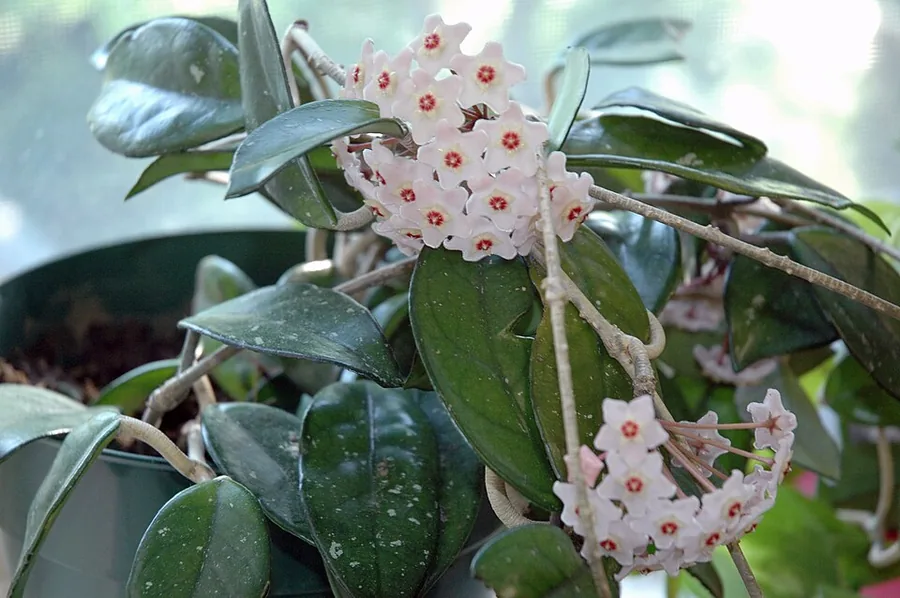
Give it a season or two and the payoff is the bloom, which turns the plant into a centerpiece. Mature vines open rounded clusters of star-shaped, waxy flowers with the look of carved porcelain, often carrying a sweet evening scent that suits a bedroom or a reading corner. The only condition is patience, since a young plant usually needs 2 to 3 years before it flowers.
It also asks very little of a daily routine, which is part of its appeal in a busy home. The semi-succulent leaves keep their own reserve of water, so the plant forgives a skipped drink far more gracefully than a heavy hand at the can. Pair it with a bright window and a light watering habit, and it settles into the background until the flowers call for attention.
Care
The short version: set it in bright indirect light with a little direct morning sun, water only once the top third to half of the mix has dried, and pot it in a loose, fast-draining mix. Keep it warm, offer some humidity, and leave the old flower spurs undisturbed.
Light
Give the wax plant bright indirect light, ideally a spot beside a window where it catches a few hours of direct morning sun. It will hold on in partial shade, but low light keeps it from blooming and softens the variegation that makes the patterned forms so striking on a shelf.
Water
Water freely through spring and fall, then let the top third to half of the mix dry before the next drink. Pull back sharply in winter. Overwatering is the single most common way to lose this plant, so when the routine is in doubt, wait.
Soil
Choose a loose, fast-draining mix rich in organic matter, along the lines of one part potting soil, one part orchid bark, and one part perlite. The plant is relaxed about pH, accepting anything from 6.0 to 8.0, but it will not tolerate a mix that stays wet at the roots.
Temperature
Keep it in the warm band of 45°F to 75°F (7°C to 24°C), treating the low end as a hard floor rather than a target. It is a tropical at heart, so steady room warmth away from cold drafts and chilled windows keeps it looking its best.
Humidity
The plant favors high humidity and does its best in a moist room such as a bathroom or kitchen. Dry indoor air will not undo it, but it does invite spider mites, so a humidifier or pebble tray earns its place through the winter months.
Feeding
Feed through the growing season, spring to fall, with a liquid fertilizer that supports flowering, roughly a 2:1:2 or 3:1:2 NPK ratio. Liquid suits it better than slow-release granules, since the plant is watered too rarely for granules to dissolve evenly.
Pruning
Trim lightly in early spring to keep the vine shapely and compact. The one rule that governs everything else is to leave the bare flower spurs intact, because the plant reblooms from those same old stalks year after year.
Repotting
Repot rarely, and only when you truly must. The wax plant blooms better when it is a little pot-bound, so resist sizing up for looks; move it on only when roots crowd the pot or the mix dries almost as fast as you can water it.
Size & spacing
Indoors the vine reaches 2 to 4 feet (61 to 122 cm) long with a spread of 12 to 24 inches (30 to 61 cm). Give it a trellis to climb or a high shelf to trail from, and leave a margin around it so air can move freely.
Troubleshooting
Almost every wax plant setback comes back to watering or light. Read the leaves and roots before reaching for a remedy, since a wrinkled leaf and a soft, rotting one call for opposite responses. Match what you see below, then act.
Yellowing leaves above soft, mushy stems and roots
This picture spells root rot, and the culprit is nearly always soil left damp for too long. A pot chosen more for looks than fit, or a mix that holds moisture, leaves the roots standing in water until they brown and soften. Set the watering aside, ease the plant out and remove the spoiled roots, then settle it into fresh fast-draining mix in a container that drains freely from the base.
Fix:
- Stop watering and let the mix dry
- Unpot and trim away soft, rotted roots
- Repot into fresh fast-draining mix in a container with drainage
- Use the pot-weight test before watering again
Firm leaves softening into wrinkles
When the smooth, waxy leaves lose their fullness and begin to crease, the plant has simply gone thirsty for a while. Lift the pot, and a surprisingly light weight tells you the mix has dried to nothing. Water it well until the excess drains from the base, then return to an unhurried let-the-top-dry rhythm through the growing months.
Fix:
- Water thoroughly until it drains from the bottom
- Resume regular watering on a let-top-dry schedule
- Check that the mix is not hydrophobic and rewetting properly
White tufts, webbing, or bumps along the stems
These marks announce the familiar indoor pests. Cottony clusters gathered in the leaf joints are mealybugs, faint webbing over tiny specks points to spider mites that settle in during dry winter weather, and firm bumps that never shift are scale. Touch the mealybugs with an alcohol-dipped cotton swab, follow with insecticidal soap or neem oil, and keep the plant apart from the collection while you repeat the treatments until it comes clean.
Fix:
- Dab mealybugs with a cotton swab soaked in isopropyl alcohol
- Treat with insecticidal soap, horticultural soap, or neem oil
- For spider mites, raise humidity and treat undersides thoroughly
- Isolate the plant and repeat treatments until clear
A handsome vine that stops short of flowering
A wax plant that stays leafy is usually asking to be moved somewhere brighter, so give it a spot at a sunny window where a few hours of direct morning sun reach the foliage. Time is part of the story too, since a young plant rarely flowers before it turns 2 to 3 years old. One styling habit undoes all of it, though: never trim away the bare peduncles, because the coming season's blooms return on that same quiet spur.
Fix:
- Move to a brighter spot with bright indirect light plus a few hours of direct morning sun
- Leave all bare flower spurs/peduncles intact - they rebloom from the same spur
- Be patient; young plants need 2-3 years to reach flowering maturity
- Do not move the pot once flower buds appear
A sticky sheen on the leaves and the shelf beneath
A wax plant in flower gives off a sweet, nectar-like sap from its blossoms, so a touch of stickiness on the leaves or the sideboard beneath during bloom is nothing more than the plant at its most generous, and a damp cloth restores the surface. The other explanation is honeydew dropped by sap-sucking pests, so glance over the leaf joints and undersides for cottony mealybugs. Treat the plant if any appear, and if none do, the sheen is simply the flowers at work.
Fix:
- If pests are present, treat for mealybugs (see pest entry)
- If from flowers, simply wipe surfaces - the sticky sap is normal
- Wipe leaves with a damp cloth
Toxicity
For a home with pets, the verdict is easy: the wax plant is non-toxic throughout. The ASPCA and NC State Extension both clear it for cats, dogs, and horses, and no poisoning is recorded for other common household animals. The single thing to keep in mind is the sticky sap from a cut stem, which can mark a surface but harms no one.
Safe for
People · Cats · Dogs · Horses · Rabbits · Livestock · Birds
Cats None
A home with a cat can welcome the wax plant freely, since the ASPCA and NC State Extension both list it as non-toxic to cats with no poisoning on record. A curious nibble does no harm, though a large mouthful of any plant may leave a cat briefly out of sorts.
Dogs None
Dogs share that easy standing, as the same toxicity databases rate the plant non-toxic for them. Nothing here will poison a dog, so a chewed vine calls for a glance rather than a worry.
Horses Safe
NC State Extension lists the wax plant as non-toxic to horses, so it brings no poisoning risk to a barn or paddock.
Rabbits Safe
No toxic compounds are documented in this plant, so a rabbit that finds a trailing stem comes to no harm from it.
Livestock Safe
There are no records of poisoning in grazing animals from the wax plant, which keeps it off the danger list for livestock.
Birds Safe
Pet birds face no known toxicity from this plant, so a parrot that shreds a leaf is in the clear.
People Safe
The wax plant sits happily in a household with children and adults alike. It isn't grown to be eaten, and the only detail to note is the sticky sap from cut stems, which can mark skin and surfaces.
Although non-toxic, ingestion of any plant material can still cause mild stomach upset; cut or damaged stems and flowers can exude a sticky/milky sap that may stain
Varieties
Beyond the plain green species, the wax plant comes in several variegated and novelty forms that lend a room a little more character. These are the ones you will come across most.
'Variegata' (incl. f. variegata)
Recognized by Kew as an accepted variegated form, it carries leaves edged in creamy white that can drift toward pink.
'Tricolor' / 'Krimson Queen'
It pairs green leaf centers with creamy-white to pink margins for a soft, layered look.
'Krimson Princess'
It turns the scheme inside out, gathering pink and white variegation toward the center of green leaves with darker outer edges.
'Compacta' / 'Krinkle Kurl' (Hindu Rope plant)
Sold as the Hindu Rope plant, it folds its crowded leaves into curled, twisting, rope-like trailing stems that make a sculptural feature.
How to propagate
Few houseplants extend through a home as easily as the wax plant, and a single vine can furnish several new pots for other rooms.
Stem cuttingsEasy
Spring to summer · Roots in a few weeks
Multiplying it is an easy weekend project: take a tip or stem cutting that carries a node and at least one leaf, then stand it in water or moist mix any time from spring through summer. Roots appear within a few weeks, leaving you a fresh plant that matches the parent for other corners of the home.
LayeringEasy
Spring to summer · Several weeks
The long vines take to layering with almost no effort. Pin a node against moist medium in spring or summer, and it roots in several weeks while still drawing on the parent, an easy way to fill out a display.
Myths
The bare flower stalks should be cut away once the blooms fade.
Those bare stalks, known as spurs or peduncles, are exactly where the next flowers will arrive. Leave them in place and the plant reblooms on the same spur year after year, while cutting them off quietly costs you the seasons to come.
A waxy semi-succulent like this barely needs watering.
The thick leaves do hold their own water and the plant should never sit soggy, yet it still appreciates a regular drink through spring and fall. Let only the top third to half of the mix dry between waterings, since a long dry spell shrivels the leaves and lets them fall.