Ornamental · Montiaceae
Lewisia
Lewisia cotyledon
Give it sharp drainage and a dry crown, and lewisia crowns its rosette with bright flowers each spring.
Partial sun
Every 7–14 days
USDA 4–8
6–12 in · 15–30 cm
Overview
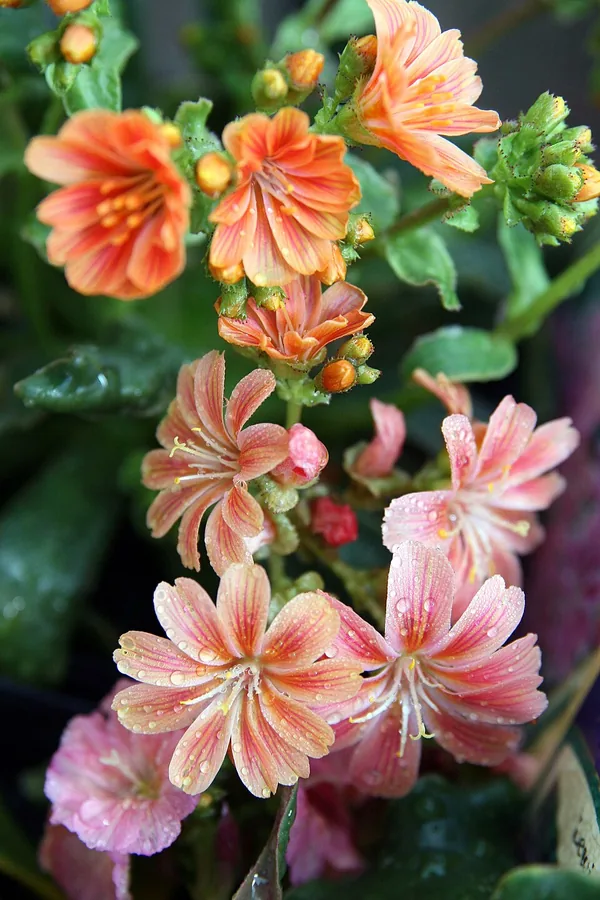
Lewisia carries a quiet sense of place into a garden, an evergreen from the mountains of western North America that reads as a small, composed jewel among stone. It settles into gravelly crevices on cool slopes and answers with a neat rosette of thick, fleshy leaves before lifting airy flower sprays in late spring. Those blooms arrive in warm pink, apricot, orange, and yellow, many threaded with fine candy stripes, and they set an easy, sunlit mood wherever they sit.
This is a plant that belongs to the world of the rock garden and the trough, where gravel, weathered stone, and low sculptural planting shape the look. Its fleshy leaves and deep root suit that spare, mineral setting, and they explain why it wants nothing to do with a rich, damp border. Give it the sharp drainage of its native scree and it looks at home; plant it in a lush, moisture-holding bed and the whole picture falls flat.
Set into a trough on a terrace, a raised rock garden by a path, or sideways in a wall crevice at eye level, it becomes a lasting fixture rather than a seasonal flourish. It is hardy and long-lived, holding its form through hard winters down to its rated zones, and it asks only for a measured routine around water. Get that rhythm right and it earns its spot in the scene for years.
Care
The short version: give lewisia gritty, sharply drained soil with the crown set high and dry, place it in bright light with afternoon shade where summers run hot, and water at the base only once the top of the soil has dried.
Light
Lewisia shows best in bright light with afternoon shade, most of all where summers turn hot. It takes full sun in cooler settings and tolerates part shade, but strong afternoon sun on an open site scorches the rosette and dulls the display.
Water
Water at the base only, and never into the center of the rosette, since water resting there rots the crown quickly. Let the top of the soil dry between drinks, which tends to fall around every 7 to 14 days, and ease right off through summer dormancy.
Soil
Plant it in gritty, sharply drained soil of gravel and sand that echoes a mountain scree, the mineral look it wears best. A pH from 5.5 to 7.0 suits it, while heavy, wet ground that holds water at the roots is the one thing it will not accept.
Temperature
Lewisia holds up through cold down to -4°F (-20°C) and warmth up to about 75°F (24°C). Heat beyond that is the true concern, so give it cool roots and afternoon shade to keep the planting looking its best in a hot summer.
Humidity
This is a low-humidity plant at heart, at ease in dry mountain air. Damp, stagnant corners invite rot, so open airflow around the crown counts for far more than any moisture in the air.
Feeding
Feed lightly through spring and early summer with a dilute, low-nitrogen balanced fertilizer. Rich feeding pushes soft, sappy growth that rots easily, so a restrained hand keeps the plant trim and sound.
Pruning
Take off the spent flower stems once the blooms fade, and lift away any withered outer leaves so rot cannot settle in. No hard pruning is needed, just light tidying to keep the rosette looking clean.
Repotting
Repot every 2 to 3 years, or sooner if the rosette crowds its pot, moving it in early spring into fresh gritty mix. Set the crown at or just above the soil line, and read roots at the drainage holes or fewer flowers as the cue.
Size & spacing
Expect a compact plant 6 to 12 inches (15 to 30 cm) tall and about 8 to 12 inches (20 to 30 cm) across. Its small, slow scale makes it a natural for troughs, crevices, and the front edge of a rock garden.
When to plant
Lewisia is a hardy perennial for zones 4 through 8, a plant that becomes part of the setting for years rather than a single season's display. Set young plants out in spring once the ground is workable, then look for the rosette to raise its flowers from late spring into early summer.
Northern hemisphere
Southern hemisphere
Typical months for a temperate climate: start earlier in warm zones, later where spring frosts linger.
- Harvest: Late spring to early summer
Hardiness
USDA hardiness zones: 4–8
Temperature: down to -34°C
Troubleshooting
Nearly every issue with lewisia comes down to one thing: water resting where it should not. Keep an eye on the crown and the fresh growth, since that is where the first signs appear. Read them early and the situation is usually recoverable.
A collapsed rosette and a browned, softened crown
A rosette that folds in on itself over a browned, mushy neck is showing crown rot, which takes hold when water lingers in the center of the rosette or the soil stays wet. Once the neck softens and sours, that plant seldom returns, so it is a loss worth learning from. Keep water at the base, set a gravel collar and grit around the crown, and give the plant a slope to sit on if the ground tends to hold moisture.
Fix:
- Stop overhead watering and water only at the base
- Improve drainage by adding grit and a gravel collar
- Lift and replant on a slope or crevice if soil stays wet
- Remove badly rotted plants to prevent spread
Sticky, misshapen new growth and clusters of small insects
Small soft-bodied insects gathered along the new leaves and flower stems, with a sticky sheen over the growth, are aphids leaving honeydew behind. A gentle stream of water aimed at the base clears the first wave, and insecticidal soap handles any that persist. Let ladybirds settle in and they will keep the colony in check for you.
Fix:
- Rinse off with a gentle stream of water at the base
- Apply insecticidal soap if persistent
- Encourage natural predators such as ladybirds
Toxicity
For a home shared with pets and children, lewisia sits easily: it is not toxic. The genus has a long history as food, and the related bitterroot was dug and eaten across generations, so a stray nibble is no cause for worry. The most a curious pet might feel is a mild stomach upset from eating too much of any plant.
Safe for
People · Cats · Dogs · Horses · Rabbits · Livestock · Birds
Cats None
A household cat is safe in its company. A passing nibble will not poison one, though a large helping of any plant can unsettle a delicate stomach.
Dogs None
A dog has nothing to fear from it. A chewed leaf or a paw at the crown might bring a mild upset, but nothing beyond that.
Horses Safe
Horses grazing nearby are in no danger, as lewisia holds no compounds known to harm them.
Rabbits Safe
Rabbits can browse the fleshy leaves without harm, though a young rosette may vanish faster than it can regrow.
Livestock Safe
Cattle, goats, and sheep passing the rock garden face no risk of poisoning from it.
Birds Safe
Garden birds and backyard poultry come away unharmed after pecking at the foliage or seed.
People Safe
People are safe around it, given the genus and its long place at the table, with the related bitterroot root dug and eaten across generations.
Varieties
Most garden lewisias are forms of Lewisia cotyledon, sold as seed strains or named hybrids. A few reward the search for a particular look.
Sunset Group / Sunset Strain
A seed strain prized for a warm palette that drifts from orange and apricot through pink and yellow.
'Elise'
A compact F1 hybrid that comes into flower quickly from seed and returns to bloom through the season.
var. heckneri
A natural variety recognized by the toothed, wavy edges along its rosette leaves.
How to propagate
You can build up more lewisia from seed or lift the small rosettes it offers on its own. Neither is quick, but both are dependable so long as the mix stays gritty and the watering stays light.
SeedModerate
Sow fresh seed in autumn or late winter; benefits from cold stratification · 1-2 years to flowering size
Surface sow fresh seed over a gritty mix in autumn or late winter and keep it cool, since a cold spell rouses the seed and lifts germination. The reward asks for patience, as the seedlings take 1 to 2 years to reach flowering size.
Offsets & pupsModerate
Spring or early summer once side rosettes form · Several weeks to root, full establishment in one season
When side rosettes appear in spring or early summer, ease off an offset with a sliver of the crown and let the cut dry for a few hours. Settle it into barely moist gritty mix, where it roots within a few weeks and comes into full establishment over one season.
Myths
Lewisia is a desert succulent that wants hot, dry, baking conditions.
The fleshy leaves and the need for sharp drainage are where the misunderstanding begins. In truth this is an alpine plant of rock crevices, one that asks for cool roots and a little afternoon shade wherever summers turn hot. Set it in dry, baking heat and it will falter rather than flourish.