Houseplant · Aizoaceae
Lithops
Lithops
Tiny living stones for the minimalist shelf, asking for almost no water and rewarding a light touch.
Full sun
41–77°F · 5–25°C
USDA 10–11
1–2 in · 2–4 cm
Overview
Few plants suit a spare, considered interior the way lithops do. Set on a bright sill they read as small sculptural objects, a quiet pair of stones among your books and ceramics that most guests never guess is alive until it flowers. They stay small for a lifetime, rarely more than 2 inches (5 cm) across, which makes them ideal for a desk corner, a shallow bowl, or the narrow ledge above a kitchen sink.
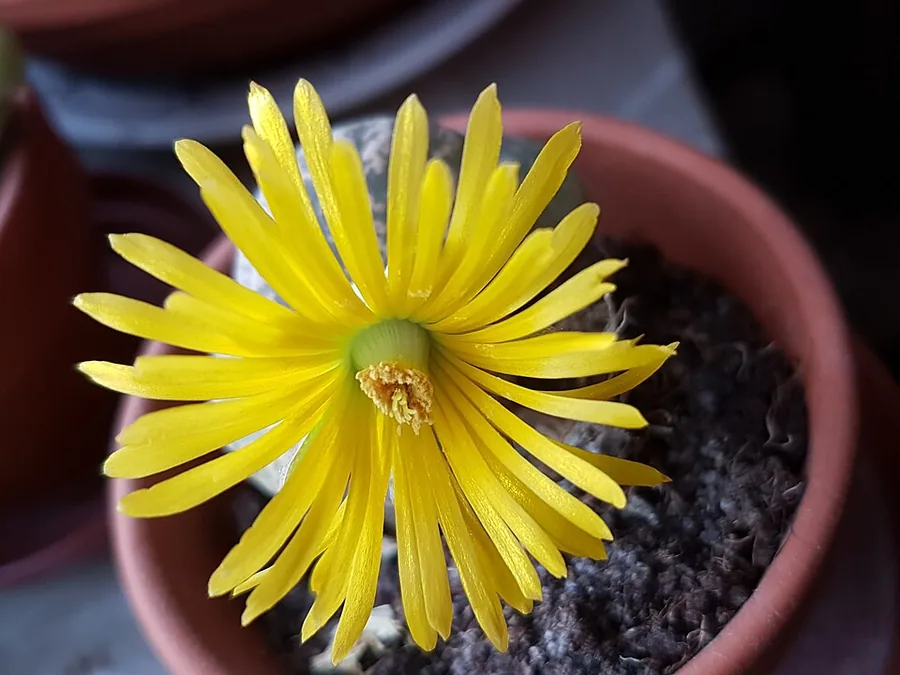
What they bring to a room is calm and a slow, unfolding interest. Native to the dry grasslands of southern Africa, they keep a seasonal rhythm that quietly marks time on your shelf: dormant and undemanding through the heat of summer, then renewing themselves as a new leaf pair replaces the old. In late summer and autumn a single daisy-like flower, white or yellow, rises from between the leaves, a small event that turns an ordinary windowsill into something worth pausing at.
As a companion to daily life they ask for almost nothing, which is the point. They fold neatly into a routine built around restraint rather than fuss, wanting a sunny spot and long stretches of being left alone. For anyone drawn to a pared-back look and a plant that keeps its own quiet counsel, a lithops earns its place on the sill for decades.
Care
The short version: set them in the brightest sun you have, pot them in a sharply draining gritty mix, and water only during active growth in autumn and spring while keeping them completely dry through summer dormancy and the leaf split.
Light
Give lithops full sun or the brightest light the room offers, all year, with a south-facing window the natural choice indoors. Short them on light and the tidy, low profile gives way to a stretched, pale one that reads far less well on a shelf.
Water
This is the routine that keeps them. Water only during active growth in autumn and spring, soaking the gritty soil and then letting it dry out completely before the next drink. Through summer rest and the leaf split, leave them bone dry, since a drink at the wrong moment brings on rot.
Soil
Pot them in a very gritty, sharply drained mineral or cactus mix that lets water run straight through, with a pH anywhere from 6.0 to 7.5. The quicker the soil dries, the safer the plant sits on your shelf.
Temperature
They keep well across a wide range, from about 41°F to 77°F (5°C to 25°C). A cool, dry winter rest suits them, so long as you spare them hard frost and the baking heat that would draw them to drink out of season.
Humidity
As desert plants they favor low humidity and moving air, so there is no figure to chase for them. The damp, still corner is the one to avoid, since it invites the rot that ends them.
Feeding
Lithops ask for almost no feeding. A dilute, low-nitrogen, high-potassium cactus fertilizer during the autumn and spring growth is ample, and even that you can skip. Overfeed and you trade the compact look for soft, weak growth.
Pruning
There is nothing to trim. As the old leaf pair shrivels during renewal, let it dry and be reabsorbed on its own, and resist peeling or pulling it away, which only sets the plant back.
Repotting
Repot only every 3 to 5 years, and only once the clump has crowded its pot or pushed roots out the drainage holes. A snug container suits both the plant and the look, so there is no rush to move it.
Size & spacing
Each plant stays small, just 1 to 2 inches (2 to 5 cm) tall and about as wide, gathering slowly into a clump over the years. A small, shallow bowl holds several with room to spread, which makes for a handsome grouping on a ledge.
Troubleshooting
Nearly every issue with lithops comes back to water and light, and most of it is easy to avoid once the routine settles in. The plant tells you when something is off by softening, stretching, or drawing in, so read those signs against where it sits in its yearly rhythm. Match what you notice below before you reach for the watering can.
A once-firm body gone soft, translucent, and sinking
A body that has gone soft and glassy has slipped into rot, and the cause is nearly always a drink offered at the wrong point in the year. Water taken during summer rest or the leaf split, or soil that stays damp on the shelf, sets the decline in motion from the base. Set the watering aside, pare away the spoiled tissue with a clean blade, and return the plant to dry, gritty mix until it firms up.
Fix:
- Stop watering immediately
- Remove the plant and cut away any rotted tissue with a clean blade
- Repot into dry, gritty mineral mix and withhold water until firm growth resumes
Bodies rising tall and pale where a low, flat profile belongs
A plant that stretches upward and fades has settled somewhere too dim for it, since the low, tidy profile that makes it such a pleasure on a shelf only holds in strong sun. The right spot is the sunniest one in the room. Move it there, and let it grow into the brighter light over a few days so the surface never scorches in the shift.
Fix:
- Move to the brightest available position
- Introduce stronger light gradually to avoid scorch
Layers of spent and fresh leaves crowding in at the same time
A plant that keeps its old leaves while a new pair rises beside them has been given water during the split, and the crowded look that follows is the tell. Renewal is meant to run on the fading old pair, not on the soil. Leave the watering can where it is until the old leaves dry down and vanish, and the clean profile returns on its own.
Fix:
- Withhold all water until the old leaf pair fully dries and is absorbed
A puckered, deflated silhouette arriving with the autumn or spring season
When the body draws in and wrinkles during its growing months, the plant is simply thirsty, and one measured drink restores its poise on the shelf. The calendar is what tells you how to read it. That same wrinkling through summer rest or renewal is part of the plant's own rhythm and asks for nothing from you.
Fix:
- Resume careful watering only if the plant is in active growth
Toxicity
For a home shared with pets or small children, lithops are entirely non-toxic. Cats, dogs, rabbits, birds, and people can all live comfortably alongside them. Nothing harmful sits in the leaves, so a stray nibble is no cause for concern.
Safe for
People · Cats · Dogs · Horses · Rabbits · Livestock · Birds
Cats None
A home with cats has nothing to fear from it. A nibble won't poison them, though a mouthful of the gritty mix may bring a passing bout of vomiting, and that comes from the soil rather than the plant.
Dogs None
A dog that chews one comes away unharmed, since the plant holds no toxic compounds. Its low, pebble-like presence rarely draws their interest anyway.
Horses Safe
Horses face no poison from it, and a shelf plant this small offers next to nothing to graze.
Rabbits Safe
Rabbits can sample it without risk, as the fleshy leaves carry nothing harmful.
Livestock Safe
Cattle, goats, and sheep meet no toxic threat from it, and a windowsill succulent this small seldom reaches them.
Birds Safe
Pet birds may peck at it freely, since the plant holds no toxins to trouble them.
People Safe
It is harmless to people, children included. No one keeps it for the table, but a curious taste does no damage.
Varieties
The genus runs to dozens of species, and collectors are drawn to the colors and surface patterns of their windowed tops. A few turn up again and again on the shelf.
Lithops aucampiae
An easygoing choice to grow, wearing reddish-brown to coppery tops traced with darker, branching lines.
Lithops lesliei
A widely kept species you can pick out by its finely netted, rusty-brown windowed tops and yellow flowers.
Lithops optica 'Rubra'
A collector's darling, prized for its striking purple-red bodies.
Lithops karasmontana
Its pale grey to pinkish bodies carry an intricate reddish pattern that plays across the surface.
Lithops salicola
Grey-green tops and translucent windows let it forgive a touch more moisture than most of its relatives.
How to propagate
You can raise more lithops from seed or by parting an older clump, though neither is a quick affair. Both reward a patient hand and a light touch with water.
SeedModerate
Sow in spring or early autumn onto gritty mix and keep warm and lightly moist until germination. · 2 to 3 years to reach mature flowering size
Most lithops begin as seed, scattered over gritty mix in spring or early autumn and kept warm and lightly moist until they sprout. It is a slow pleasure for the patient, since a seedling needs 2 to 3 years to reach mature flowering size and a light hand with moisture at every step.
DivisionModerate
Divide established multi-headed clumps at repotting during active growth. · Several months to root and re-establish
An older clump of several heads can be parted during active growth, most easily as you repot. Cut between the heads so each keeps its roots, let the cut faces dry, then settle them into their pots and allow several months for them to root and take hold.
Myths
Lithops are a type of cactus.
They are leaf succulents in the family Aizoaceae, with no close kinship to the true cacti of the Cactaceae. Both simply arrived at the same water-storing solution along separate branches of the plant world.
Lithops appreciate the same steady watering as the rest of a houseplant collection.
Tending them like an ordinary leafy plant on the sill is what claims most of them. They need to stay completely dry through summer rest and the leaf split, and overwatering is the single most common cause of death.