Houseplant · Aizoaceae
Split Rock
Pleiospilos nelii
A quiet, sculptural succulent that reads like a cracked pebble on the sill and asks only for sun and stillness.
Full sun
50–86°F · 10–30°C
USDA 9–11
2–3 in · 5–8 cm
Overview
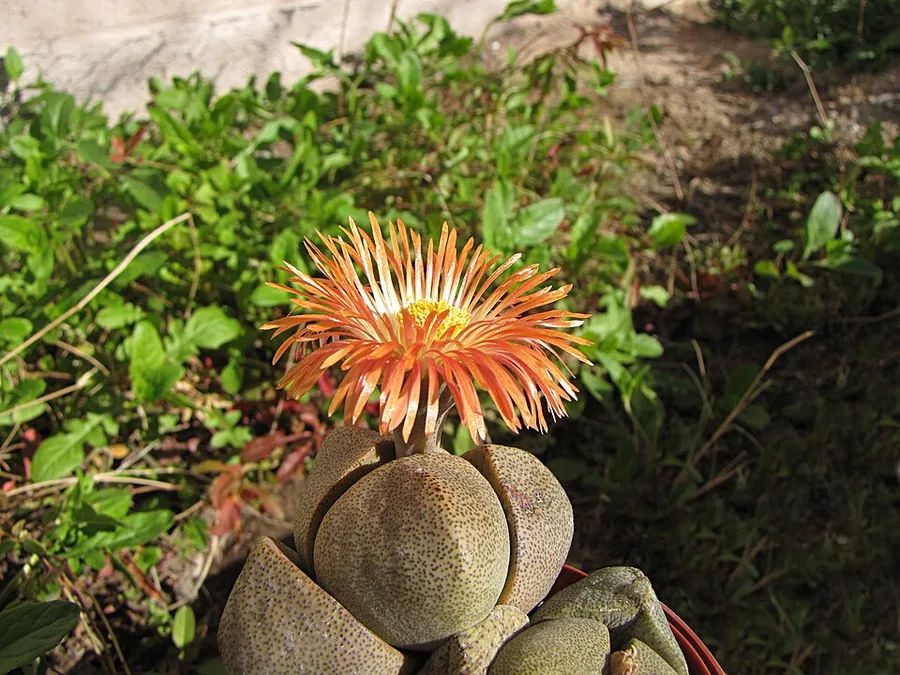
Few houseplants make a statement as quietly as split rock. This small South African succulent belongs to the mesemb branch of the family Aizoaceae, and its rounded, cleft form settles onto a shelf like a found object rather than a potted plant. Set in a shallow gritty bowl, it carries the composure of a smooth garden stone, an easy anchor for a pared-back, considered interior.
Its appeal on a windowsill comes partly from restraint. Growing slowly and staying just 2 to 3 inches (5 to 8 cm) tall, it never crowds a surface or competes with the objects around it. Through the year it keeps only one or two leaf pairs, quietly renewing itself as a fresh pair rises from within the old, a slow rhythm that rewards the patient owner.
Living with split rock is less about tending and more about placing it well and leaving it be. It runs on a strict cycle and wants a completely dry summer rest, so the plant suits a hands-off routine and a bright, sunlit corner. Give it the right spot and it offers a seasonal flourish: a daisy-like bloom in late winter or spring.
Care
The short version: choose your brightest, sunniest spot, pair it with a sharply draining gritty mix, and water only during spring and autumn growth, keeping it dry through dormancy and leaf renewal.
Light
Give split rock your brightest, sunniest position, ideally full sun at a south-facing window where it can preside over a sill all day. That strong light is what preserves its neat, composed form, while a shaded corner leaves it pale and stretched, and far less handsome on display.
Water
Watering is where restraint pays off. Offer it a drink only during active growth in spring and autumn, and only once the soil has dried through completely. Keep it bone dry across summer dormancy and while a new leaf pair emerges, since water at those moments spoils the plant, splitting and rotting the leaves that give it its looks.
Soil
Set it in a very gritty, sharply draining mineral or cactus mix that never lingers wet, the kind that suits a shallow, understated pot. A pH anywhere from 6.0 to 7.5 works, so the choice of vessel and grit matters more than any precise reading.
Temperature
Ordinary room warmth keeps it content, anywhere between 50°F and 86°F (10°C to 30°C), which makes it an easy companion for a lived-in space. A cooler, dry stretch in summer suits its natural rest and asks nothing extra of you.
Humidity
This is a plant for dry, airy rooms, since low humidity is exactly what it prefers and there is no target to manage. Dry air keeps it looking crisp, while damp, still corners are the ones that invite rot.
Feeding
Feeding stays minimal, reserved for the spring and autumn growth spells. A dilute, low-nitrogen cactus or succulent feed is all it wants, since a heavier hand pushes soft growth that undoes its tidy, sculptural shape.
Pruning
There is nothing to prune here, and the plant should never be cut, which suits a low-effort home beautifully. Simply let the old leaf pair shrivel as the new one takes it up, then lift away the papery remains once they are spent.
Repotting
Repotting is a rare occasion, needed only every 2 to 3 years or when the plant outgrows its container. Watch for roots slipping through the drainage holes or the body lifting from the soil, the cues that it is ready for a fresh gritty mix and perhaps a new pot to suit the room.
Size & spacing
Compact by nature, it reaches only 2 to 3 inches (5 to 8 cm) tall and spreads 3 to 4 inches (7 to 10 cm) across, ideal for a small pot on a shelf or a grouped tablescape. A single plant holds its own without any companions.
Troubleshooting
Split rock asks for little, but the little it asks centers on water and timing, and any misstep shows in the leaves. Learn to notice whether they stay firm, soften, or begin to stack, and the plant becomes easy to keep looking its best. Match the sign below and adjust before rot takes hold.
Leaves that split open or soften into translucence
Soft, splitting leaves are the mark of rot from overwatering, and the culprit is almost always a drink offered at the wrong time. The risk runs highest through summer dormancy and while a new leaf pair pushes out, when the plant wants nothing at all. Set the watering can aside, pare away the mushy tissue with a clean blade, and move it into a grittier, quicker-draining mix.
Fix:
- Stop watering immediately
- Cut away rotted tissue with a clean blade
- Repot into a much grittier, faster-draining mix
- Allow the plant to dry out fully before any further water
Leaf pairs stacking up rather than fading away
At its best, split rock shows only one or two leaf pairs. A stack of three or more usually means it was watered or fed during leaf renewal, so the old pair never drew down as it should. Hold back water and let the plant live off those older leaves, then return to the usual dry cycle once the surplus fades.
Fix:
- Withhold water so the plant draws on the old pair
- Resume the normal dry-cycle once excess pairs are reabsorbed
Pale, stretched growth that loses its composed shape
When a split rock reaches upward and pales, it is short on light, plain and simple. That tidy, stone-like form holds only under strong sun, and a dim sill quietly undoes it. Move it to the brightest position in the home, one that catches several hours of direct sun.
Fix:
- Move to the brightest available position with several hours of direct sun
Toxicity
For a home shared with pets or children, split rock brings peace of mind: it is not toxic. The ASPCA does not list it, and the mesembs in its family carry no known poisons. The only caveat is a passing stomach upset if a pet swallows a mouthful of the gritty, fibrous leaf.
Safe for
People · Cats · Dogs · Horses · Rabbits · Livestock · Birds
Cats None
A curious cat can share the room with it in comfort. Should one chew a leaf, the fibrous tissue might bring a brief, mild stomach upset, yet nothing toxic is at play.
Dogs None
Dogs run no risk of poisoning here. The most a determined chewer meets is short-lived drooling or loose stool from the gritty leaf, and it settles on its own.
Horses None
Horses face no poisoning concern from it. And with a plant this small, there is barely a mouthful on offer to begin with.
Rabbits None
It holds no toxins that could harm a rabbit. A nibbled leaf may pass with a little gas, since the dense succulent tissue sits outside a normal diet.
Livestock None
Goats, sheep, and cattle meet no toxic threat here. At most a grazing animal notices a mild, brief digestive grumble from the gritty mouthful.
Birds None
Pet birds are safe in its company, with no poisoning on record. A bird that pecks a leaf risks nothing worse than a slightly unsettled crop from the fibrous bite.
People None
For adults and children alike, handling and growing it carries no toxic risk. It is not a food plant, though, so there is no reason to taste it.
Its sharp gritty soil and fibrous leaf tissue could cause minor mechanical or digestive upset if a pet chews and swallows large amounts.
Varieties
Only two forms tend to reach collections, set apart mainly by color. Both are worth knowing when you choose one for a room.
Pleiospilos nelii (species)
The wild species carries grey-green, fissured leaves that round into an almost spherical body, the picture of a cracked stone on a shelf.
Pleiospilos nelii 'Royal Flush'
This cultivar trades the familiar grey-green for deep purple to reddish leaves, a richer note for a styled corner, while keeping the same split-stone silhouette.
How to propagate
Split rock grows on slowly, and it multiplies at the same gentle pace. You can raise more from seed or divide an established clump when the time comes to repot.
SeedModerate
Sow in warm conditions during spring or autumn · Several months to over a year to reach a recognizable plant
For seed, sow in the warmth of spring or autumn, scattering it over a gritty mix and keeping it lightly moist until it germinates, then shifting to the strict dry cycle. It is a slow project for a patient grower, taking several months to more than a year before a seedling looks like a plant worth displaying.
DivisionModerate
During active growth when repotting an established clump · Several weeks to a few months
Once a clump has spread, you can divide it during active growth as you repot. Ease off an offset with a few roots, let the cut surfaces dry and callus, then settle it into a dry gritty mix. A division tends to establish within a few weeks to a couple of months.
Myths
Split rock is a kind of Lithops.
The two sit in separate genera, for all that they share the mesemb group. Split rock is a Pleiospilos, with far fatter and fewer leaves than a true Lithops, so the resemblance stays on the surface alone.
Water it on a regular schedule like any other succulent.
It keeps to a strict cycle and insists on a bone-dry summer rest. Watering it year-round on routine bursts and rots the leaves, and there is no faster way to lose the plant.