Houseplant · Araceae
Peace Lily
Spathiphyllum wallisii
A graceful, low-fuss houseplant that signals its own thirst and answers a little light with crisp white blooms.
Bright indirect
68–85°F · 20–29°C
USDA 11–12
1–6 ft · 0.3–1.8 m
Overview
Few houseplants ask for as little as the peace lily, which goes a long way toward explaining its quiet ubiquity across homes and offices. Its roots lie in the humid tropical forests of Colombia and Venezuela, where it lives out its days in the deep shade of the forest floor. That ancestry is precisely what lets it make peace with the modest light most rooms have to give.
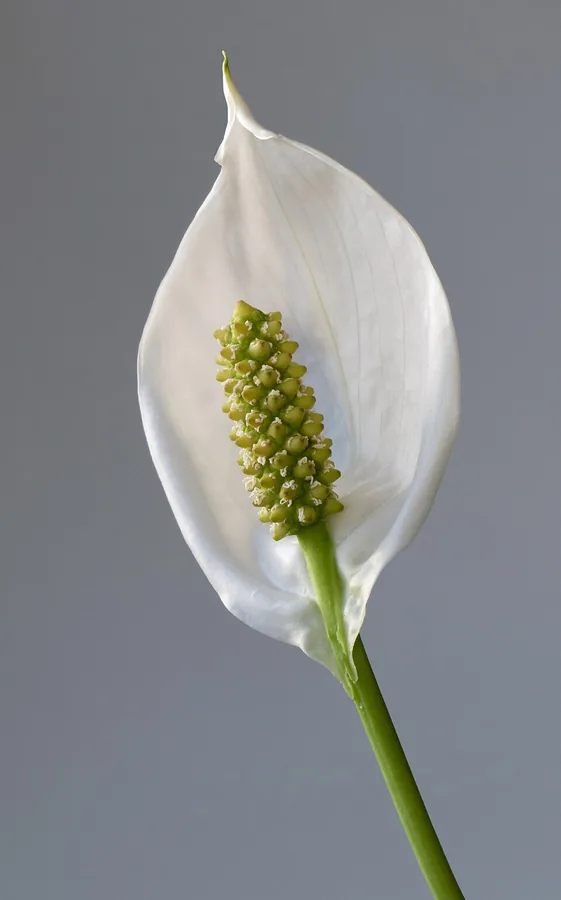
The draw, though, is the flower. What looks like a single white bloom is in truth a spathe, a sleek, hood-like leaf curling around a slender spike of the real flowers. Poised against foliage of glossy dark green, those clean white spathes carry the whole aesthetic, and a contented plant offers them on and off through spring and summer.
It carries one more endearing trait: it announces its thirst for all to see. Let the soil run dry and the entire plant droops dramatically, only to stand tall again within hours of a drink. That candor makes it forgiving for a newcomer, though a plant left to wilt over and over will quietly shed leaves as the seasons pass.
Care
The short version: offer bright, indirect light with no direct sun, keep the soil evenly moist yet never soggy, hold the warmth above 60°F (16°C), and lean toward higher humidity. Set it out of reach of pets and children, since every part is an irritant.
Light
Settle it in bright, indirect light and spare it direct sun, which scorches the foliage. Its name rests on a genuine tolerance for low light, yet a shadowy corner buys you leaves and next to no flowers, so a brighter spot pays off whenever blooms are the goal.
Water
Hold the soil evenly moist but never soggy, letting only the surface dry between drinks. The plant slumps hard once it gets too dry and revives within hours of water, though that recovery is no substitute for a steady rhythm. Pour room-temperature, dechlorinated water, and never leave the pot lingering in a saucer.
Soil
Give it a rich, well-drained potting mix generous in organic matter. A slightly acidic blend suits it best, near a pH of 6.0 or a shade below, and reliable drainage is what keeps the roots out of harm.
Temperature
Ordinary room warmth pleases it, ideally 68°F to 85°F (20°C to 29°C). It has no tolerance for frost and starts to suffer in the chill, so hold it comfortably above 40°F (4°C) and clear of cold drafts and winter glass.
Humidity
At heart this is a high-humidity plant, shaped by tropical forest air. Dry indoor rooms betray themselves in brown, crisp leaf tips, so cluster it among other plants, perch it on a pebble tray, or let a humidifier hum nearby.
Feeding
Its appetite is slight. Offer a balanced liquid fertilizer at roughly quarter strength through the spring and summer push, about every 6 to 8 weeks. An overfed plant answers with browned leaf tips, so when you waver, feed less.
Pruning
There is precious little upkeep here. Simply trim off yellowed or damaged leaves and spent flower stalks at the base as they turn, which keeps the silhouette neat and channels energy into fresh growth.
Repotting
Move it on every 1 to 2 years, or once roots begin to nose through the drainage holes, ideally across late winter into early spring. It blooms more freely when kept slightly potbound, so resist sizing up the pot too generously.
Size & spacing
Indoors it tends to hold around 1 to 3 feet, while the grandest cultivars stretch to 6 feet (183 cm) tall and fan out close to 5 feet (152 cm) across. Allow a large one breathing room so its arching leaves are not pressed flat against the wall.
Troubleshooting
Almost every peace lily complaint comes down to water, light, or salts, and the plant is candid about which is at play. A sudden swoon means thirst, scorched tips point to salt or dry air, and yellowing in wet soil warns that the roots are suffering. Read what the plant is showing you below before you reach for a fix.
Yellowing lower leaves where the soil never dries
Yellowing foliage on a plant standing in waterlogged soil usually traces to root rot brought on by overwatering. Set the watering can aside, tip out any saucer, and inspect the roots, which darken and turn to mush once decay sets in. Move it into fresh, well-drained mix, snip away the spoiled roots, and from here let the surface dry a touch between drinks.
Fix:
- Stop overwatering and empty any saucer of standing water
- Improve drainage; repot into fresh, well-drained mix and trim away rotted roots
The whole plant slumps, then rises again after water
That theatrical collapse reads as alarming, but it is only thirst rather than real harm. The foliage folds the instant the soil runs too dry, then lifts again within a few hours of a generous soak. Treat the gesture as a quiet cue if you like, though a plant pushed to wilt time after time will start dropping leaves, so reach for the watering can before the drama begins.
Fix:
- Water thoroughly until water drains from the bottom
- Allow excess water to drain away and do not leave the pot sitting in water
Lush foliage, yet no white spathes appear
Park a peace lily in deep shade and it answers with handsome leaves and not a single bloom. Shift it toward brighter, indirect light and the elegant white spathes tend to arrive in their own time. A young specimen, or one resting in its off-season, may simply be waiting, since many cultivars flower chiefly across spring and into summer.
Fix:
- Move to a brighter spot with bright, indirect light (no direct sun)
- Be patient through the natural spring-to-summer bloom period for season-dependent cultivars
Parched brown tips and edges along the leaves
Crisp brown edges most often signal a salt buildup, whether from heavy feeding or from the chlorine and fluoride carried in tap water. Rinse the pot with a long, slow flush to carry those salts away, then ease the feed back to roughly quarter strength and pour only room-temperature, dechlorinated water. Dry air sharpens the problem, so lift the moisture in the air around the plant.
Fix:
- Leach the soil with plenty of water to flush excess salts
- Cut fertilizer back to about quarter strength and apply less often
- Water with room-temperature, dechlorinated or distilled water
- Raise humidity around the plant
Toxicity
For all its serene name, a peace lily is not safe to chew. Every part holds insoluble calcium oxalate crystals that sting the mouth and throat the moment they touch, setting off burning, drooling, and swelling in pets and people alike. It is no true lily, so it spares cats the fatal kidney failure an Easter lily can trigger, yet it still hurts and no part is edible, so keep it beyond the reach of animals and small children.
Toxic to
Cats · Dogs · Horses · Rabbits · Livestock · Birds · People
Cats Toxic
One bite into a leaf delivers a mouthful of needle-fine calcium oxalate crystals, and the sting lands almost at once. Watch for streaming drool, a paw pressed to the muzzle, and a tongue or lips swollen enough to make swallowing a struggle.
Dogs Toxic
A dog meets the very same crystals, which prickle the mouth and throat on contact. Telltale signs are drooling, vomiting, and a pet that turns away from its bowl soon after gnawing the leaves.
Horses Toxic
Those crystals trouble a horse exactly as they do smaller animals, leaving a sore mouth, ropey drool, and a clear unwillingness to eat. Keep the plant well away from stables and paddocks.
Rabbits Toxic
The irritant crystals sit in every part of the plant, so an inquisitive rabbit courts a burning mouth and a hunger strike to match. Keep those leaves out of nibbling range.
Livestock Toxic
Cattle, goats, and sheep meet the identical mouth and gut irritation should they reach the foliage. Site the plant beyond any patch a grazing animal can wander into.
Birds Toxic
A pet bird that nibbles the leaves can wind up with the same scorched mouth and throat. Keep the plant where no bird could ever perch on it.
People Caution
Nothing on a peace lily belongs on a plate. A single bite sets off instant burning of the mouth and lips, drooling, and swelling, so keep it clear of small children who explore by mouth.
Despite the name it is not a true lily (it is an aroid, Araceae) and is far less dangerous than true Lilium, but it still causes painful oral/GI irritation if chewed
Helpline numbers

United States
ASPCA Animal Poison Control: (888) 426-4435 (fee applies)
Poison Control: (800) 222-1222



Canada
Poison Centres: 1-844-764-7669
Varieties
Peace lilies span a generous range of sizes, from desktop miniatures to floor-anchoring statement plants. A handful of cultivars show up often enough to recognize on sight.
'Mauna Loa' (and 'Mauna Loa Supreme')
The crowd-pleaser stocked by most shops, it lifts generous white spathes above a plant that settles in at a comfortable 2 to 3 feet tall.
'Sensation'
The giant of the family, reaching 5 to 6 feet on broad, sweeping leaves that furnish an empty corner all by themselves.
'Domino'
Marbled foliage, green brushed and flecked with white, lends a variegated polish to a plant that holds near 30 inches tall.
'Petite'
A neat, compact dwarf made for a desktop or a slim windowsill where space runs short.
How to propagate
Only one dependable route makes more peace lilies, and it falls in step with the day you repot.
DivisionEasy
Late winter to early spring, typically when repotting · Several weeks to a few months
Division is the only way to multiply a peace lily, as no leaf or stem cutting will ever take root. The natural moment falls in late winter to early spring, the same window when a repot is already on the calendar. Ease the plant from its pot, separate the clump into sections that each carry their own roots and crown of leaves, then settle them into fresh pots. Give each new division anywhere from a few weeks to a few months to find its feet and resume growing.
Myths
A peace lily is a true lily and as deadly to cats as Easter lilies.
The peace lily sits in the arum family rather than among the true lilies, which spares it that particular reputation. The ASPCA does flag it as toxic to cats and dogs, yet the trouble comes from calcium oxalate crystals that burn and inflame the mouth and gut. It does not cause the kidney failure that true lilies and daylilies bring on in cats, though it still smarts and belongs out of a pet's reach.
Peace lilies clean the air and pull toxins out of your home.
The claim grows out of a sealed-chamber experiment that bears little resemblance to a lived-in room. A peer-reviewed review pooling 196 results from 12 such studies concluded that potted plants make no meaningful dent in indoor air quality, and you would need somewhere between 10 and 1000 plants per square meter to rival the air a routine ventilation system already turns over.
Sources
- Plants of the World Online, Royal Botanic Gardens Kew
- NC State Extension Plant Toolbox
- ASPCA Animal Poison Control
- Missouri Botanical Garden Plant Finder
- Clemson Cooperative Extension HGIC
- University of Florida IFAS Extension (EDIS EP477)
- University of Florida IFAS Extension (EDIS EP320)
- Journal of Exposure Science & Environmental Epidemiology (Cummings & Waring, 2020; PubMed)