Houseplant · Araceae
Pink Princess Philodendron
Philodendron erubescens 'Pink Princess'
With filtered light and consistent moisture, this rosy showpiece keeps its blush-toned foliage on display through every season.
Bright indirect
65–85°F · 18–29°C
USDA 10–12
2–60 ft · 0.6–18.3 m
Overview
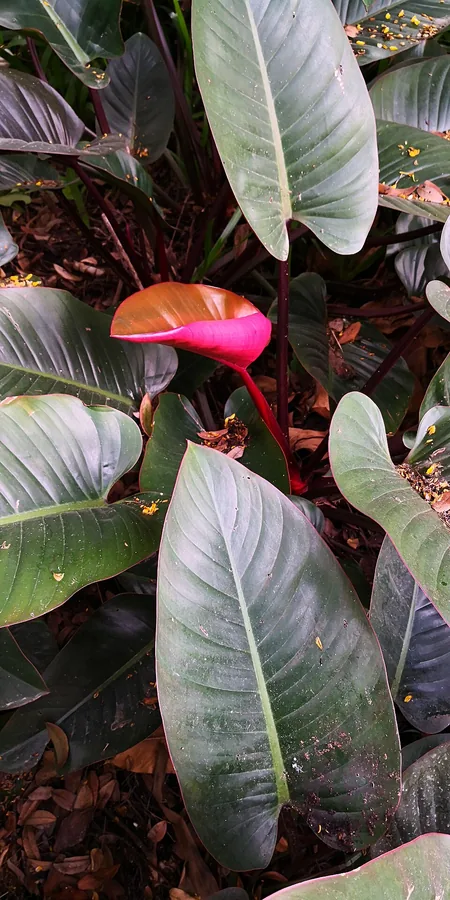
Few houseplants make an entrance the way the Pink Princess does, a climbing philodendron of the arum family that reads as a single striking accent on a shelf, a mantel, or a plant stand. The pink it wears turns an ordinary corner into a focal point and draws the eye the moment you enter the room. It rewards a spot where it can be seen rather than tucked away.
That signature color rests on a chimeral variegation, a trait the plant holds loosely, so the display shifts as new leaves arrive and no two are quite alike. A stem can slip back to plain green and, left alone, quietly outgrow the pink that made it a centerpiece. A short, steady habit of watching the growth and pruning at the right point keeps the plant looking styled rather than left to chance.
Kept indoors it stays gracefully in scale, usually around 3 feet (90 cm) trained up a moss pole or trellis, a vertical line that suits a narrow console or a bright reading nook. Give it warmth, bright indirect light, and a mix that drains well, and it grows at an unhurried pace that fits easily into the rhythm of a home.
Care
The short version: a spot with bright indirect light, a warm room between 65°F and 85°F (18°C to 29°C), and a moist but free-draining mix, with reverted green stems pruned back so the pink keeps its place in the room.
Light
Give it bright indirect light beside a window but out of the hard, direct beam that scorches the leaves. That same good light is what keeps the pink alive, so a corner that is too dim leaves you with weak, mostly green growth and a plainer plant on display.
Water
Keep the mix evenly moist but never soggy, letting the surplus drain freely after each watering. Waterlogged soil is the quickest way to root rot, so lean toward good drainage over a heavy hand with the can.
Soil
Set it in a rich, well-draining mix built on organic matter such as loam or silt. An acidic to neutral pH suits it well, and the drainage counts for more than the exact recipe, since standing water rots the roots.
Temperature
It looks its best in a warm room between 65°F and 85°F (18°C to 29°C). Keep it clear of cold drafts and chilly winter windowsills, since it has no tolerance for the cold and a chilled spot dulls the display.
Humidity
The plant favors high humidity and answers with fuller, healthier leaves. It will adapt to average room air, though a humidifier or a pebble tray set nearby keeps it looking its most polished.
Feeding
Feed monthly through spring and summer with a balanced liquid houseplant fertilizer at half strength. Ease off through the darker months as growth slows, since the plant draws up little then and asks for less.
Pruning
Prune to shape the plant and, more than that, to protect the pink that gives it presence. When a stem reverts to all green, cut it back to a node still bearing pink, or that vigorous green growth will take over the look.
Repotting
Repot in spring once it is root-bound, which shows when roots fill the pot or press out through the drainage holes. Move up just one pot size so the fresh mix does not sit wet around the roots and undo the effort.
Size & spacing
24–720 in (61–1829 cm) tall
Troubleshooting
Most of what troubles a Pink Princess surfaces in its leaves and roots, and watering and light sit behind nearly all of it. Notice the early signs and the remedy is a quiet one. Find the picture below that matches yours, then act before it settles in.
Sagging, yellowed foliage above compost that refuses to dry
A plant that droops in a pot that never dries has slipped into root rot, the usual price of overwatering or a mix that holds too much water. The roots, firm and pale when all is well, turn soft and brown below the surface. Settle it into a fresh, fast-draining mix, clear away the spoiled roots, and let the watering can rest a little longer between visits.
Fix:
- Reduce watering frequency
- Repot into a fresh, well-draining, organic-rich mix
- Trim away rotted roots
The newest leaves arriving without a trace of pink
When the pink that gives this plant its presence begins to fade from new leaves, the cause is its chimeral variegation, a trait the plant holds loosely and can surrender to a plain green stem. A dim corner encourages the same drift. Trim the reverted stem back to a node that still carries pink, then give it a brighter, well-lit spot so the color returns to the room.
Fix:
- Prune the reverted stem back to a node that still bears pink variegation
- Provide bright indirect light
Blemishes and dark markings spreading from leaf to leaf
Tidy spots, some circled by a pale yellow ring, mark a fungal or bacterial leaf spot that arrives where the air is close and the leaves stay damp. Lift away the marked leaves and give the plant a more open, breathable place to stand. Keep the leaves themselves dry at watering time and the display holds its poise.
Fix:
- Remove affected leaves
- Improve air circulation
- Avoid wetting the foliage
Webs, a sticky sheen, or cottony flecks marring the foliage
Fine webbing, a sticky sheen, or a scatter of cottony specks are the marks of sap-feeding pests, among them spider mites, mealybugs, aphids, scale, and thrips. The webbing belongs to mites, the cotton to mealybugs, and the stickiness to something quietly at work. Rinse or wipe them away, treat with insecticidal soap or horticultural oil, and set the plant apart from its companions until it is clear.
Fix:
- Wipe off or rinse away pests
- Treat with insecticidal soap or horticultural oil
- Isolate the affected plant
Faded, scorched-looking areas across the leaf display
Pale, papery patches along the window side are sun scorch, the mark of a beam falling too hard through the glass. This plant asks for light that is bright but softened, the kind that flatters a room rather than bleaches it. Draw it back from the window or hang a sheer curtain, and it settles into the gentle bright indirect light it prefers.
Fix:
- Move to bright indirect light, out of direct sun
Toxicity
As lovely as it looks on a shelf, this is a toxic houseplant, so give it a place well out of reach of pets and children. Every part holds insoluble calcium oxalate crystals that sting and burn the mouth the moment they are chewed, and the sap can irritate bare skin. Style it for the eye, never for the plate.
Toxic to
Cats · Dogs · Horses · Rabbits · Livestock · Birds · People
Cats Moderate
A leaf chewed by a cat releases sharp calcium oxalate crystals that burn the mouth at once, so give it a shelf or hanging spot beyond a cat's reach. The signs are drooling, pawing at the face, vomiting, and a cat that holds off swallowing while its mouth and tongue stay sore and swollen.
Dogs Moderate
A dog that mouths the foliage takes in the same stinging crystals, so a raised, out-of-the-way place suits a home with a dog. Look for heavy drooling, retching or vomiting, swelling around the lips and tongue, and difficulty swallowing before long.
Horses Moderate
The crystals inflame a horse's mouth and throat, bringing drooling, painful swelling, and trouble swallowing. Because a horse cannot vomit, the burning lingers in the mouth and gut.
Rabbits Caution
A rabbit's mouth is irritated by the oxalate crystals just as any animal's would be, so keep the plant well beyond a hop's reach. Even a single nibbled leaf can leave a rabbit sore-mouthed and off its food.
Livestock Caution
Grazing animals that mouth the leaves meet the same burning irritation and drooling. It has no place in a pasture, yet a curious goat or sheep that reaches it can end up with a sore, swollen mouth.
Birds Caution
A bird that bites the foliage encounters the same irritant crystals, with swelling and discomfort in the mouth. Keep pet birds clear of the leaves and stems.
People Caution
No part of this plant belongs on a plate. A chewed leaf burns the mouth and lips, and the sap can leave skin red and itchy, so wear gloves when you prune and keep it away from small children.
Sap can cause contact dermatitis - wash hands or wear gloves when pruning
Helpline numbers

United States
ASPCA Animal Poison Control: (888) 426-4435 (fee applies)
Poison Control: (800) 222-1222



Canada
Poison Centres: 1-844-764-7669
How to propagate
The Pink Princess can furnish a second plant for another corner of the home, drawn from the one you already keep, provided you start from growth that already wears pink. Both methods below are dependable as long as the cutting begins at a variegated node.
Stem cuttingsModerate
Spring to summer, during active growth · Several weeks to root
Take cuttings in spring or summer, while the plant is in active growth, choosing pieces that each carry at least one node marked with pink. A cutting taken from an all-green section will only ever grow green, since the variegation is chimeral, so the choice of stem sets the tone for the plant to come. Settle it into a moist medium and allow several weeks for roots to form.
LayeringModerate
Spring to summer, during active growth · Several weeks to root before separating
Layering is the calmer, lower-risk approach, best done in spring or summer during active growth. The stem roots while it remains attached to the parent, and after the several weeks it needs to root you separate it to stand as a plant of its own.
Myths
The rosy variegation is a fixed feature that every future leaf inherits.
The pink comes from a chimeral variegation that is never truly settled, so the plant can drift back to all green at any point. A vigorous green stem will grow past the pink if it is left to its own devices. Prune reverted growth back to a pink node to keep the color coming, and the plant keeps earning its place in the room.
An all-green branch will find its way back to pink if simply left alone.
Once a stem has turned all green it holds there, since the green tissue is stable and will not recover its variegation. The remedy is simple. Cut it back to a node that still shows pink and let fresh variegated growth carry the color forward.