Houseplant · Begoniaceae
Polka Dot Begonia
Begonia maculata
Give it bright indirect light, careful watering, and humid air, and the polka dot begonia rewards the room with spotted, silver-flecked leaves.
Bright indirect
USDA 10–11
2–3 ft · 0.6–0.9 m
Overview
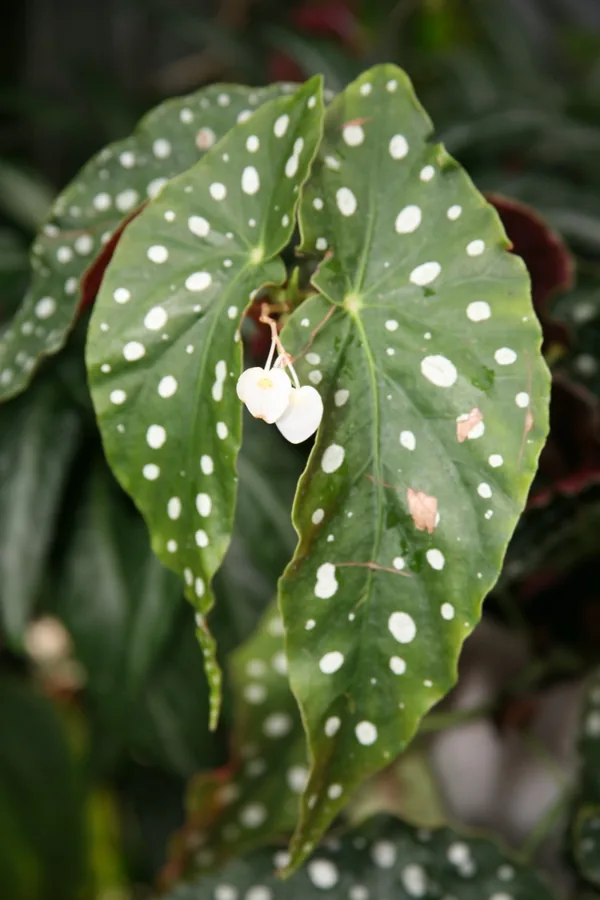
The polka dot begonia carries a certain quiet drama, the sort that lifts a plain corner without asking for attention. Its silvery-white spots and crimson-lined leaves rise on upright, bamboo-like canes that read beautifully against a pale wall or a run of books. It belongs to the cane-stemmed begonias and comes originally from the forests of southeast Brazil, a heritage that gives it its poised, slightly exotic presence.
Indoors it keeps to a considerate scale, reaching about 2 to 3 feet (61 to 91 cm) tall over a few seasons, tall enough to anchor a side table or plant stand without crowding the room. Pale pink to white flowers appear in the warmer months, a soft seasonal grace note above the foliage. Its moderate temperament suits a considered home: not needy, but happiest where its few preferences are met.
Those preferences shape where it lives. It wants a bright spot away from wet feet and the high humidity of its native understory, which makes a well-lit bathroom or a kitchen near a window a natural home. Settle it into that daily rhythm, with steady moisture and a little moving air, and it becomes a fuller, more striking fixture year after year.
Care
The short version: a bright indirect spot, water only once the top of the soil dries, and humid air that keeps gently moving. Feed lightly through the growing season and pinch the tips to hold its full, furnished shape.
Light
Set it in bright, indirect light near a window where direct sun never falls on the leaves, the kind of glow that flatters both plant and room. It will hold in medium light or partial shade, though the spots dull and the canes stretch. Fierce midday sun scorches the foliage.
Water
Water moderately through the growing season, then let the top of the soil dry before the next round. This begonia rots easily, so the rule that keeps it handsome is never to leave it in soggy soil or standing water. Ease back in winter as growth quiets.
Soil
Choose a light, well-drained mix rich in organic matter, one that holds a little moisture and lets the rest slip away. A slightly acidic pH of 5.5 to 6.5 suits it best. Good drainage is the quiet foundation everything else rests on.
Temperature
Keep it warm and never let the room fall below 55°F (13°C). Cold drafts and chilled windowsills make it shed, so in winter move it clear of doors and vents to a steadier corner.
Humidity
This plant asks for high humidity, more than most rooms offer, so a humidifier or a pebble tray earns its keep. The catch is that still, humid air invites powdery mildew, so pair the moisture with gentle airflow around the leaves.
Feeding
Feed through the growing season, spring into summer, with a balanced liquid fertilizer at alternate waterings, roughly every two weeks. Let it rest through autumn and winter and set feeding aside.
Pruning
Pinch the growing tips to draw out side branches and keep the plant full rather than leggy, the shape that photographs and displays best. Regular pinching also holds its size and keeps the lower canes from going bare.
Repotting
Repot every one to two years, or sooner once roots reach the drainage holes and water runs straight through. As you work, keep the dug-up roots and tubers away from pets, since they hold the most toxin.
Size & spacing
Indoors it reaches about 2 to 3 feet (61 to 91 cm) tall and spreads 1 to 2 feet (30 to 60 cm) wide, a tidy footprint for a stand or shelf. Leave space and airflow on all sides to keep mildew at bay.
Troubleshooting
Nearly everything that unsettles a polka dot begonia comes back to water or air, the two things easiest to adjust in a room. Read the leaves and stems early and most of it is a matter of a small change in placement or routine. Match what you see below, then act while the plant can still return to form.
A sagging plant above stems gone dark and soft where they meet the soil
A soft, darkened stem base above soil that stays wet marks root and stem rot, the most serious trouble this plant meets, and it grows from overwatering. Set styling aside and act: lift the plant from its pot, cut away every rotted root and stem, and settle it into fresh, quick-draining mix. From then on, water only once the surface has dried, and the plant can return to the centerpiece it was meant to be.
Fix:
- Remove the plant and cut away rotted roots and stems
- Repot into fresh, well-drained mix
- Water only after the top of the soil dries
A fine white bloom settling over the leaves
A pale, dusty veil across the leaves is powdery mildew, and it tends to settle where humid air pools in a still, closed corner. The fix is as much about placement as treatment: open the setting so air can drift through, lift away the worst leaves, and keep water off the foliage. This begonia thrives on humidity, so the aim is a spot that stays moist in feel yet never stagnant.
Fix:
- Improve air circulation around the plant
- Remove and discard affected leaves
- Avoid wetting the foliage when watering
Leaves yellowing and falling off
When leaves yellow and let go, overwatering is the usual story, most often where the soil never quite dries between waterings. Cold is the other culprit, since a position below 55°F (13°C) or in the path of a draft prompts a begonia to shed. Ease it back to health by letting the top of the soil dry before the next watering, settling it into a warm spot away from cold currents, and choosing a pot that drains cleanly.
Fix:
- Let the top of the soil dry before watering again
- Move away from cold drafts and keep above 55°F (13°C)
- Ensure the pot drains freely
Woolly white spots, a sticky sheen, or delicate webbing among the leaves
A few sap-sucking pests may find this begonia, and each signs its presence differently. White cottony tufts are mealybugs, small clouds of white flies are whiteflies, fine webbing over speckled leaves is spider mites, and silvery scarring is thrips. Move the plant apart from the rest of a grouped display so nothing travels, wash away what shows, then treat with insecticidal soap or horticultural oil and repeat until the plant is clear enough to return to its place.
Fix:
- Isolate the affected plant
- Wipe off or wash off visible pests
- Treat with insecticidal soap or horticultural oil and repeat as needed
A stretched silhouette with foliage gathered high on empty stems
A begonia that grows tall and leggy, with leaves clustered only at the top, has usually been placed in a spot too dim for it and left unpinched. The remedy fits any room: shift it to a brighter corner and begin pinching the tips. If a cane has run too far, cut it back to a node, and the plant will refill into the fuller, more furnished shape that reads best against a wall or shelf.
Fix:
- Move to brighter indirect light
- Pinch the growing tips to force branching
- Prune back leggy canes to a node to encourage bushier regrowth
Toxicity
For all its polish, this is a plant to place with pets and grazing animals in mind. Every part holds calcium oxalate crystals, and the underground tubers and roots hold the most, so a chewed leaf stings the mouth and a dug-up root does worse. Nothing on it is edible, so style it well out of reach of small children too.
Toxic to
Cats · Dogs · Horses · Rabbits · Livestock · Birds · People
Cats Moderate
A cat that chews any part takes in calcium oxalate crystals, so look for drooling, pawing at the mouth, and vomiting. Because the tubers hold the most, keep repotting debris off the floor and out of a wandering cat's path.
Dogs Moderate
Dogs respond much the same, with drooling and a queasy stomach after sampling a leaf or stem. A dog that digs down to the roots and chews them takes a stronger dose.
Horses Moderate
The same oxalates trouble horses and other grazing animals, bringing mouth irritation and stomach upset. Larger or repeated mouthfuls can strain the kidneys.
Rabbits Caution
The crystals that unsettle cats and dogs would irritate a rabbit's mouth and gut every bit as much, so the whole plant is best kept beyond a rabbit's reach.
Livestock Caution
Grazing stock share the risk that horses face, since the oxalates behave the same across animals. Keep cattle, goats, and sheep away from the foliage and any unearthed roots.
Birds Caution
There is little reason to let a pet bird nibble the leaves, and the irritant crystals make it unwise. Display the plant where curious beaks cannot reach it.
People Caution
No part of this begonia belongs on a plate, and a bite leaves the mouth burning and stinging. Style it up high, out of reach of small children who like to taste things.
Most toxic part is underground; keep the plant and any repotting debris (tubers/roots) away from pets and grazing animals
Helpline numbers

United States
ASPCA Animal Poison Control: (888) 426-4435 (fee applies)
Poison Control: (800) 222-1222



Canada
Poison Centres: 1-844-764-7669
Varieties
Most plants sold as polka dot begonia lead back to one celebrated cultivar. This is the one worth knowing by name.
Begonia maculata 'Wightii'
A vigorous, free-flowering cane-stem cultivar whose long, narrow green leaves are patterned with silvery-white spots over deep crimson-red undersides.
How to propagate
Polka dot begonias are generous to grow on, and no special equipment is needed to do it. A cutting taken in the growing season roots on its own, ready to fill another corner or grace a gift.
Stem cuttingsEasy
Spring to summer · Roots in a few weeks (often in water)
Stem and tip cuttings are the graceful way to grow your display, and to gift a start to a friend. Take them in spring or summer while the plant is growing, stand them in a glass of water or set them into moist mix, and they root within a few weeks.
Leaf cuttingsModerate
Spring to summer · Several weeks
A single leaf can become a whole new plant too, a quiet project for the patient. Set a leaf cutting in spring or summer and allow it several weeks to raise roots and a small plantlet before it earns a pot of its own.
Myths
A begonia in the home is scarcely a hazard to animals, the leaves being its only questionable part.
The reality is less forgiving than the styling might suggest. Begonia is genuinely toxic to cats, dogs, and horses through calcium oxalate crystals, and the leaves are the mild part. The real danger sits underground in the tubers and roots, which is exactly what a digging pet or a careless repotting can bring into a shared room.