Houseplant · Commelinaceae
Purple Heart
Tradescantia pallida
In a bright corner, purple heart's deep violet foliage brings a quiet drama that few houseplants offer.
Full sun
USDA 10–11
8–12 in · 20–30 cm
Overview
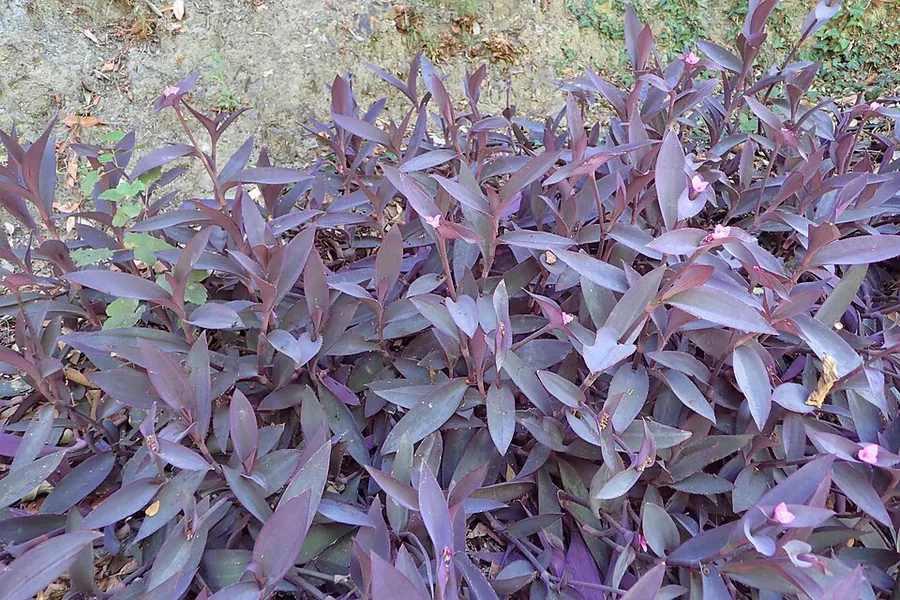
Purple heart earns its place in a room through color alone. Its low, trailing stems settle into a saturated violet-purple, softened by small pink flowers across the warmer months, a shade that reads as both moody and modern against pale walls or terracotta. The plant traces to Mexico and joins the spiderworts, close company to the inch plants.
Part of its appeal is how easily it fits a busy life. Growth is quick, its tolerance for a missed watering generous, and a broken stem roots without ceremony, which makes it forgiving of an erratic routine. Light is the one thing it insists on: a sunny position keeps the violet luxe and deep, while a dim setting turns the tone green and the stems loose and searching.
Indoors it belongs in the brightest window of the home, where its stems spill over a pot rim and lend a shelf or sill an effortless, trailing line. One note for the styling: the sap is a mild skin irritant, so keep gloves nearby for pruning and set it away from pets and inquisitive children.
Care
The short version: the strongest light in the room for the richest color, well-drained soil left to dry between waterings, a setting kept above 50°F (10°C), and an occasional pinch to hold its shape.
Light
Give it the brightest position in the room, ideally full sun, and the violet stays deep and true; in a shaded corner the color drifts to green and the stems grow loose. A south-facing sill is the natural home for it indoors, where the light does the work of keeping it striking.
Water
Once established it is remarkably drought-tolerant, content to be forgotten between waterings, which suits a plant meant to look after itself on a sunny ledge. Let the surface dry before the next drink; it prefers dry to damp. Constant wet at the roots is the one thing that undoes it, bringing on rot.
Soil
Any free-draining mix will serve, though a rich, organic blend flatters it most; clay, loam, or sand are all within its range, as is a broad sweep of pH. The single condition it will not abide is a soil that holds water and stays sodden.
Temperature
Hold it above 50°F (10°C); it has no appetite for cold, and a cold snap turns the top growth black. Ordinary room warmth carries it through the year, and in a climate that dips below that mark it belongs indoors, or at least under cover before the season turns.
Humidity
Everyday room humidity suits it, so it asks for no special attention here. Dry indoor air poses no problem, one less thing to manage in a busy home.
Feeding
Through the active growth of spring and summer, a monthly feed with a balanced general-purpose fertilizer keeps it looking its best. As the light fades and growth slows, let the feeding lapse.
Pruning
An occasional pinch keeps it shapely and full and prompts fresh growth, and the spent flower stems are best clipped away once they fade. The pieces you remove root with ease, ready to start another pot for a different room.
Repotting
Move it to a larger pot every 1 to 2 years, or as soon as it feels crowded. Roots at the drainage holes, thin new growth, or soil that dries the moment it is watered all signal a plant that wants more space, and a fresh container is a chance to restyle its place on the shelf.
Size & spacing
It keeps a compact, low profile, roughly 8 to 12 inches (20 to 30 cm) high and spreading 12 to 18 inches (30 to 45 cm) across. That trailing spread is made for a hanging planter or the edge of a grouped arrangement, where it softens the line of a shelf.
Troubleshooting
Purple heart asks little and falters rarely, and when it does the cause is nearly always light or water. The signs below read clearly once you know them, and the remedy tends to be a small, well-timed adjustment.
Soft, dark stems collapsing at the base
Stems that go soft, dark, and mushy at the base signal root and stem rot, the result of soil kept too wet and the one real threat to an otherwise easy plant. The roots turn brown and slack rather than firm and pale, and the soil never quite dries. Withhold water, cut back to sound tissue, and reset a few healthy cuttings in fresh, free-draining mix.
Fix:
- Stop watering and allow soil to dry out
- Cut away rotted tissue and re-root healthy firm stem cuttings in fresh well-drained mix
- Discard severely rotted plants and soil
Top growth blackening after a cold spell
A cold night undoes the top of this plant. It withstands no frost and nothing below 50°F (10°C), meeting a chill with limp, blackened growth. Clip away the damage and return it to warmth. Where frost is likely, bring the container indoors for the season, or keep a few rooted cuttings as insurance.
Fix:
- Remove damaged top growth
- Bring containers indoors or take cuttings to overwinter where frost occurs
- Where roots survive in mild climates, allow the plant to resprout from the base
Stippled or sticky foliage, or a trace of webbing
A tired, stippled look with sticky residue or fine webbing usually means sap-feeders have found the plant: spider mites, mealybugs, aphids, or scale, each with a signature. Watch for webbing, cottony flecks, small clustered insects, or hard bumps on stems and the undersides of leaves. Rinse and wipe it down, treat with insecticidal soap or horticultural oil, and set it apart from other plants until it recovers.
Fix:
- Rinse plant and wipe off pests
- Treat with insecticidal soap or horticultural oil, repeating as needed
- Isolate affected plants to prevent spread
Foliage turning green as stems stretch and thin
When the violet gives way to green and the plant loses its trim silhouette, it is short of light. The color depends on strong sun, and without it the stems lengthen and the leaves drift apart, and the whole look turns leggy. Reposition it to the sunniest window, or move it into direct sun, and a light pinch restores both the depth of color and the fullness.
Fix:
- Move to a spot with full sun or as much bright direct light as possible
- Pinch back leggy stems to encourage compact, well-colored regrowth
Bare, reaching stems with foliage only at the tips
By nature this is a trailing, sprawling plant, so without regular attention the stems run long and bare, the leaves gathered only at the ends, and low light exaggerates the effect. A routine pinch brings back branching and body. Better still, the trimmings root readily and can be tucked back in to refill the display.
Fix:
- Pinch or cut stems back to encourage branching and bushier growth
- Root the removed tips as cuttings to fill in the plant or start new ones
Skin reddening after handling cut stems
Cut or crush a stem and the sap can irritate skin, a mild contact dermatitis that shows as redness and a little itch. It clears quickly with a wash of soap and water. The graceful habit is to keep gloves on whenever you prune or cut, and the issue never arises.
Fix:
- Wash the affected skin with soap and water
- Avoid further bare-handed contact with cut stems
Toxicity
This is a plant to enjoy with a little discretion. Its sap counts as a mild irritant that can redden and itch the skin, and a pet inclined to chew may drool and turn briefly queasy. Reach for gloves when cutting stems, and give it a spot beyond the curiosity of animals and children.
Toxic to
Cats · Dogs · Horses · Rabbits · Livestock · Birds · People
Cats Mild
Should a cat nibble the foliage, expect some drooling and a stomach that is a little off, while sap on the skin can leave it red and itchy. The upset stays minor, though a habitual nibbler is best kept at a polite distance.
Dogs Mild
Dogs meet the plant much as cats do: a little drool and a brief stomach upset after a nibble, with some skin irritation where the sap makes contact.
Horses Caution
That irritant sap can leave a horse sore around the mouth and skin, so a horse is better kept from browsing on it than allowed to.
Rabbits Caution
For rabbits no dependable feeding record exists, and the sap's irritant nature alone keeps the plant off their menu. It should not be offered as forage.
Livestock Caution
Grazing stock run the same risk of a sore mouth and stomach once they take in the sap, so a fence around the plant is wise wherever animals might reach it.
Birds Caution
Small and easily affected, pet birds are poorly matched with an irritant-sapped plant. Position it away from the cage and its perches.
People Caution
For anyone handling it, broken stems can bring on contact dermatitis, the skin reddening and itching where the sap settles. Slip on gloves for pruning and cutting, and keep the leaves out of the hands and mouths of small children.
Cell sap is a skin irritant (contact dermatitis); wear gloves when pruning, pinching, or taking cuttings
Helpline numbers

United States
ASPCA Animal Poison Control: (888) 426-4435 (fee applies)
Poison Control: (800) 222-1222



Canada
Poison Centres: 1-844-764-7669
Varieties
Purple heart reaches the market almost solely as one named form, the selection that carries its color at full strength.
'Purpurea'
Nearly every purple heart offered for sale is this form, its stems and leaves a deeper, steadier violet-purple than the ordinary species.
How to propagate
Purple heart multiplies with almost no effort, taking root from nearly any stem lifted from the plant.
Stem cuttingsEasy
Any time during active growth · Roots in 1-2 weeks
Few plants reward a little propagation so willingly. The stems root from every node, so a shoot tip or a stem length settled in soil or a glass of water takes hold within a week or two, ready to fill a second pot for another corner of the home. Take cuttings whenever the plant is in active growth.
Myths
Purple heart craves constant watering and will not last through a dry spell.
The reverse is true. An established plant takes dryness in stride, and it is excess water that threatens it, since sodden roots decay and the stems buckle. Allow the soil to dry between waterings and it stays at its best.
The purple holds the same in any spot you choose.
Placement decides the color. A sunny position yields the richest violet, while shade lets the tone slip to green and draws the stems out as they seek the light.