Houseplant · Asparagaceae
Spider Plant
Chlorophytum comosum
Set it in bright indirect light and water when the soil dries, and the spider plant flourishes fast while staying safe near your pets.
Bright indirect
Every 7–10 days
55–75°F · 13–24°C
USDA 9–11
Overview
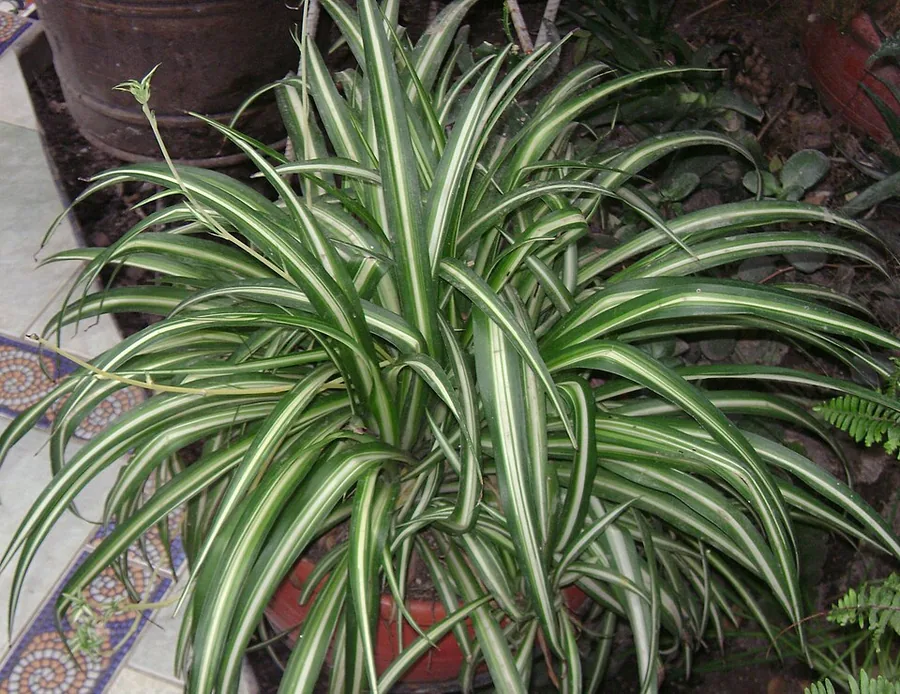
Hardly any houseplant lives so agreeably alongside you. Its roots reach back to the woodlands of southern Africa, where dappled shade is home, and that lineage explains its ease in a low-lit corner. Long, ribbon-like blades arch and tumble past the rim of the pot, which is why it looks so at home on a shelf or in a hanging basket.
Its signature, though, is the offspring. Once mature, it throws out slender, wiry stems hung with tiny plantlets, the so-called spiderettes, swaying on their threads like small spiders aloft. Each takes root almost at once, so one plant quietly becomes a shelf full of giveaways to share around.
For many households the deciding charm is its safety. Being non-toxic to cats and dogs, it leaves a pet that paws at the trailing leaves entirely unharmed. Give it indirect light and a drink as the soil dries, and it grows quickly while forgiving nearly every beginner stumble.
Care
The short version: bright indirect light away from direct sun, a drink every 7 to 10 days once the top half of the soil has dried, a well-draining potting mix underfoot, and a room held between 55°F and 75°F (13°C to 24°C).
Light
Settle the spider plant in bright indirect light, well clear of direct sun that bleaches and scorches the blades. It manages in medium light, in shade, even in a dim corner, though the leaf color reads richest where the light is bright and filtered. A window dressed with a sheer curtain makes an ideal home.
Water
Wait until the top half of the soil has dried before watering, which tends to land around every 7 to 10 days. Ease back through winter, when growth idles and the soil holds its moisture longer. Water stored in the fleshy roots means a forgotten watering troubles it far less than a waterlogged pot.
Soil
Pot it in a well-draining general-purpose potting mix that lets water pass through rather than gather at the roots. Acidity hardly concerns it, and it grows contentedly anywhere across a pH of 6.0 to 8.0. Drainage is the one quality that matters, since standing moisture invites root rot.
Temperature
Everyday room warmth agrees with it, with the happiest range falling between 55°F and 75°F (13°C to 24°C). Spare it cold drafts and any chilly nook that nears freezing, for at heart this is a tender plant. A steady indoor climate is the whole of its request.
Humidity
Typical indoor humidity serves it well, so there is no figure to track down. Dry winter air tends to crisp the leaf tips, and that same dryness is when spider mites are likeliest to move in. Misting the leaves at the tap or setting a water-filled tray nearby helps when your air runs especially dry.
Feeding
Reserve feeding for the spring and summer growing months, and set it aside through autumn and winter. An occasional half-strength balanced houseplant fertilizer is all it wants. Restraint pays here, since overfeeding browns the leaf tips and reduces the very plantlets you are after.
Pruning
A spider plant asks for little pruning beyond a light tidy. Trim browned leaf tips on the diagonal to preserve the natural taper, and clip spent flower stems once they have faded. Plantlets can come off too, whether to pot up or simply to keep the look trim.
Repotting
Expect to repot every 1 to 2 years, or sooner once the plant grows rootbound. The cues are clear: roots crowding or splitting the pot, the fleshy tubers heaving the soil upward, or the plant drying out quickly and slowing its plantlets. Step it up a single pot size and renew the mix.
Size & spacing
Mature, a spider plant reaches about 12 to 24 inches (30 to 60 cm) high and broadens across 12 to 35 inches (30 to 90 cm) as the leaves arc outward and the babies trail below. Allow it space to cascade, since a shelf edge or hanging basket frames it beautifully. Quick to grow, it fills a pot within one season.
Troubleshooting
The leaves usually speak first when a spider plant is unhappy, and browning tips top the conversation. Once you can read these opening signals, a minor concern is easy to settle before it grows. Find your symptom below, then step in while your effort still counts.
Yellowing foliage over soft, rotting roots
When yellow leaves crown a pot of waterlogged soil, the trouble is root rot from overwatering, and it escalates quickly. Lift the plant from its pot, cut off every soft brown root, and settle it into fresh, quick-draining mix. From there, water more sparingly and confirm the pot can shed excess.
Fix:
- Unpot and trim rotten roots
- Repot in fresh well-draining mix
- Reduce watering
Faded, sun-bleached blotches across the foliage
Leaves that look washed out and scorched have taken too much direct sun. This plant prefers bright indirect light and will burn on a baking sill. Set it a step back from the pane, or hang a sheer curtain, so harsh midday rays never reach the foliage.
Fix:
- Move to bright indirect light
- Shield from midday sun
Hard brown lumps clinging to foliage and stems
Those immovable brown lumps are scale insects, and the tacky sheen beside them is the honeydew they secrete. Rub them away with a soft cloth, then go over the plant with horticultural oil or insecticidal soap. Always look over a new arrival before it stands beside the rest.
Fix:
- Wipe off scales
- Apply horticultural oil or insecticidal soap
Cottony white tufts in the leaf crooks
Those soft white puffs settled where leaves meet are mealybugs, sap feeders that leave their own sticky trace. Touch each puff with a cotton swab dipped in rubbing alcohol, then finish with insecticidal soap. Hold any newcomer aside until you are sure it carries nothing.
Fix:
- Dab with rubbing alcohol
- Apply insecticidal soap
Faint webbing and a speckled, dusty surface
Delicate webbing paired with a finely speckled leaf surface points to spider mites, which thrive when indoor air turns dry. Wash the foliage at the tap, apply insecticidal soap or a miticide, and lift the moisture in the air around the plant. Mites have little appetite for a humid spot.
Fix:
- Rinse foliage
- Apply insecticidal soap or miticide
- Raise humidity
Dry brown points along the leaf ends
Almost every spider plant develops these eventually, and a healthy plant is no exception. Blame fluoride, chlorine, and salt building up from tap water, with parched air or a heavy hand at feeding time adding to it. Pour distilled or rainwater instead, rinse the pot through occasionally, and trim each crisp end on a slant.
Fix:
- Water with distilled or rainwater
- Flush pot to leach salts
- Trim browned tips
- Ease off fertilizer
Tiny insects massing on the tender new shoots
Soft little bugs clustered on fresh shoots, trailing a sticky film, are aphids. One firm rinse at the tap dislodges most of the colony at once. Reach for insecticidal soap should they return, and keep watching the new growth they favor most.
Fix:
- Rinse off with water
- Apply insecticidal soap
A thriving plant that withholds its offsets
A vigorous plant that sends out no babies is usually just too young or too snug in its pot. Spider plants reward a little maturity and a slightly potbound root ball with offsets. Lighten the feeding, wait for the plant to settle, and offer short days with long, unbroken nights for roughly 3 weeks to coax them out.
Fix:
- Let plant mature and become slightly potbound
- Reduce fertilizer
- Give short days and long uninterrupted nights ~3 weeks
Toxicity
Here is a plant you can simply enjoy without a second thought. Counted non-toxic to cats, dogs, and people, it needs no high shelf or hidden corner. A pet that gnaws a leaf comes away unharmed, and that ease is much of its appeal in a busy home.
Safe for
People · Cats · Dogs · Horses · Rabbits · Livestock · Birds
Cats Safe
A cat can swat and nibble the swaying leaves and be perfectly fine. Overdo the snacking and you might see mild stomach upset, and nothing worse.
Dogs Safe
A dog can mouth the foliage without consequence. Among leafy houseplants, few are gentler company for an inquisitive pup.
Horses Safe
Harmless to horses. An inquisitive muzzle may sample a leaf and come away just fine.
Rabbits Safe
Rabbits can graze it without worry, keeping in mind that leafy greens belong to only a small share of their feeding.
Livestock Safe
Harmless to grazing animals, presenting no poisoning hazard to cattle, goats, or sheep.
Birds Safe
Gentle around pet birds and poultry alike. A pecked leaf does them no harm.
People Safe
Harmless and reassuring near small children, a quality that earns it a place in homes with wandering toddlers.
Varieties
A short roster of named cultivars distinguishes the spider plant, each one telling itself apart by the striping or curl of its leaves. The selections below are the ones you will most often meet by name.
'Vittatum'
The familiar classic, marked by a pale cream ribbon tracing the center of every green blade.
'Variegatum'
Here the coloring reverses, with crisp white edges framing green blades rather than a stripe down the middle.
'Bonnie'
A small-scale selection whose variegated foliage twists into loose curls instead of arching in a clean sweep.
'Milky Way'
Defined by a wide cream-to-white heart, it leaves only a slim green rim along the leaf margins.
'Mandaianum'
A petite, dark green variety brushed with yellow stripes, sized neatly for a narrow ledge or a shelf.
How to propagate
Few plants multiply with less effort than the spider plant, and those dangling babies handle most of the labor themselves. Root the plantlets, divide an overgrown clump, or sow seed if patience is on your side.
Offsets & pupsEasy
Anytime plantlets present · 2-4 weeks
Here lies the rewarding part, and the simplest route to new plants. Press a plantlet, the little spiderette, against a pot of damp soil while it still hangs from the parent, or rest it in water until roots appear and then pot it. Roots form in roughly 2 to 4 weeks either way, at which point you cut it loose to stand on its own.
DivisionEasy
At repotting or spring · Few weeks
Once a generous clump has outgrown its container, dividing it is the answer. During repotting or in spring, ease the plant out and tease the fleshy, tuberous mass apart into sections that each keep leaves and roots. Pot those pieces separately and they find their footing in a few weeks.
SeedModerate
Spring · Several weeks
Raising plants from seed is the patient, less traveled path. Sow in spring and allow the seedlings several weeks to establish. Bear in mind that seedlings may stray from the parent, so a variegated mother can yield plainly green offspring.
Myths
Spider plants clean indoor air enough to matter.
That reputation traces back to a study run inside a sealed chamber rather than an actual living space. Reviewed research shows a single potted plant draws only a sliver of what an open window does. Crack a window when you want fresher air, and grow the plant for the pleasure of it.
Brown leaf tips mean the plant is dying.
The browning catches the eye, yet the plant beneath it is generally healthy. Trace it to fluoride, chlorine, and salts in tap water, or to parched air, rather than any real decline. Make the change to distilled or rainwater and the fresh leaves arrive unblemished.
Spider plants need bright direct sun.
Direct sun is precisely what this plant resents, and it leaves the foliage bleached. What suits it is bright indirect light, and it copes happily in shade and low light besides. Keep it clear of a scorching sill and the color holds an even, deep green.
Spider plants are toxic to cats and dogs.
This needless fear shuts a wonderful plant out of countless pet households. In fact the ASPCA lists the spider plant as non-toxic to both cats and dogs, which stands as its greatest virtue. A pet that samples a leaf faces no risk whatever.
Heavy feeding makes more plantlet babies.
Lavishing fertilizer brings about the very result you hoped to avoid. Too much feed thins out the plantlets and scorches the leaf tips brown. What truly draws the babies forward is light, balanced feeding through spring and summer paired with a snug, potbound root ball.
Tap water is fine for spider plants.
Ordinary tap water is the common culprit behind those crisp, browning tips. Its fluoride and chlorine accumulate and burn the leaf ends as the weeks pass. Reach for distilled or rainwater in its place, and rinse the pot through from time to time to carry the salts away.
Sources
- ASPCA
- NC State Extension Gardener Plant Toolbox
- University of Wisconsin-Madison Horticulture Extension
- Clemson Cooperative Extension HGIC
- Missouri Botanical Garden Plant Finder
- South Dakota State University Extension
- Royal Horticultural Society
- Journal of Exposure Science & Environmental Epidemiology (Cummings & Waring 2020)
- Drexel University