Houseplant · Cactaceae
Star Cactus
Astrophytum asterias
A quiet, sculptural little cactus for a sunny shelf or minimalist desk, asking only for gritty soil and a long dry spell between waterings.
Bright indirect
Every 14–21 days
USDA 9–11
1–2 in · 3–6 cm
Overview
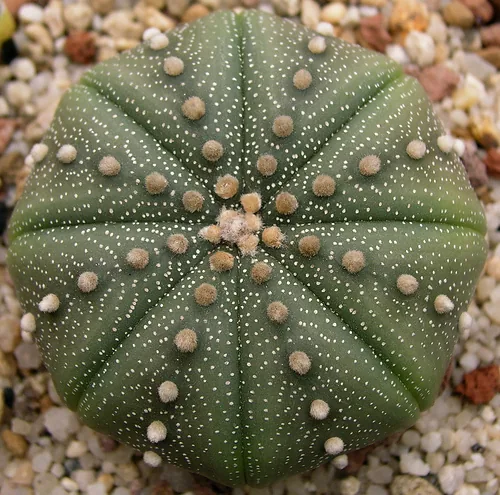
The star cactus brings a quiet, sculptural presence to a room, a small spineless dome that settles into its pot like a sand dollar. Native to just a narrow band of south Texas and northern Mexico, where it sits low against the rocks, it grows at such an unhurried pace that a coin-sized plant may already be years old. A scatter of pale woolly flecks gives it the soft, starry look behind its name, the kind of understated detail that suits a considered space.
For all that it belongs to the cactus family, it keeps no spines at all, which makes it as easy to live with as it is to move from shelf to sill. That same smooth surface has long invited confusion with peyote, a resemblance that has driven heavy illegal collection in the wild. Each late spring it offers a brief flourish of yellow flowers with red throats, opening right at the crown.
This is a plant of restraint, one that rewards a light touch more than fuss. It stands among the most protected cacti anywhere, endangered in the wild and closely governed in trade, so a specimen for the home should always come from a nursery. Settle the soil and the watering into your routine and it will ask for very little else.
Care
The short version: set it in bright light with a sharply draining, gritty mix, water deeply only once the soil has dried through, and let it rest almost untouched across winter.
Light
Give it bright light to keep its form at its best. Bright, indirect light suits it, and it will accept a measure of direct sun, though any move into strong light should be gradual, since a plant used to shade can scorch when set straight in a hot window.
Water
Restraint is everything here. Water deeply only after the gritty mix has dried through completely, which tends to mean about every 14 to 21 days through the spring and summer growing season. Come winter, keep it nearly dry, since the fleshy body rots quickly if left wet in the cold.
Soil
Root it in a fast-draining mineral mix, the sandy or gravelly sort with little organic matter. A near-neutral pH of 6.5 to 7.5 suits it, and the grit is what carries water past the roots before it can turn to rot.
Temperature
It is at ease across a generous range, from about 23°F to 95°F (-5°C to 35°C), though that cool low end holds only for a plant kept bone dry. Warmth encourages its growth, while cold and damp together are what truly harm it.
Humidity
Favor dry air, somewhere near 20% to 40%. A desert native at heart, it finds still, humid rooms an open door to the rot and fungus it cannot fend off.
Feeding
Feed with a light hand, and only while it grows through spring and summer. A dilute, low-nitrogen cactus fertilizer once a month is ample, as excess nitrogen coaxes soft growth that splits and rots.
Pruning
There is nothing here to shape. A sterile blade is called for only to lift away spent flowers or any rotted tissue, never to trim its form.
Repotting
Repot every 2 to 3 years, or sooner should roots reach the drainage holes or the body crowd the pot. Move it into fresh gritty mix and hold off water for a few days, giving disturbed roots time to settle.
Size & spacing
It stays gracefully small. Height tops out at just 1 to 2 inches (3 to 6 cm), with a spread of about 2 to 6 inches (5 to 15 cm), and its slow pace lets it hold a modest pot beautifully for years.
Troubleshooting
For all its poise on a shelf, nearly every issue a star cactus meets comes back to water, and it writes the story on its own body. Learn to read soft flesh, a shrunken form, or a dusting of cottony pests, and you can step in before a small lapse becomes final. Find the match below and act without delay.
Soft, dark, mushy patches on the body or near the base
This is rot, and in a star cactus it almost always follows too much water or a mix that clings to it. It tends to take hold at the soil line, where damp lingers against the fleshy body. Stop watering at once, pare back to firm green tissue with a sterile blade, let the wound callus in dry, airy shade, then resettle the plant in fresh gritty mineral mix.
Fix:
- Stop watering immediately
- Cut away all rotted tissue with a sterile blade until only firm green tissue remains
- Let the cut surfaces callus in dry, airy shade
- Repot into fresh fast-draining mineral mix and water only sparingly once healed
A wrinkled, shrunken, or sagging body
A shriveled body tells one of two stories. If the soil is bone dry and the roots stay sound, the plant is simply thirsty, and a thorough soak revives it. If the soil is still moist, suspect roots lost to rot, and treat it as such, cutting back to healthy tissue and re-rooting in dry mineral mix.
Fix:
- If dehydrated, give a thorough soak and resume regular dry-down watering
- If roots are rotted, treat as rot: cut back to healthy tissue, callus, and re-root in dry mineral mix
White cottony tufts in the areoles with weak, off-colour growth
Those cottony patches are mealybugs, sheltered in the woolly areoles where they slip past a casual glance. Probe one to be sure: the pest smears, while the plant's own white wool and flecks hold firm. Set the cactus apart, touch each insect with a swab of 70 percent isopropyl alcohol, then return weekly and check the roots, since root mealybugs keep to the soil below as well.
Fix:
- Isolate the plant
- Dab visible insects with a cotton swab dipped in 70 percent isopropyl alcohol
- Repeat weekly and inspect the roots, drenching with an appropriate insecticide if root mealybugs are present
Toxicity
There is reassurance in its company: the star cactus is safe around pets and people. It holds no toxin, and for all the peyote nickname suggests, there is no mescaline in it. Spineless, it will not even catch a curious nose, though it was never meant for the table.
Safe for
People · Cats · Dogs · Horses · Rabbits · Livestock · Birds
Cats None
An easy companion to share a room with. A cat that nibbles the body may drool or bring a little back, though only because plant matter can unsettle a stomach, never from a toxin.
Dogs None
No poisoning to fear. A dog that chews a piece might feel a passing stomach upset from the fibrous tissue, and with no spines, the cactus leaves the mouth unscathed.
Horses Safe
Nothing within this cactus can poison a horse, so its presence gives no cause for concern.
Rabbits Safe
Harmless to rabbits. It carries no toxin, yet it is no food plant and has no place in their diet.
Livestock Safe
Cattle, goats, and sheep may graze beside it untroubled, for the plant holds nothing harmful.
Birds Safe
No toxic risk to birds. A pet bird that pecks the flesh meets no chemical harm.
People Safe
Safe to handle and to keep near children. It holds no mescaline for all the peyote confusion, though it is not grown to eat and invites no tasting.
Though spineless, handle this rare protected plant minimally and wash hands after contact with any houseplant; keep out of reach of pets or children inclined to chew it.
Varieties
A few named forms circulate among collectors, most chosen for the way their flecks and wool pattern the body. These are the ones worth seeking out.
'Super Kabuto'
A chosen cultivar so richly dusted with large white woolly flecks that they can all but veil the green body beneath.
var. nudum
A naturally fleckless form with a smooth, unadorned green body, recognized by Kew as a variety of its own.
'Ooibo Kabuto'
Prized for the unusually large, raised wool spots that rest upon its areoles.
How to propagate
There are two considered ways to raise more, and neither is hurried. One keeps the plant true from seed, the other quickens the pace by grafting onto a sturdier root.
SeedDemanding
Spring, in warmth · Several months to germinate and establish; years to reach flowering size
Seed is the main course and the one that best preserves the plant's genetic range. Sow fresh seed in spring across a sterile gritty mix and keep it warm and humid until it stirs. The seedlings come on slowly and rot without care, so harden them off by degrees and let time do its work, since establishment runs to several months and flowering size to years.
GraftingModerate
Spring-summer, during active growth · A few weeks for the graft union to take
Grafting onto a vigorous rootstock is the shortcut of choice, quickening growth and sidestepping the rot that ends so many seedlings, especially for coveted cultivars. Undertaken in spring or summer while growth is active, the union comes together in a few weeks.
Myths
Star cactus is peyote and carries mescaline.
It is taken for peyote so routinely that star peyote lingers as one of its names, yet the two are separate plants and this one holds no mescaline at all. That very confusion keeps feeding illegal collection of a species already endangered.
With no spines, it is hardy enough to water like a leafy houseplant.
A smooth body reveals nothing about its thirst. Frequent watering rots the fleshy tissue quickly, and it wants the same dry-down and gritty soil as any desert cactus.
Wild star cactus is yours to dig up or buy.
It is federally endangered and listed on CITES Appendix I, so lifting plants from the wild or trading wild-sourced ones is unlawful. Only plants raised in a nursery may be legally kept.