Ornamental · Caryophyllaceae
Sweet William
Dianthus barbatus
Give it a sunny border and sharp drainage, let it reseed, and Sweet William brings clove-scented, cottage-garden charm to the whole planting.
Full sun
Every 3–7 days
USDA 3–9
12–24 in · 30–60 cm
Overview
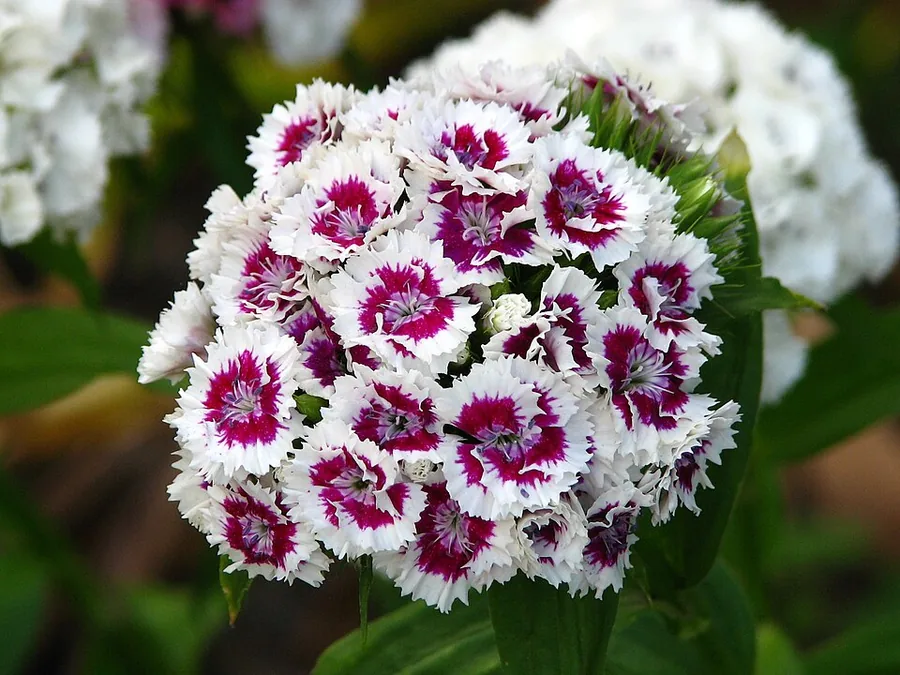
Few flowers say cottage garden quite like Sweet William. A long-loved classic, it gathers its small blooms into dense, flat-topped clusters in white, pink, red, and bicolors, many finished with a contrasting eye that lends a planting its old-fashioned character. A relative of carnations and garden pinks within the pink family, it traces its wild roots to the mountains of southern Europe. Best of all for a relaxed border, the flowers carry a soft clove scent that keeps bees and butterflies drifting through.
Its rhythm suits a garden that changes with the seasons. As a biennial or short-lived perennial, Sweet William settles in as a leafy rosette one year and saves its display for the next spring and early summer, then quietly sets seed. Left to sow where it pleases, it renews a planting on its own, so a border keeps its cottage fullness year after year with very little intervention.
For all its charm, it asks remarkably little of a gardener. A place in full sun with soil that drains freely and air moving easily around the planting is nearly the whole story. The one caveat worth honoring is drainage, since damp, heavy ground invites the crown rot and fungal troubles that undo an otherwise effortless flower. Get the setting right and it becomes one of the easiest players in a relaxed scheme.
Care
The short version: site Sweet William in full sun, with a little afternoon shade in the heat, in rich free-draining soil kept evenly moist and dry at the leaf; deadhead for a longer show, yet leave a few blooms to self-sow so the planting returns next year.
Light
Sweet William gives its fullest display in full sun, accepting a little afternoon shade where summers turn hot. Set it in too much shade and the flowering fades while the stems lengthen and lean, so the brightest corner of a border serves it best.
Water
Keep the soil evenly moist in a freely draining spot, avoiding the swing between parched and waterlogged. Watering at the base with a soaker or drip line keeps the foliage dry and the planting looking its best. When overhead watering is the only option, choose the morning so the leaves dry before nightfall and fungal disease finds no opening.
Soil
Give it deep, rich, free-draining ground, either loam or sandy loam, worked with compost before planting. It settles happily across a pH of 6.0 to 8.0, taking the neutral to slightly alkaline soils that many border flowers refuse in stride.
Humidity
Ordinary garden air suits it, and there is no reading to chase. What matters to the look of a planting is airflow, since leaves left damp and crowded give rust and crown rot the opening they need to spoil the display.
Feeding
Feeding is a light touch. Work a balanced general-purpose fertilizer into the top 4 to 6 inches of soil as the bed is prepared, and that early groundwork carries the planting gracefully through the season.
Pruning
Deadheading the spent flowers keeps a planting fresh and coaxes more perennial behavior. With biennial types there is a trade to weigh: remove every bloom and the self-seeding that refreshes the border next year stops with it, so leave a few flowers to set seed where you want the display to return.
Size & spacing
Plants rise 12 to 24 inches (30 to 60 cm) and spread 6 to 12 inches (15 to 30 cm), a tidy scale for the front and middle of a border. Give each that much room, and air drifts through the planting to keep the foliage dry.
When to plant
Sweet William rewards a gardener who plans ahead. Sow in late winter to early spring, or again in late summer to early fall, and move young plants into their places by late spring. Most hold their color for the following year, opening from late spring into summer wherever the season stays cool, a slow build that makes the display all the more welcome.
Northern hemisphere
Southern hemisphere
Typical months for a temperate climate: start earlier in warm zones, later where spring frosts linger.
- Sow: Late winter to early spring, or sow in late summer/early fall for bloom the following year
- Plant: Direct sow or transplant in late spring; fall-sown seedlings may be set out for next-year bloom
- Harvest: Late spring to early summer, often continuing into summer in cooler climates
Hardiness
USDA hardiness zones: 3–9
Temperature: down to -40°C
Troubleshooting
Nearly every setback with Sweet William traces to the same pair of conditions: ground that stays too wet and air that hangs still. Watch the leaves and the crown, and a passing glance is usually enough to catch trouble while it can still be turned around. Match what you notice below, then step in early.
Collapse and rot right at the soil line
A plant that folds and rots at the base is showing crown rot, which sets in when the crown lingers in soggy, poorly drained ground. An affected plant cannot be saved, so lift it and dispose of it. Restore the setting by opening up the drainage, leaving each plant room for moving air, and directing water to the base rather than over the top.
Fix:
- Remove and discard affected plants
- Improve soil drainage
- Avoid overwatering and overhead watering
One side yellows and wilts as stems give way
Yellowing and wilting confined to one side reveals fusarium wilt, a soil fungus that seals off the stem from within, and it cannot be cured. The honest course is to lift the plant, destroy it, and set no more Dianthus in that ground. Begin again with clean, free-draining soil and seed or cuttings known to be healthy.
Fix:
- Remove and destroy infected plants
- Avoid replanting Dianthus in the same soil
- Use pathogen-free planting material
Rusty pustules freckling the foliage
Those raised, rust-red spots are rust, a fungus that takes to damp leaves in still air. Remove the marked foliage and burn or bin it, then open the spacing so a breeze can pass through the planting. Keep water off the leaves, and turn to a protective fungicide only if the marks continue to spread.
Fix:
- Remove and destroy infected foliage
- Improve air circulation
- Apply a protective fungicide to healthy plants if needed
Ragged holes and silvery trails across the leaves
Torn leaves trailed with silver point to slugs and snails, most active after damp spells. A dusk patrol to pick them off by hand does the quiet work. Clear the leaf litter and boards that shelter them, water in the morning so the surface dries, and set baits or barriers wherever they keep returning.
Fix:
- Hand-pick slugs and snails in the evening
- Remove garden debris that provides shelter
- Use slug baits or barriers as needed
Toxicity
Sweet William earns its place in a relaxed, family garden, though it is not entirely without caution. Like its dianthus and carnation kin, it holds saponins that can unsettle a pet's stomach, and the sap leaves some skin itching. The petals are edible when the plant is grown clean while the leaves are not, so keep curious pets and children clear of the foliage.
Toxic to
Cats · Dogs · Horses · Rabbits · Livestock · Birds · People
Cats Mild
A cat that samples the leaves tends to drool, be sick, or suffer a bout of diarrhea, while brushing past can leave a patch of mild skin irritation.
Dogs Mild
A dog that chews the foliage is apt to develop an upset stomach with vomiting and loose stools, plus mild dermatitis where the sap meets the skin.
Horses Caution
The saponins that trouble cats and dogs can give a grazing horse a mild stomach upset as well, so clumps are best placed beyond its reach.
Rabbits Caution
For rabbits it is best considered off the menu, as the foliage can unsettle a sensitive gut and the risk simply is not worth taking.
Livestock Caution
Grazing livestock rarely seek it out, yet a mouthful of the leaves may bring on mild digestive upset from the plant's saponins.
Birds Caution
Little suggests birds feed on it, though the irritant compounds make it wise to keep an inquisitive pet bird away from the foliage.
People Caution
The petals are edible when grown clean, while the leaves can cause a mild stomach upset if eaten and the sap leaves some people with itchy, irritated skin, so gloves are worth wearing when handling it.
Wear gloves when handling, as contact with the plant can cause mild skin irritation in sensitive individuals.
Helpline numbers

United States
ASPCA Animal Poison Control: (888) 426-4435 (fee applies)
Poison Control: (800) 222-1222



Canada
Poison Centres: 1-844-764-7669
Varieties
Sweet William offers a wardrobe of named selections to suit the mood of a planting, from neat dwarfs for the border's edge to brooding dark-flowered forms for drama. A few are worth seeking out by name.
Pinocchio
A compact dwarf that tucks neatly into the front of a bed or a container display.
Sooty
Chosen for its near-black flowers of deep maroon, set against darkly dramatic foliage.
Nigrescens
A dark-leaved form that pairs rich crimson blooms with bronze-purple foliage.
How to propagate
Adding more Sweet William to a garden is an easy pleasure, whether you let it scatter its own seed or lift and divide a clump that has settled in.
SeedEasy
Direct sow in late spring for bloom the following year, or sow in late summer/early fall; some cultivars bloom the first year if started early. · Germination in about 1 to 2 weeks; plants typically bloom the season after sowing for biennial types
Seed is the natural and easiest way to build a planting. Sow directly in late spring for bloom the following year, or in late summer and early fall for the same reward, though a handful of cultivars will flower in their first year when started early. Seedlings appear in 1 to 2 weeks, and since most are biennial they reserve their color for the season after sowing. Allowed to drop seed each year, a planting quietly renews itself and keeps the presence of a long-lived perennial.
DivisionEasy
Divide established clumps in spring or early fall · Several weeks to re-establish roots
For the short-lived perennial forms, lifting and dividing a settled clump keeps a planting vigorous. Divide in spring or early fall, replant the pieces without delay, and allow them several weeks to root before they resume their stride.
Myths
Sweet William is a dependable perennial that returns faithfully every year.
In truth it lives as a biennial or short-lived perennial, holding its place mainly by scattering seed. Deadhead every last bloom and the reseeding that refreshes the planting stops with it, so leave a few flowers to set seed if you want the show to return.
Sweet William flowers are decorative and nothing more.
The petals are in fact edible when the plant is grown clean, and cooks sometimes candy them in sugar to finish a cake. The leaves are another matter and can cause a mild stomach upset if eaten.