Ornamental · Liliaceae
Toad Lily
Tricyrtis hirta
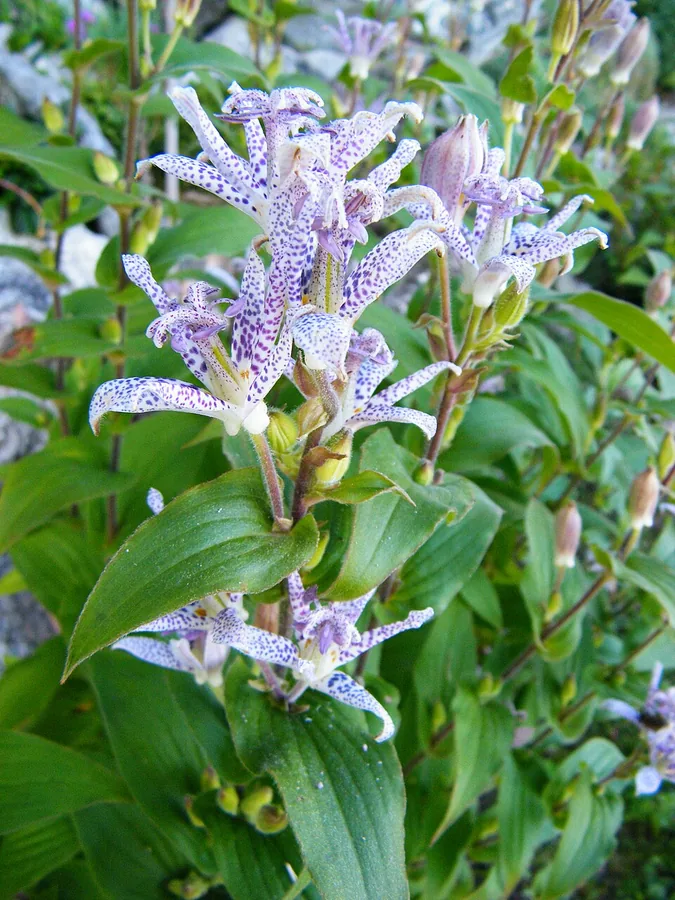
In a shaded, restful corner, the toad lily waits until the season quiets to unveil its orchid-like, purple-freckled flowers.
Partial shade
Every 3–7 days
USDA 4–8
2–3 ft · 0.6–0.9 m
Overview
The toad lily is the quiet finale of a shaded garden, holding back its orchid-like flowers speckled in purple until the season has all but closed. Native to the woodlands of Japan, it grows as a hardy perennial across USDA zones 4 to 8, arching leafy stems through the dappled light of a border's shadier reaches. It reads as understated from a distance and rewards the visitor who slows down beside it.
This is a plant for the cool, shaded corners a garden often struggles to fill, the far side of a path or the foot of a north wall. It asks for rich, humusy soil kept evenly damp and dislikes drying out, so it belongs where the ground stays moist and the mood stays restful. Growth is slow and clumping, which suits a considered planting, and once established it returns to that same spot each spring.
Placed well, the toad lily earns its keep with almost no fuss and holds a corner together through the fading weeks of the year. Kept cool, shaded, and watered, it asks only for the odd division and a watchful eye for slugs. Set it in a bright, dry spot, though, and the composure gives way to spotted leaves and an early dieback long before the flowers arrive.
Care
The short version: a shaded, moisture-holding corner sheltered from hot afternoon sun, and rich soil kept evenly moist. Feed once in spring, clear the spent stems at season's end, and divide the clump every few years to keep the planting looking composed.
Light
Give it part to full shade, the softly lit corners where a garden feels calm and the soil stays cool underfoot. A little morning sun flatters it, but hot afternoon light scorches the foliage and cuts the season short, so keep it on the shadier, more sheltered side of the border.
Water
Keep the soil consistently moist and never let it dry out, since a thirsty toad lily loses its poise to leaf spotting and early dormancy. Water every 3 to 7 days as the weather asks, delivering it to the base so the foliage stays dry and the planting keeps its clean look.
Soil
Set it in moist, humusy, well-drained soil rich with organic matter, the cool woodland-floor feel that suits a shaded scheme. A slightly acidic to neutral pH of 5.5 to 7.0 is ideal, and a yearly top-dressing of compost keeps the ground generous and the planting handsome.
Temperature
It settles into a garden for the long term, taking winter lows to -29°F (-34°C) and summer warmth to about 86°F (30°C) in its stride. The roots ride out hard frost in place, so the corner needs no lifting or wrapping to see the plant through winter.
Humidity
Ordinary outdoor air suits it, so there is no figure to manage. What shapes the look is airflow, since a still, damp pocket around crowded leaves invites anthracnose and dulls the planting, while an open corner keeps it fresh.
Feeding
One feed in spring is all the occasion calls for, whether a balanced fertilizer or a simple compost top-dressing as growth begins. This is a slow, undemanding plant, and restraint keeps it looking natural rather than forced.
Pruning
Upkeep is minimal and tidy. Once the foliage and stems brown off at the close of the season, cut them down to the ground to reset the corner for winter, and otherwise leave the plant to its own quiet rhythm.
Repotting
Grown in the border rather than a container, the clumps still benefit from renewal to keep a planting composed. Lift and divide them every few years in early spring when the center crowds, the flowering thins, or the new leaves come up small and the corner starts to look tired.
Size & spacing
Plants reach 2 to 3 feet (58 to 91 cm) tall and spread to about 18 to 23 inches (46 to 58 cm), an easy scale for the middle of a shaded scheme. Give each clump room to arch and let air move between neighbors, which keeps both the health and the line of the planting.
When to plant
The toad lily keeps a graceful, unhurried calendar that suits a slow garden. Settle plants into their place in spring once frost has passed, let them find their footing through summer, and they save the flourish for last, blooming from August into September.
Northern hemisphere
Southern hemisphere
Typical months for a temperate climate: start earlier in warm zones, later where spring frosts linger.
- Sow: Late winter to early spring (seed; may require cold stratification)
- Plant: Spring after frost danger has passed
- Harvest: August to September (late summer to early fall)
Hardiness
USDA hardiness zones: 4–8
Temperature: down to -34°C
Troubleshooting
A toad lily that looks out of sorts is usually telling you its setting is a touch too dry or its corner a little too close and still. Read the mood of the planting, then adjust the conditions before the look slips. The cues below point to the fix.
Streaked, mottled blooms and foliage slipping toward purple
When the flowers streak and the foliage mottles before the whole bloom turns purple, the cause is Tricyrtis floral virus, carried between plants by aphids and beyond any spray. Lift and destroy the affected plant to protect the rest of the planting, keep aphids in check, and wipe your tools between plants so the sap travels no further.
Fix:
- Remove and destroy infected plants to limit spread
- Control aphid vectors
A scatter of small orange marks over stem and leaf
Small orange spots scattered over leaves and stems point to anthracnose, a fungus that settles in when foliage stays wet in a close, still corner. Opening the setting up is the remedy. Strip the spotted leaves, give the planting more air, and water at the base so the foliage dries and the look stays crisp.
Fix:
- Remove and discard symptomatic leaves
- Improve air circulation
- Water at the base to keep foliage dry
Foliage spotting and a clump that retreats into dormancy by midsummer
A toad lily that spots and then fades into early dormancy is under drought stress, usually from a corner that catches too much sun or dries out between waterings. Water deeply on a steady rhythm and mulch to hold the moisture, keeping the planting in good form. If the corner keeps drying, move the plant to a shadier, damper spot.
Fix:
- Water deeply and consistently
- Add organic mulch to retain moisture
- Site in shadier, moister conditions
Leaves nibbled into ragged openings, silvered trails close by
Ragged holes chewed into the fresh growth, trailed by silver, are the mark of slugs and snails, drawn to the same shaded, damp corner the plant favors. Step out with a torch at dusk or first light and lift them off by hand. Clearing the mulch and debris they shelter in restores the setting, and iron-phosphate bait handles any that linger.
Fix:
- Hand-pick slugs and snails in the evening
- Remove garden debris and mulch harboring them
- Use iron-phosphate slug bait if needed
Toxicity
For a home shared with pets or children, the toad lily settles the question gently: it is not toxic. The lily in its name suggests otherwise, yet this is not a true lily and holds none of the kidney danger real lilies pose to cats. It can take its place anywhere the household gathers.
Safe for
People · Cats · Dogs · Horses · Rabbits · Livestock · Birds
Cats None
Safe around cats. For all the lily in its name, this is not a true lily, so it holds none of the kidney danger that Easter and Asiatic lilies carry, and a curious nibble is no cause for concern.
Dogs None
No toxicity is on record for dogs, so a dog that chews a leaf or stem should be fine. A large mouthful of any plant may unsettle a sensitive stomach briefly, as ever.
Horses Safe
Horses can share a property with it comfortably; nothing recorded suggests it does them any harm.
Rabbits Safe
Rabbits browse toad lily without harm and often graze it down, so a discreet wire guard helps if you want the clump to flower and hold its place.
Livestock Safe
No poisoning is reported in cattle, sheep, or goats, and as a small shade perennial it rarely grows where stock graze in any case.
Birds Safe
Birds move around it untroubled; neither the foliage nor the flowers nor the seed holds anything flagged as toxic.
People Safe
Not known to be toxic to people. It is grown for its looks rather than the table, so treat it as ornamental and wash your hands after handling, as with any plant in the garden.
Generally considered safe; no toxicity reported. Wash hands after handling as a routine precaution.
Varieties
A short, well-edited cast of named toad lilies covers most gardens, distinguished mainly by height, habit, and the character of their freckling. These two are the ones worth designing around.
Miyazaki
Miyazaki brings a more compact, refined presence, its shorter arching stems reaching about 2 feet and carrying white to pale lilac flowers heavily freckled in purple.
Hairy toad lily (species form)
The upright species form gives a border more height at 2 to 3 feet, on stems hairy from top to bottom, the very feature behind the hairy toad lily name.
Companions
Toad lilies pair best with the other plants of the moist woodland floor, which share their love of shade and damp, rich soil.
How to propagate
Extending a toad lily planting is refreshingly simple, and dividing an established clump is the elegant, dependable route. Cuttings and seed suit a patient gardener who wants to fill more of the garden over time.
DivisionEasy
Early spring while dormant · One growing season
Division is the most reliable way to extend a planting, and the one to choose for named cultivars since it holds them true to type. Lift the clump in early spring while it is still dormant and part it into rooted pieces to place elsewhere. Each finds its feet over a single growing season.
Stem cuttingsModerate
Late spring to early summer · Several weeks to root
Cuttings offer an easy way to raise a few more, rooting even in a plain glass of water on a windowsill. Take them from late spring into early summer and give them several weeks to root before potting them on for the garden.
SeedModerate
Late winter to spring · Multiple seasons to flowering size
Seed suits raising the species rather than named forms, and in a corner it likes the plant self-sows to fill the ground on its own. Sow from late winter into spring, with the patience to wait several seasons for seedlings to reach flowering size.
Myths
The toad lily is a true lily, so it brings the same deadly kidney risk to cats that Easter and Asiatic lilies do.
The name invites the worry, but the setting is safer than it sounds. The toad lily belongs to the lily family yet to the genus Tricyrtis, not Lilium, so it is not a true lily. No source records it as toxic, and it never appears on the ASPCA toxic plant list. It carries none of the severe kidney danger that true lilies pose to cats.