Houseplant · Araceae
ZZ Plant
Zamioculcas zamiifolia
Lacquered, all but unkillable, and content in a corner everyone forgets, the ZZ plant asks for next to nothing and stays beautiful for years.
Bright indirect
Every 14–30 days
59–84°F · 15–29°C
USDA 9–11
Overview
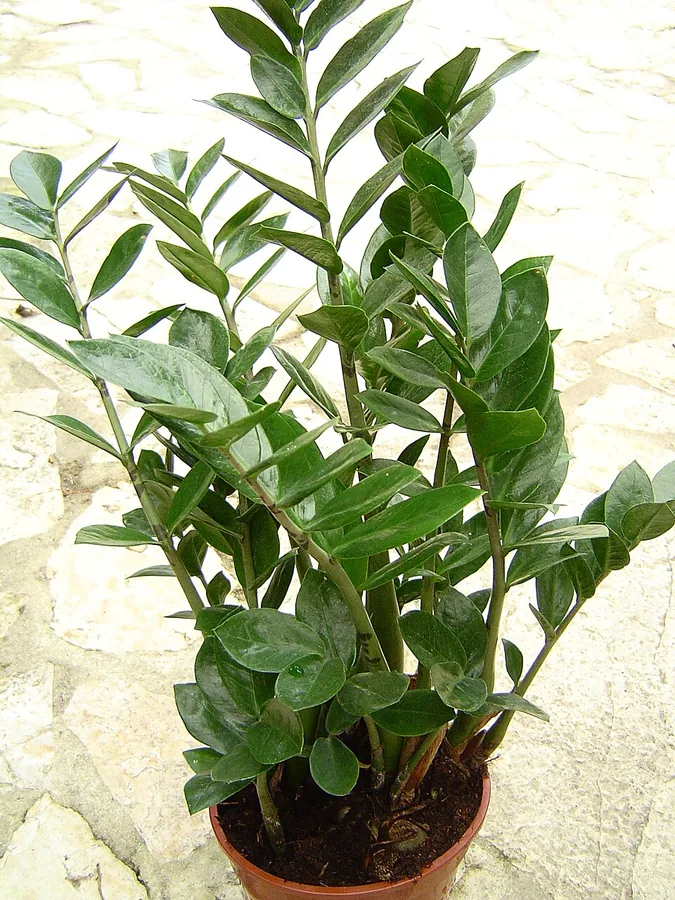
Few houseplants live up to the legend of the unkillable as gracefully as the ZZ. A native of eastern Africa, it banks moisture in stout subterranean rhizomes, the trick that lets it forgive a skipped watering and settle happily in a dim spot well removed from any window. Glossy, dark-green leaflets file in tidy ranks along gracefully arching stems, each one bright enough to look freshly buffed.
Its charm as a houseguest lies in how undemanding it is. Growth comes slowly and surely, the silhouette holds without coaxing, and it seldom overstays its space at a manageable 2 to 4 feet (61 to 122 cm). Weeks of benign neglect leave it none the worse, which is precisely why it has become a fixture of lobbies, desks, and shadowy hallways.
The single caveat is chemical: every part of the plant carries calcium oxalate crystals, making it a poor choice within reach of pets or young children inclined to chew. Place it thoughtfully, somewhere just out of the way, and it repays you with year upon year of calm, polished foliage.
Care
The short version: set it in bright indirect light, water only once the soil has gone fully dry, pot it in a free-draining mix, and keep it warm and clear of direct sun.
Light
This plant looks its best in bright indirect light, yet it weathers low and medium conditions better than nearly any houseplant going. Spare it direct sun, which leaves scorch marks on the foliage. A dim corner is no death sentence, but it buys you slower growth and a looser, leggier form.
Water
Hold off until the medium has dried out completely, which generally lands around once every 2 to 4 weeks. With reserves tucked away in the rhizomes, a forgotten watering troubles it far less than a waterlogged pot ever would. Nothing kills it quicker than too much water.
Soil
Choose a well-drained potting mix built on peat or bark, loosened further with perlite or sand. You want a medium that sheds water fast and never sits sodden, since lingering moisture is exactly what rots the rhizomes.
Temperature
Comfortable room warmth, 59°F to 84°F (15°C to 29°C), mirrors what this plant likes. Cold is its weakness: drop below 60°F (15°C) and the leaves yellow or begin to fall.
Humidity
The everyday humidity of a home suits it perfectly, with no target reading to meet. Even the drier air of most rooms presents no trouble, and neither misting nor any other fuss is called for.
Feeding
A light hand through the spring and summer season is plenty: a balanced, diluted fertilizer offered just once or twice a year. As a slow grower it needs barely any feeding, and a heavy hand causes more harm than good.
Pruning
There is little to do here. Snip off yellowing or damaged leaflets whenever they turn up, and the plant keeps its trim, composed look.
Repotting
Plan on a move every 2 to 3 years, sooner should it outpace its pot. The cues are clear enough: rhizomes pressing hard against the walls, roots escaping the drainage holes, or growth tapering off. Step it up a single size into fresh, fast-draining mix.
Size & spacing
Indoors the plant settles at roughly 2 to 4 feet (61 to 122 cm) tall with a spread to match. Leave the arching stems space to fan open so they are not jostling the neighbors.
Troubleshooting
This is a plant of few complaints, so a grievance usually has an obvious source. Most setbacks lead back to watering or light, and the foliage and stems do the telling. Read the signs below against what you see, and a quiet correction is usually all it takes.
Yellowed foliage above soft, spoiling rhizomes
Yellowing paired with spongy, sour-smelling rhizomes points to root and rhizome rot, a problem born of generosity rather than neglect. Because those plump underground stores already hold their own moisture, a saturated pot has nowhere to send the excess and the tissue simply rots. Lift the plant, pare back every soft section, withhold water, and settle it again into a dry, quick-draining blend.
Fix:
- Stop watering
- Unpot and cut away rotted rhizomes
- Repot in dry well-draining mix
Leaflets shriveling and dropping off
Left parched well past the point of dryness, the plant begins shedding leaflets to conserve itself, and the petioles wither as the canopy thins. Treat it to one deep soak. From there, return to the rhythm of letting the medium dry out completely before the next drink.
Fix:
- Water thoroughly
- Resume regular watering once soil dries
Small brown bumps stuck to the stems
The waxy little knobs clinging along stems and petioles are armored scale, essentially the sole pest this plant attracts, and a tacky sheen often gives them away. Scrape them clear by hand, follow up with horticultural oil or insecticidal soap, and quarantine each newcomer before it shares a shelf with the rest of the collection.
Fix:
- Wipe off scale
- Treat with horticultural oil or insecticidal soap
Yellowing or a sudden slump after a cold stretch
This is a plant with little patience for chill, and a dip beneath 60°F (15°C) leaves the foliage yellowed or slumping. Carry it somewhere warm without delay. Through winter, hold it clear of draughty panes, and usher any summer guest back indoors before the evenings cool.
Fix:
- Move to a warmer spot above 60°F (15°C)
Faded, browning patches along the window-facing side
Faded or browned blotches concentrated on the window-facing leaves are the signature of leaf scorch, the result of light too fierce for this species. Draw the plant away from the glass into a softer, bright indirect position. Clean foliage returns with the next flush of growth.
Fix:
- Move to bright indirect light
Sparse new growth on lanky, reaching stems
A shadowed corner keeps the plant alive but rarely flattering, with petioles reaching and stretching as fresh leaves all but stall. The shortfall is light. Relocate it to a brighter spot, still shielded from harsh sun, and the steady pace of growth resumes.
Fix:
- Move to brighter indirect light
Toxicity
Keep this one beyond a pet's reach. Throughout the plant sit sharp calcium oxalate crystals that inflame the mouth and throat, bringing drooling and vomiting if chewed. The sap can redden your own skin and eyes too, and no part is fit to eat, so choose a spot well out of reach and rinse your hands once you have handled it.
Toxic to
Cats · Dogs · Horses · Rabbits · Livestock · Birds · People
Cats Toxic
Bite into a leaf and a cat takes in a sting of fine crystals, which brings drooling, frantic pawing at the muzzle, and vomiting. The discomfort tends to put a stop to further nibbling.
Dogs Toxic
A chewing dog meets the same irritant: copious drooling, a sore mouth, and a queasy stomach. Swallow more and it may retch or turn away from meals for a spell.
Horses Toxic
Those crystals inflame a horse's mouth and digestive tract alike, leaving the animal slobbering and uninterested in feed. Site the plant far from stalls and paddocks.
Rabbits Toxic
It has no place near a rabbit. The oxalate needles scald mouth and belly, prompting drooling and a refusal to eat.
Livestock Toxic
In goats, sheep, and cattle the crystals provoke a stinging mouth, drooling, and a churning gut, so wall the plant off from anything that grazes.
Birds Toxic
A curious bird collects the same prickling crystals across mouth and throat. Pet birds belong nowhere near the foliage.
People Caution
Nothing here is meant for the plate, and contact with the sap can redden and sting skin or eyes. Rinse your hands once you have handled it, and steer young children away from mouthing the leaves.
Wash hands after handling; crystals can irritate skin
Helpline numbers

United States
ASPCA Animal Poison Control: (888) 426-4435 (fee applies)
Poison Control: (800) 222-1222



Canada
Poison Centres: 1-844-764-7669
Varieties
Past the familiar glossy green form, growers have brought out a small cast of distinctive ZZ cultivars worth a closer look.
'Raven' (Dowon)
Fresh growth emerges a bright lime before deepening, leaf by leaf, into a lustrous near-black aubergine.
'Zenzi'
A neat dwarf reaching only about 10 to 12 inches, its short stems carrying dark leaves clustered close together.
'Dark Zamicro'
A second compact form that holds under 2 feet, distinguished by leaflets daintier than those of the ordinary plant.
Variegated
Cream and white streaking marbles the leaves in place of an even green.
'Chameleon'
Each new shoot unfurls a warm golden-yellow that mellows toward deep green with age.
'Lucky'
Broader green leaves give it a fuller look, each leaflet finished with a gently rounded tip.
How to propagate
There are two paths to more ZZ plants: one swift and easygoing, the other a slow exercise in patience.
DivisionEasy
Spring, at repotting · Weeks to months
Splitting a mature specimen is the simplest route to new plants. With the rootball already out for its spring repot, ease the rhizome clusters apart so each portion holds its own roots alongside a shoot or two. Pot the pieces individually and expect them to take hold across the following weeks to months.
Leaf cuttingsDemanding
Anytime; very slow · Several months to form a rhizome
Single leaflets will root as well, though the method rewards only the patient. Set a sound leaflet into damp medium at any season and wait: several months may pass before even a small rhizome forms, and longer yet until a shoot finally breaks the surface.
Myths
A ZZ plant thrives in no light at all.
Its rare tolerance for gloom, unmatched among houseplants, is where this notion took root. Yet light still drives growth, and a genuinely dark corner brings it to a standstill. Bright indirect light is where it truly flourishes.
A once-a-season drink is all the watering a ZZ plant requires.
Those water-holding rhizomes make it admirably drought-hardy, but a single seasonal drink stretches the gap too thin. Offer water once the medium has dried through, about once or twice a month. Push the dry spell past its limit and leaflets begin to fall.
A ZZ plant makes a real difference to the air quality of a room.
The claim descends from dated sealed-chamber experiments that bear little resemblance to a lived-in room. One peer-reviewed analysis concluded that potted plants do not measurably improve indoor air, while simple airflow accomplishes far more than foliage ever could.
Contact with a ZZ plant invites cancer or grave poisoning.
Calcium oxalate within the leaves and sap acts as an irritant, not a lethal toxin, and has nothing to do with cancer. Contact may leave skin or eyes smarting, so rinse your hands afterward, and while it is unsafe to swallow, the upshot is irritation rather than grave harm.
The ZZ plant is safe around pets.
Not so. The ASPCA classes it as toxic to cats and dogs, owing to the insoluble calcium oxalate crystals it holds, which prickle the mouth and trigger drooling and vomiting when chewed.
Sources
- ASPCA Animal Poison Control
- NC State Extension Gardener Plant Toolbox
- Missouri Botanical Garden Plant Finder
- Missouri Botanical Garden Plant Finder
- Clemson Cooperative Extension HGIC
- UF/IFAS Extension Santa Rosa County
- UF/IFAS Extension (ENH1375/EP639)
- Journal of Exposure Science & Environmental Epidemiology (Cummings & Waring 2020)