
Introduction
Good rain garden design turns the worst corner of your yard into the prettiest one. Picture the next heavy storm at your house. Water sheets off the roof, races down the driveway, and pools in that one soggy patch of lawn that never quite dries out. A well-planned rain garden catches all of that runoff and puts it to work instead of leaving you with mud.
A rain garden is a shallow planted basin, not a pond. The whole point is that it drains. I dug my first one too deep, and it held water for days like a sad little swamp. A well-built one clears its standing water within 24 to 48 hours. That number comes from the team at the University of Nebraska-Lincoln. Get the depth and soil right, and the water soaks away too fast for mosquitoes to breed.
This guide hands you the exact specs that make the difference. You get depth matched to your slope, the right size for your yard, and the safe distance to keep from your foundation. We pair those hard numbers with the looks and plant choices that turn a basin into a feature you want out front.
You also learn why native plants with deep roots beat ordinary turf grass in heavy clay. Their roots open up channels that boost infiltration and pull stormwater runoff deep into the soil. The result is a feature that cuts flooding, filters pollutants, and looks like you meant for it to be there. Let's start with the design essentials.
Rain Garden Design Essentials
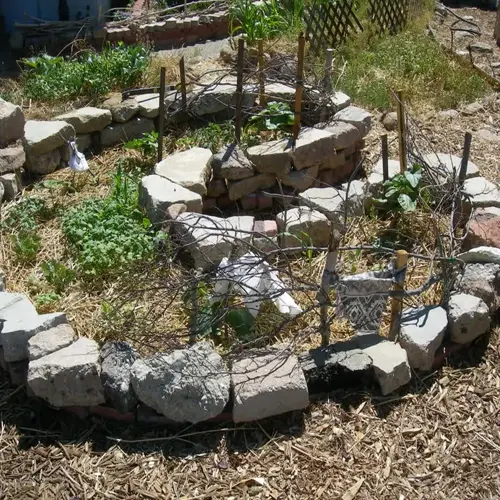
Good rain garden design starts with one simple idea from the EPA. A rain garden is a low spot that collects rain water from a roof, driveway, or street. The dip lets that water soak into the ground. You plant it with grasses and flowering perennials, and the depression does the rest.
That planted depression is the whole point. Runoff from any impervious surface like a paved drive or a roof has nowhere to go, so it rushes into storm drains and streams. A rain garden gives that water a place to slow down and sink in, which is the heart of good stormwater management at home.
Strong design comes down to four pillars: site, soil, sizing, and plants. Think of them as links in a chain. A great planting plan cannot save a garden built on untested soil, and a perfect site fails if the basin is too small for the water it must hold. Each pillar carries the next, and one weak link drops the whole load.
Site Selection and Setbacks
- What it covers: Choosing a low spot that catches runoff while staying safely away from the house foundation, septic system, and wellhead.
- Why it matters: Placing a garden too close to the foundation risks water seeping toward the basement, so setback distances come first.
- Key number: Keep the garden at least 10 feet (3 meters) from the house foundation and 25 feet (7.6 meters) from a septic field or wellhead.
Soil Testing and Drainage
- What it covers: Confirming the ground actually soaks up water fast enough before any digging or planting begins.
- Why it matters: Slow-draining soil leaves standing water for days, defeating the purpose and inviting complaints, so testing is non-negotiable.
- Key number: The soil should infiltrate at least 0.25 inches per hour, which a simple 6-inch test hole confirms by draining within 24 hours.
Sizing and Depth
- What it covers: Matching the garden's area and basin depth to the drainage area feeding it and the slope of the ground.
- Why it matters: An undersized or too-deep garden either overflows or holds water too long, so the dimensions follow the math.
- Key number: Most residential gardens run 100 to 300 square feet (9 to 28 square meters) with a maximum basin depth of 8 inches (20 centimeters).
Native Plant Selection
- What it covers: Choosing deep-rooted native perennials, grasses, sedges, and rushes that survive both flooding and dry spells.
- Why it matters: Deep roots open channels in the soil and improve long-term drainage, so plants are part of the engineering, not decoration.
- Key number: Research found deep-rooted prairie plants infiltrated clay at 0.88 inches per hour versus 0.28 inches per hour under turf grass.
One last point keeps you from over-building. The EPA splits projects into two camps. A simple backyard rain garden sits on one side. Bioretention sits on the other, the engineered version with amended soil layers and built-in drainage. Your backyard project belongs in the simple camp. You dig a shallow basin, pick the right plants, and let the ground work, so you can skip the heavy engineering and still soak up the rain.
Site Selection and Setbacks
Good rain garden placement starts with one simple idea. You read where water wants to go, then you meet it partway. Walk your yard during the next steady storm and watch the path runoff takes from a downspout or driveway. That line of moving water shows you the natural low point where a rain garden belongs.
Pick a spot that already sits along that flow but does not stay soggy for days. A rain garden needs to drain, so a chronic wet patch is the wrong choice. The right spot dips low enough to gather water yet dries out between storms. Most rain garden plants want full sun to partial shade, which makes an open low point near the house ideal.
Before you commit, check your rain garden setback distances against the numbers below. These come from a university extension guide, and they keep your home and water supply safe. The one that matters most is distance from foundation. Keep the garden at least 10 feet (3 meters) from the house so soaking water never pools against the wall.
Call 811 to have underground utilities marked before you dig. It is free, and it keeps you clear of buried gas, power, and water lines.
One more siting detail makes a big difference. Run the long axis of the garden across the path of incoming water, not in line with it. When the garden sits sideways to the flow, water spreads wide across the whole bed and soaks in evenly. Line it up with the flow and water just channels straight through one narrow track.
Your yard's slope also shapes where the garden works best. A gentle grade carries runoff to your chosen low point on its own, which is exactly what you want. Once the spot passes the setback checks and the 811 call comes back clear, you are ready to dig and size the bed.
Soil Testing and Drainage
My test hole still held water the next morning. I had dug it in the heavy clay back corner of my yard. That is where the lawn meets the garage downspout. I filled the hole the day before, and by morning the level had barely dropped. My fix was deep-rooted prairie plants instead of giving up on the spot. Those roots punch channels through the clay that a shovel never could.
Before you commit to a spot, you need to know how fast your rain garden soil takes in water. The simple field check is a perc test, short for percolation test. You dig a hole, fill it, and watch the clock. This one cheap step saves you from building a swamp that sits wet for days.
Here is the number that matters. UNL Extension sets the pass mark at an infiltration rate of 0.25 inches per hour. In plain terms, a 6-inch hole filled with water should drain within 24 hours. If yours does that, your ground is ready. Penn State Extension draws a harder line. It flags any soil below 0.2 inches per hour as a site that needs an underdrain.
Dig a hole about 6 inches (15 centimeters) deep in the spot you are weighing for the rain garden.
Fill the hole with water and let it drain all the way once to soak the soil around it.
Fill the hole a second time and mark the start time so you can measure how fast the level drops.
If the water is gone within 24 hours the soil drains well enough. Much slower means you need amended soil or an underdrain.
Do not write off a clay yard. A USGS study in Madison tested clay soil with deep-rooted prairie plants. The water soaked in at 0.88 inches per hour. The same clay under turf grass managed only 0.28 inches per hour. Plant choice does the heavy lifting. The right roots make slow ground drain more than three times faster.
If your test fails outright, you can rebuild the soil itself. Bioretention beds often get amended toward a loose mix of sand, compost, and topsoil that moves water fast and still feeds the plants. Aim for a garden where standing water clears in less than 48 hours. Anything longer and you are fighting your site instead of working with it.
Sizing and Depth by Slope
Two numbers set your whole plan: how much hard surface feeds the garden, and how steeply your yard tilts. Get those right and the rain garden size almost picks itself. Start by adding up the roof and driveway that drain to one spot. That total is your drainage area, and every sizing choice flows from it.
From there you scale down. Multiply the drainage area by a sizing factor tied to your soil. That factor runs from about 0.03 in sandy ground to 0.43 in heavy clay per UNL Extension. Penn State gives a quick cross-check too. They peg the garden at roughly one twentieth to one quarter of the hard surface feeding it. If both methods agree, trust the result.
Most home gardens come out at 100 to 300 square feet, or 9 to 28 square meters. Keep a single garden at or below 300 square feet. Bigger than that and you are better off splitting it into two. For the shape, aim for a length-to-width ratio of at least 2:1 and turn the long axis so it sits across the flow of water, not in line with it. That spreads runoff over more soil and helps it soak in.
Tight on space? You have room to bend the rules. Shrink the garden by up to 30% and it still controls about 90% of your average runoff. A smaller footprint barely costs you any performance. That trade gives you real freedom when you plot the rain garden dimensions against a narrow side yard or a packed back lot.
Now for the floor of the basin. Think of rain garden depth the way a stair tread follows a hillside. Flat ground takes a shallow tread, and a steep slope needs a deeper drop to hold the same water. So depth tracks your slope, going shallow where the land is level and deeper where it pitches. The table below pairs each slope range with the depth UNL Extension recommends.
Notice where the table stops. Once your slope passes 12%, skip the spot and find flatter ground. A basin that steep holds water on the low edge and dries out on the high one, so it never drains as one even pool. And no matter how steep the site, 8 inches is the deepest you should ever go. Past that the water sits too long and your plants drown.
Plants That Boost Drainage
A few seasons back I knelt in the damp back corner by the garage downspout. I worked switchgrass and cardinal flower into the soggy clay there. That spot had been a dead patch for years. By the next summer the same corner drank up a downpour and dried in a day. I'd watch it from the kitchen window after every storm.
Those deep-rooted natives do real work down in the soil. A USGS study in Madison tested clay under plain lawn. It drained at just 0.28 inches per hour. The same clay with deep-rooted prairie plants drained at 0.88 inches per hour. The roots punch open channels that run straight down. So the right rain garden plants are part of your drainage, not just the pretty part.
That's why native plants for rain gardens beat thirsty exotics or plain lawn. Their deep roots keep opening the soil year after year. Most are tough perennials that come back on their own. Pick plants that fit your local hardiness zone. Extension services point you to regional native lists for a reason.
Set your plants in moisture zones to match how the basin floods and then dries. Put the wettest-loving species in the deep center where water sits longest. Move drought-tolerant perennials and ornamental grasses out to the dry edges that bake between storms. Plant them in drifts of three to five for a full, natural look.
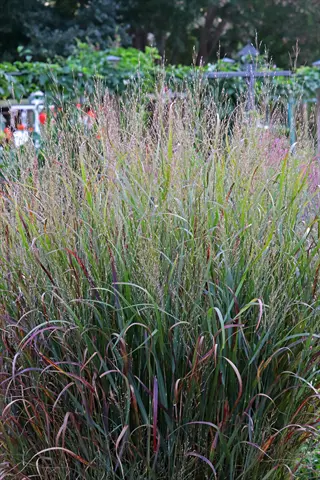
Switchgrass (Panicum virgatum)
- Zone fit: A tall warm-season grass that handles the transition zone between the wet center and dry edges with ease.
- Roots: Sends roots several feet deep, opening channels that help water move down through heavy soil over time.
- Look: Upright blue-green blades turn golden in fall and hold structure through winter for year-round interest.
- Wildlife: Provides cover and seed for songbirds, supporting the habitat benefit rain gardens are known for.
- Care: Cut back the old growth in late winter before new shoots emerge; otherwise it is low maintenance.
- Spacing: Plant in drifts of three to five for a natural massed effect rather than as single specimens.
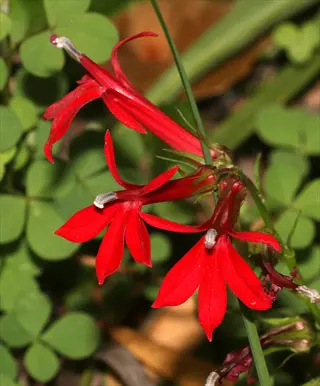
Cardinal Flower (Lobelia cardinalis)
- Zone fit: Loves the wettest deep center of the garden where water ponds longest after a storm.
- Roots: Fibrous roots tolerate saturated soil, making it one of the best choices for the boggy core.
- Look: Sends up brilliant scarlet flower spikes in late summer that stand out against green foliage.
- Wildlife: A magnet for hummingbirds and butterflies drawn to its tubular red blooms.
- Care: Keep the center zone from drying out completely in its first season while roots establish.
- Spacing: Group several together in the basin floor for a strong color statement when in bloom.
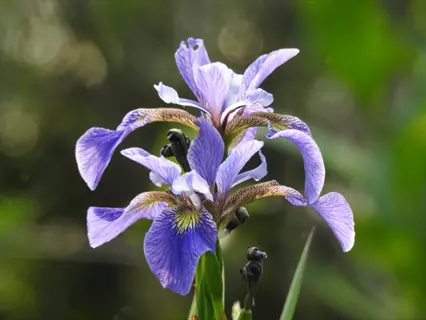
Blue Flag Iris (Iris versicolor)
- Zone fit: A wetland native that thrives in the saturated center and lower slopes of the basin.
- Roots: Spreading rhizomes knit the soil together and tolerate standing water for stretches.
- Look: Violet-blue flowers rise above sword-shaped leaves in early summer for a striking display.
- Wildlife: Offers nectar for pollinators and structural cover in the wet zone of the garden.
- Care: Divide clumps every few years to keep them vigorous and prevent overcrowding.
- Spacing: Set in small clusters along the wet center where its upright form reads clearly.
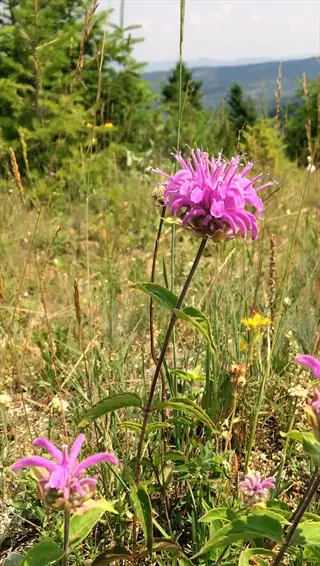
Wild Bergamot (Monarda fistulosa)
- Zone fit: Best on the drier upper edges of the garden that dry out quickly between storms.
- Roots: Drought-tolerant once established, handling the dry-down cycle of the basin rim well.
- Look: Lavender, shaggy summer flowers add a soft, meadow-like texture to the garden's edge.
- Wildlife: A favorite of bees, butterflies, and hummingbirds, boosting the pollinator value.
- Care: Thin stems for airflow and cut back after flowering to keep the clump tidy.
- Spacing: Plant in loose drifts along the rim where its airy form softens the transition to lawn.
Cost and Maintenance Reality
Let's talk real numbers on rain garden cost, since that is where the plans usually go quiet. Raw construction runs about $1.50 to $3.00 per square foot in soil that drains well, and $4.00 to $6.00 per square foot in slow, clay-heavy ground. The slow soil costs more because you have to dig deeper and amend more to get water moving.
Once you add your own plants and labor, the popular DIY range lands around $3 to $5 per square foot. Hire a pro and you'll see closer to $10 to $15 per square foot for full design and install. The two biggest cost drivers are soil amendment and how many plants you pack in, so a small garden on good soil stays cheap while a large bed on clay climbs fast.
- Costs roughly $3 to $5 per square foot, mostly soil amendment and plants.
- Full control over plant choices, shape, and design integration.
- Best for small, simple gardens on workable soil.
- Requires your own perc testing, digging, and utility-locate call.
- Costs roughly $10 to $15 per square foot for design and installation.
- Handles slow soils, underdrains, and overflow design for you.
- Best for larger gardens, steep sites, or tricky drainage.
- Often includes a plant warranty and establishment care.
Top up with 2 to 4 inches (5 to 10 centimeters) of double-shredded hardwood mulch, not pine. It holds moisture and suppresses weeds while plants establish.
Here is the part that surprises people. Rain garden maintenance is front-loaded. The first year asks the most from you, with steady weeding and watering while the roots dig in. After that, the work drops off sharply once deep-rooted native plants take hold and crowd out the weeds on their own.
Think of a rain garden as a new lawn in reverse. A fresh lawn needs constant care up front and then keeps demanding it forever. A rain garden flips that. You baby it for one season, and then the established plants mostly run the show while you step back.
So your real workload is a few hours of weeding through that first summer, a deep soak during dry spells, and a yearly top-up of mulch. Keep up with those three and the garden settles into something that asks for almost nothing while it soaks up your runoff.
5 Common Myths
A rain garden is just a pond that holds water all the time, so it will become a stagnant mosquito breeding ground.
A properly designed rain garden drains within 24 to 48 hours, far too fast for mosquitoes to breed in the standing water.
Rain gardens only work in sandy, fast-draining soil and are a waste of effort on heavy clay ground.
Research found deep-rooted prairie plants infiltrated clay at 0.88 inches per hour, more than three times the rate of turf grass.
A rain garden must sit right against the house to catch all the roof runoff coming off the downspout.
Gardens should sit at least 10 feet (3 meters) from the foundation; placing one too close risks water damage to the basement.
Deeper rain gardens always hold more water and therefore handle storms much better than shallow ones.
Depth above 8 inches (20 centimeters) drains too slowly; designers match depth to slope, never just digging deeper.
Rain gardens are high-maintenance projects that demand constant weeding, watering, and replanting season after season.
Maintenance is heavy only in the first year; once deep-rooted native plants establish, upkeep drops sharply.
Conclusion
Good rain garden design gives you two things at once. It is a working tool that soaks up stormwater runoff before it floods your yard. It is also a planted bed that looks far better than a bare ditch. Four pillars pull it together. You size it for your roof, set the depth for your slope, keep safe gaps from the house, and pick soil that drains plus deep-rooted native plants.
The payoff here is real, and the numbers prove it. A well-built bioretention cell can soak up to 90% of the annual rainfall that lands on it. It also scrubs the dirty stuff out of that water, pulling 95% to 98% of metals like cadmium, zinc, and lead out before it reaches the ground below. That is a serious jump in water quality from one small bed in your yard.
Worried your yard is too small? Don't be. Even a garden shrunk by up to 30% still controls about 90% of your average runoff, so a tight space is no reason to skip the project. A smaller bed still does most of the work. You can always add a downspout extension or a second tiny garden later.
Your rain garden does more than protect your own lot. The water it cleans flows on to streams and lakes downstream. Take the work done at Washington State University. They tested highway runoff that was strong enough to kill fish. But the fish lived once that water filtered through rain garden soil. Your bed does its part in that same chain, one storm at a time.
The first big rain after planting is your real test. Watch the bed fill, then watch it drain. With proper infiltration, the standing water should be gone within 24 to 48 hours, just as promised at the start. When you see that empty basin the morning after a storm, you will know your design works.
Glossary
- Bioretention
- The engineering term for a rain garden built with amended soils and a drainage system to capture and filter stormwater.
- Drainage area
- The total surface, such as a roof and driveway, whose runoff flows into the rain garden.
- Impervious surface
- A hard surface like a roof, driveway, or sidewalk that water cannot soak through, so it runs off instead.
- Infiltration rate
- How quickly water soaks down into the soil, usually measured in inches per hour.
- Perc test
- A simple percolation test where you fill a small hole with water to measure how fast the soil drains.
- Setback
- The minimum safe distance a rain garden must sit from a house foundation, septic system, or well.
- Swale
- A shallow, gently sloped channel that moves and slows stormwater rather than holding it in place.
- Underdrain
- A buried perforated pipe added under a rain garden to help water drain away when the soil is too slow.
External Sources
Frequently Asked Questions
What makes a good rain garden?
A good rain garden has the right site, tested soil drainage, correct depth for the slope, and deep-rooted native plants.
What is the difference between a swale and a rain garden?
A swale is a shallow sloped channel that moves water along; a rain garden is a basin that collects and infiltrates it.
What is the best soil for a rain garden?
Soil that drains at least 0.25 inches per hour, usually a loose mix of sand, compost, and topsoil.
What is the maximum depth of a rain garden?
About 8 inches (20 centimeters). Deeper than that and the garden drains too slowly.
What plants are rain gardens best planted with?
Deep-rooted native perennials, grasses, sedges, and rushes that tolerate both flooding and dry spells.
What plant likes to be waterlogged?
Cardinal flower, blue flag iris, rushes, and sedges thrive in the wettest center zone.
How far should a rain garden be from the house?
At least 10 feet (3 meters) from the foundation to keep water away from the basement.
Do rain gardens work in clay soil?
Yes. Research shows deep-rooted native plants drain clay soil far faster than turf grass.
How much does a rain garden cost?
Around $3 to $5 per square foot for DIY and $10 to $15 per square foot professionally installed.
How do you do a perc test for a rain garden?
Dig a 6-inch hole, fill it with water, and check that it drains within 24 hours.