Bulb · Asparagaceae
Common Camas
Camassia quamash
Blue spring spikes that turn a damp corner into a meadow scene.
Full sun
Every 3–7 days
USDA 3–8
1–4 ft · 0.3–1.2 m
Overview
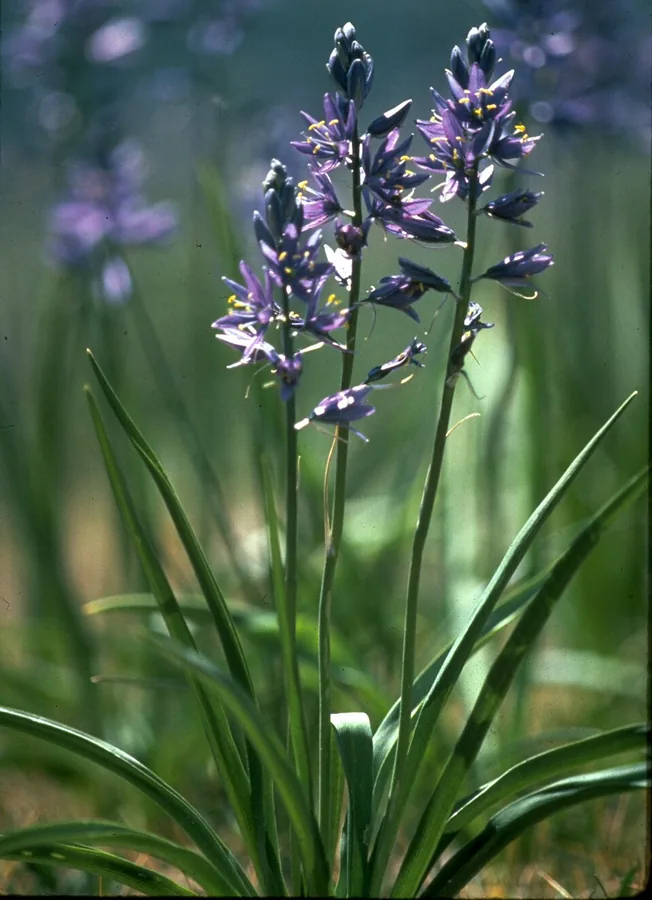
Picture a loose sweep of blue rising over damp ground in spring: that is the look common camas gives a naturalistic garden. This North American bulb belongs to the Asparagaceae family, is easy to grow, and lives outdoors as a long-lived perennial that returns each year.
Its appeal is built around a seasonal rhythm rather than constant display. Leaves and tall flower spikes arrive in spring, March to June, and the blooms carpet wet meadows in soft blue and violet before the plant slips underground to rest through the dry heat of summer.
Treat it as a plant for mood and place rather than fuss. It suits a meadow border, a low spot that stays moist in spring, or any easygoing scene where you want color to drift in and then bow out gracefully, and where the bulbs once served Native American peoples as a cooked food.
Care
The short version: plant the bulbs in fall, keep the soil moist through spring growth and bloom, then let it dry as the plant rests over summer. Give it full sun and rich, free-draining ground, feed lightly at planting, and otherwise leave it alone to settle into a drift.
Light
Full sun is where camas flowers at its best and where it earns its place in an open, naturalistic scene. It will sit happily in partial sun or light shade, but lean too far into shade and you trade flowers for foliage.
Water
This is a wet-meadow plant at heart, so keep the soil evenly moist through spring growth and bloom, watering before it dries out while it is active. As it eases into summer dormancy, back off and let the bulbs stay drier at rest.
Soil
Give it well-drained, moist, humus-rich ground worked with plenty of organic matter, the kind of soil a meadow planting loves. On acidity it is unfussy, settling comfortably across a pH of 5.5 to 7.5.
Temperature
Hardy across zones 3 to 8, camas shrugs off real cold, down to about 10°F (-12°C). It also takes summer heat well, coping up to roughly 86°F (30°C) before it retreats into dormancy for the season.
Humidity
Average air humidity suits it, and outdoors there is nothing to manage on that front. What truly counts is moisture at the roots in spring, not the feel of the air around the foliage.
Feeding
Feeding stays light and front-loaded. Work a balanced bulb fertilizer or compost into the soil at planting in spring, and that single gesture carries the planting through the season.
Pruning
There is no routine pruning to schedule. Let the foliage die back on its own after the flowers fade so the bulb can recharge, and trim spent flower stalks only when you would rather it did not self-seed.
Repotting
Camas prefers to be left undisturbed, so lifting is rare. Divide only when a clump grows so crowded that flowering tails off, or when offsets start pushing up to the soil surface.
Size & spacing
Flower spikes carry the plant to 1 to 4 feet (30 to 120 cm) tall, with each clump spreading 12 to 24 inches (30 to 60 cm) across. Left to settle, the bulbs knit into natural drifts over time, so plan the spacing with that easy spread in mind.
When to plant
The whole appeal of camas runs on a calendar you can plan a season around. Bulbs go in during fall to root over winter, the spikes rise and bloom from March to June, then the foliage fades and the bulbs rest underground through summer.
Northern hemisphere
Southern hemisphere
Typical months for a temperate climate: start earlier in warm zones, later where spring frosts linger.
- Plant: Plant bulbs in fall; sow seed outdoors in fall or spring
- Harvest: Spring (March to June)
Hardiness
USDA hardiness zones: 3–8
Temperature: down to -40°C
Troubleshooting
An easygoing plant rarely asks for much, but two issues turn up often enough to know in advance. Both are simple to read once you know what to look for, and both come down to giving the planting the light and drainage it quietly prefers.
Soft, hollowed bulbs hiding below the surface
Trouble underground tends to come from pests or sodden ground. Larvae of the narcissus bulb fly burrow in, and bulbs left sitting in waterlogged soil over their rest period simply rot. Lift the spoiled ones and fix the drainage before the next season.
Fix:
- Remove and destroy infested or rotten bulbs
- Improve soil drainage for summer dormancy
- Avoid leaving wounded bulbs in waterlogged soil
Plenty of leaves, but the spikes never show
When a clump greens up nicely yet refuses to bloom, the light, the spacing, or simply the age of the planting is usually behind it. Move it into more sun, give crowded bulbs room, and let young plantings settle before you expect a display.
Fix:
- Site in full sun for best flowering
- Lift and divide crowded clumps of bulb offsets after foliage dies back
- Be patient with seed-grown plants, which need several years to bloom
Toxicity
As a garden presence, common camas is as relaxed as plants come: it carries no toxicity for people or pets, and its bulbs were a traditional cooked food. The single caution is about identity in the wild, where it can be mistaken for the deadly death camas.
Safe for
People · Cats · Dogs · Horses · Rabbits · Livestock · Birds
Cats None
Not poisonous to cats; a curious nibble from a garden cat is nothing to lose sleep over.
Dogs None
Not poisonous to dogs; a pet that digs up and chews a bulb should come to no harm.
Horses Safe
No toxicity has been reported in grazing horses, so a meadow planting sits easily alongside them.
Rabbits Safe
Rabbits can browse the planting without harm, as there is no toxin to trouble them.
Livestock Safe
Grazing cattle, goats, and sheep are not put at risk by true common camas.
Birds Safe
No known danger to birds, which can share the space freely.
People Safe
The cooked bulbs were a staple food of Native American peoples and are safe to eat once correctly identified; the one real hazard is mistaking the plant for deadly death camas, so never eat a wild bulb without an expert's confirmation.
The true danger is misidentification: edible camas bulbs closely resemble the highly poisonous death camas (Toxicoscordion/Zigadenus). Never forage or consume wild bulbs without expert identification.
Varieties
Two selections stand out when you are styling a planting, each bringing a slightly different note to the same easy, meadow-loving habit.
Camassia quamash 'Blue Melody'
Pairs deep blue-violet spikes with cream-edged variegated foliage, so the planting reads beautifully well before the first flower opens.
Camassia quamash 'Orion'
Carries deep blue flowers on tall stems and is a strong choice for naturalizing across a moist meadow.
How to propagate
Building a drift is part of the pleasure here, and camas gives you several easy ways to do it. Most simply multiply the planting on its own seasonal schedule, asking only a little patience in return.
Offsets & pupsEasy
After foliage dies back in summer dormancy · 1 to 2 seasons
Once the leaves have faded into rest, lift a clump and ease apart the offsets gathered around the parent bulb, then replant in moist humus-rich soil. They settle over 1 to 2 seasons and are the quickest path to a generous drift.
Bulbs & cormsEasy
Fall · 1 to 2 seasons
Set dormant bulbs into moist humus-rich ground in fall and let them root through winter to flower the following spring. Allow 1 to 2 seasons before the planting comes into its full show.
SeedModerate
Sow outdoors in fall or spring · Up to 3 years to flower
In a damp meadow it self-seeds with ease, and you can sow your own outdoors in fall or spring. Seedlings take up to 3 years to reach blooming size, so this rewards a patient gardener.
DivisionEasy
During summer dormancy · 1 to 2 seasons
Divide an established clump while it rests in summer to keep it vigorous and widen its reach. The split pieces re-establish within 1 to 2 seasons.
Myths
Every camas bulb is safe to eat, since Native American peoples ate camas.
Edible common camas is almost identical to death camas (Toxicoscordion/Zigadenus), whose bulbs are poisonous and can kill. The two are easy to mix up out of bloom, once the flower color that sets them apart is gone, so never eat a wild bulb without expert identification.