Bulb · Asparagaceae
Grape Hyacinth
Muscari armeniacum
Set the little bulbs out in fall, and spring answers with rivers of blue.
Full sun
Every 7–14 days
USDA 4–8
4–8 in · 10–20 cm
Overview
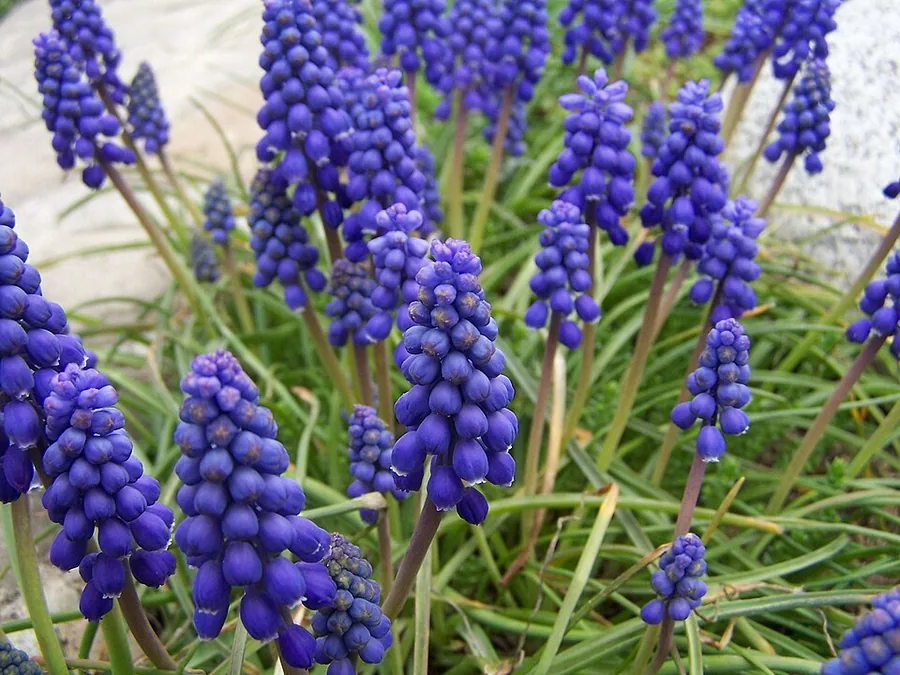
Grape hyacinth owes its name to the neat spikes of small, rounded flowers that gather like a bunch of upside-down grapes. Standing just 4 to 8 inches (10 to 20 cm) tall, it works best not as a single accent but as a low blue wash, planted in drifts that return faithfully each year to edge a path or pool at the foot of taller bulbs. In spite of the name, it keeps no company with the true hyacinth and belongs to its own genus, Muscari.
This is a bulb that asks very little of a busy household. Set the bulbs out in fall, and they carry grassy leaves through winter before opening their deep blue spikes in mid-spring, arriving in step with the tulips and daffodils that anchor the season. They settle happily into almost any spot, unbothered by cold down to -29°F (-34°C), which makes them a dependable fixture year after year.
The one habit to plan around is its enthusiasm for spreading. Grape hyacinth self-seeds and multiplies by offset bulbs, so a small planting can drift into the lawn across a few seasons. In a relaxed cottage setting that wandering reads as charm, while a crisp modern border wants it reined in, so give it a spot where a little roaming suits the mood of the space.
Care
The short version: plant the bulbs in fall in well-drained soil, give them full sun to part shade, keep them moist through spring growth, then ease off the water once the foliage dies back.
Light
Grape hyacinth flowers most freely in full sun, though it takes partial sun or partial shade in stride, which gives you room to place it. More light returns denser spikes and stronger color, while a little afternoon shade suits it well in hot, bright spots.
Water
Keep the soil evenly moist while the leaves and flowers are growing in spring. Once the foliage yellows and dies back, cut the water sharply, because the bulbs prefer to rest dry through their summer and fall dormancy.
Soil
Average, well-drained soil serves it well, and it even accepts clay so long as water does not linger. A pH between 6.0 and 7.0 with some organic matter mixed in keeps the bulbs content.
Temperature
This is a hardy, unfussy bulb that shrugs off winters down to -29°F (-34°C) and grows well up to about 75°F (24°C). The deep winter chill is exactly the cue that brings on a strong spring bloom.
Humidity
Ordinary outdoor humidity is all it asks, so there is no figure to watch. Drainage matters far more, since bulbs left sitting in damp ground are the ones that rot.
Feeding
Work a little bone meal or balanced bulb fertilizer into the soil at planting, then feed again after the flowers fade to help the bulbs build up for next year. It is not a hungry plant, so a light hand is plenty.
Pruning
There is no real pruning to do. Let the foliage die back on its own after bloom so the bulb can store energy, and only then clear away the spent leaves, since cutting them green weakens next year's display.
Repotting
In the ground, leave the bulbs to multiply and divide a crowded clump every 4 to 5 years. The cues are congested clumps, fewer flowers, and bulbs beginning to heave up to the surface.
Size & spacing
Grape hyacinth stays low at 4 to 8 inches (10 to 20 cm) tall with a spread of just 3 to 6 inches (8 to 15 cm). Set the bulbs close in groups so they read as a solid sheet of blue rather than scattered dots.
When to plant
Grape hyacinth keeps to the bulb calendar, and it folds easily into the flow of the gardening year. Set the bulbs out in fall before the ground freezes, let them root and rest through winter, and they return the favor with blue spikes in mid-spring, around April to May.
Northern hemisphere
Southern hemisphere
Typical months for a temperate climate: start earlier in warm zones, later where spring frosts linger.
- Plant: Fall, before ground freezes
- Harvest: Mid-spring (April to May)
Hardiness
USDA hardiness zones: 4–8
Temperature: down to -34°C
Troubleshooting
Grape hyacinth asks for very little upkeep, and the occasional issue is usually cosmetic or a matter of it spreading too freely for the scheme. Learn to read its normal winter scruffiness apart from a genuine problem, and you can mostly let the planting be. Match what you see below before reaching for any fix.
A planting that quietly outgrows its intended footprint
A composed spring scheme can lose its lines over time, because grape hyacinth is a generous self-seeder that also multiplies through offset bulbs, so a considered patch drifts into the lawn and beds across a few years. Clipping the spent flower spikes before they set seed preserves the design, and lifting stray seedlings and rogue bulbs restores the edges. For a scheme meant to hold its shape, a pot or a defined bed keeps the effect exactly where it belongs.
Fix:
- Deadhead spent flower spikes before seed sets
- Dig and remove unwanted seedlings and offset bulbs
- Grow in containers or contained beds to limit spread
Weary, yellowing leaves through the fall and winter months
Before the border reads as neglected, know that this is almost always the plant's natural rhythm rather than a fault. Grape hyacinth raises its grassy leaves in autumn and keeps them all winter, so they look tired well before the spring display arrives to redeem the scene. Let the foliage stay until it yellows and fades on its own, and lift and divide the clump if the planting has grown too congested to look its best.
Fix:
- Leave foliage in place until it yellows and dies back naturally
- Divide crowded clumps every 4 to 5 years
- Reduce watering once foliage begins to die back
Grazed leaves and flower stalks gone from the display
The planting mostly looks after itself, though deer will occasionally sample it when other forage grows scarce and leave the display looking picked over. Torn, ragged foliage alongside tracks or droppings settles the question. A repellent spray keeps a casual visit at bay, while a discreet fence or a companion planting of bulbs deer dislike protects the look where browsing is a regular event.
Fix:
- Apply deer repellent
- Use fencing or interplant with less palatable bulbs
Toxicity
Grape hyacinth is a low-toxicity plant and an easy fit for most homes. The leaves and flowers are harmless, and the flowers are even eaten in some places, but the bulbs hold mild saponins that can cause drooling or an upset stomach if a pet or child digs one up and eats it. Keep an eye on enthusiastic diggers and curious toddlers, and the planting minds itself.
Safe for
People · Cats · Dogs · Horses · Rabbits · Livestock · Birds
Cats Caution
For a household cat the leaves and flowers are safe, and only the bulbs give pause, holding mild saponins that can leave a cat drooling or queasy if it digs one up and chews it. A stray nibble of foliage asks for no concern at all.
Dogs Caution
A dog with a taste for digging might swallow a bulb, and the saponins within can bring on drooling and a spell of stomach upset. Everything above the soil is of little concern.
Horses None
Horses may graze the grassy foliage without harm, as the plant carries no toxin that would trouble them.
Rabbits None
Rabbits browse the leaves in perfect safety, since nothing in the foliage affects them.
Livestock None
Cattle, goats, and sheep may graze around a planting of grape hyacinth with no trouble from the foliage.
Birds None
Birds come to no harm, and garden flocks may forage close to a planting without concern.
People Caution
In some parts of the world the flowers are pickled and served at the table, yet the raw bulb is best left be, since its saponins can cause drooling and an upset stomach if eaten. Keep small children from sampling the bulbs.
No special handling precautions are required; the plant is considered pet-safe.
Varieties
The straight species carries most gardens, but a few named cultivars are worth seeking out when a particular shade or form suits the scheme.
Cantab
A softly scented, sky-blue cultivar that opens later than the species and stands about 6 to 9 inches tall.
Valerie Finnis
Its powder-blue flowers rise on firm 8-inch spikes that carry themselves without staking.
Blue Spike
A double form whose closely gathered florets fill each spike into a fuller, plumper cluster.
Saffier
A rich blue, sterile cultivar that holds its flowers longer than most and never self-seeds.
Album
A white-flowered selection that grows a little less vigorously than the blue species.
Companions
Grape hyacinth shines among other spring bulbs, where its low blue spikes carpet the ground beneath taller flowers that bloom at the same time.
Plant near
Daffodils (Narcissus): Bloom at the same mid-spring time and combine for layered drifts of color.
Tulips: Pairs well in mass plantings and borders for contrasting spring color.
Crocus: Early-blooming companion bulb for naturalized lawn and rock-garden plantings.
How to propagate
Grape hyacinth multiplies almost unaided, and you can guide it along by lifting offsets, splitting clumps, or letting it set seed.
Offsets & pupsEasy
Lift and separate offset bulbs in summer dormancy or fall. · Offsets typically flower the following spring.
The simplest way to extend a favorite drift is to lift the offset bulbs that gather around the parent and settle them into a new corner, a quiet task for summer dormancy or fall. Most of these offsets are ready to flower the very next spring, so the effect fills in fast. Handling a congested clump this way every 4 to 5 years keeps the whole planting flowering at its best.
DivisionEasy
When foliage has died back, in summer to early fall. · One season
Once the leaves have yellowed and faded, from summer into early fall, a tired clump can be lifted and split into pieces to refresh the scheme. The divisions settle in within a single season. It is also the tidiest way to hold a spirited planting to the shape you had in mind.
SeedModerate
Self-sows readily; collected seed sown after ripening. · Seed-grown plants may take up to 4 years to flower.
Grape hyacinth self-sows so freely that sowing on purpose is rarely worth the trouble, though ripened seed can be collected and sown for a slower, wilder effect. Patience is the price, since a seed-grown plant can take up to 4 years to reach its first bloom. Clipping the spent spikes is the graceful way to keep that self-seeding from blurring the edges of a design.
Myths
Grape hyacinth is as poisonous to cats and dogs as a true hyacinth.
The reputation is borrowed, not earned. The ASPCA lists Muscari armeniacum as non-toxic to dogs and cats, and it is unrelated to the genuinely toxic true hyacinth despite the shared name. The bulbs do hold mild saponins, so a pet that digs one up and eats it may drool or get an upset stomach, yet the plant is nothing like its dangerous namesake.
Grape hyacinth is a kind of true hyacinth.
It sits in its own genus, Muscari, within the family Asparagaceae, and not in the genus Hyacinthus. The hyacinth in its name simply echoes the look of the flower clusters, not any close family tie.