Vegetable · Brassicaceae
Cauliflower
Brassica oleracea Botrytis Group
Give it cool air, regular feeding, and water that never lapses, and a dense, weighty head pays you back.
Full sun
Every 3–7 days
45–75°F · 7–24°C
55–100 days
Overview
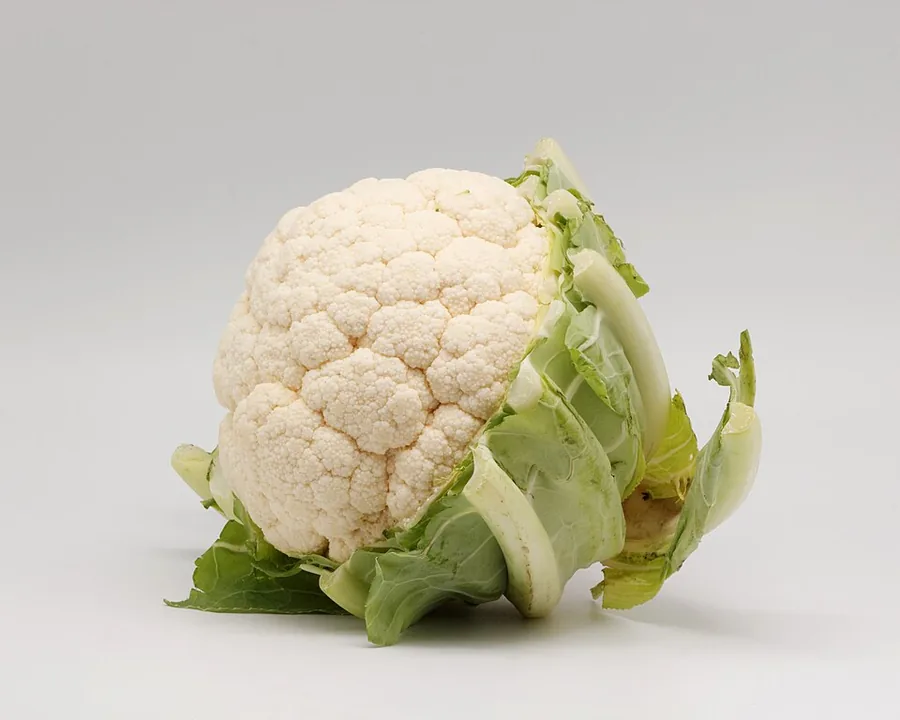
Cauliflower earns a quiet place of honor in the cool-season plot, a cabbage relative prized for the firm pale curd that gathers within its broad leafy rosette. The line descends from the wild stock behind cabbage, broccoli, and kale, yet growers nudged it toward one tight knot of flower buds caught before they open. Time the cut well and you lift a mild, solid head; linger a few days and that head loosens fast.
Few brassicas test a gardener as steadily, which is how it landed among the more demanding of the family. Cool, even weather from the seedling stage right through the cut is what it wants, and a single stumble leaves a mark. A chill, a heat wave, or even a brief dry spell can arrest growth and hand you a marble in place of a proper head.
Color now adds to the draw. Set beside the familiar white, a planting plan can hold orange, purple, and lime-green Romanesco selections, each of which sets its pigment out in the open sun rather than beneath leaves tied closed. Match the type to the length of your season and to how patient you care to be, and the picking follows in turn.
Care
The short version: a bright open spot, fertile ground kept evenly damp near pH 6.0 to 7.0, generous feeding, and most of all cool weather that never lets the plant pause on its way to a head.
Light
Give cauliflower a spot in full sun, six hours daily or better, though a bit of cover from harsh afternoon light suits places where spring heats up early. Pigment is at stake for the colored selections, which lean on that exposure to bring up the orange, purple, or green.
Water
Consistent moisture decides the outcome. Plan on roughly 1 inch (2.5 cm) of water a week, never letting the bed run dry, because even one spell of thirst can wreck the curd or bring on buttoning. Light, sandy ground sheds water sooner than clay, so reach for the hose more often there.
Soil
Plant into fertile, free-draining loam of good richness, dug through with plenty of aged manure or finished compost, ground that stays damp yet never waterlogged. Holding the pH near 6.0 to 7.0 keeps nutrients reachable and fends off the hollowed stem that comes with overly acid ground.
Temperature
Cool weather suits this crop best, with growth strongest between 45°F and 75°F (7°C to 24°C). Long runs of days above 86°F (30°C), or nights that stay warm, will distort or stop the curd outright, so schedule around any real heat.
Humidity
Garden-variety outdoor humidity, somewhere in the 40% to 70% band, suits it fine, and there is no figure to fuss over. What matters more is airflow through the planting, since still air over crowded, damp foliage invites disease.
Feeding
Plan for a heavy feeder. Dig a balanced fertilizer like 5-10-10 into the ground at planting, follow with a nitrogen side-dressing roughly 3 to 4 weeks past transplanting, and keep boron topped up so the curd does not brown.
Pruning
No shaping cut is needed, but white selections call for blanching: when the curd grows to 2 to 3 inches, draw the outer leaves over the top and tie them to hold it pale, unless that variety folds its own. Leave orange, purple, and Romanesco kinds bare to the light, and strip off any battered outer leaves.
Repotting
No repotting schedule applies, given that cauliflower never grows indoors. Raise seed in plug cells or open flats, then set each start into the ground just once, roughly 4 to 6 weeks past sowing, ahead of the point where a seedling stiffens and goes woody.
Size & spacing
Mature plants run 12 to 24 inches (30 to 60 cm) high and roughly as broad. Space them 18 to 24 inches (45 to 60 cm) apart so every rosette gets the elbow room to fill out while air keeps moving along the row.
When to plant
This is a crop ruled by cool weather, prickly toward frost and warmth in equal measure. Raise seed under cover, slide the young plants into place a couple of weeks ahead of spring's final frost, or hold a second sowing for the back half of July, and gather each head while cool conditions still hold.
Northern hemisphere
Southern hemisphere
Typical months for a temperate climate: start earlier in warm zones, later where spring frosts linger.
- Sow: Spring crop: start seed indoors about 4-6 weeks before the last frost (around April in cold climates). Fall crop: start seed in July, indoors or direct-seeded.
- Plant: Transplant 2-3 weeks before the average last spring frost, or mid- to late July for a fall crop; space plants 18-24 inches apart.
- Harvest: Harvest the curd when full-sized, firm, and still tight/white, before the florets begin to separate; cut with a few wrapper leaves attached.
Hardiness
USDA hardiness zones: 3–10
Temperature: down to -40°C
Troubleshooting
Nearly all of this plant's setbacks lead back to one root cause, a pause in even growth, and they tend to register first across the curd or its surrounding leaves. Catch these signs early and a quick response can save the planting before a minor stall turns costly. Find what fits below, then move while a remedy still counts.
Yellow V-marks on leaves or knotted roots
Two soilborne diseases share this appearance. Black rot cuts yellow V-shaped notches along the leaf edges and darkens the veining, while clubroot bloats each root into a gnarled lump that cannot take up moisture, so the plant droops. Neither can be cured once present. Dig out and burn anything affected, plant only clean starts, keep a rotation of four years or more clear of every cabbage relative, and turn to resistant varieties.
Fix:
- Remove and destroy infected plants
- Use clean, disease-free transplants
Heads the size of a marble, far too soon
Gardeners call the problem buttoning, a response to any stall a young plant runs into, be it cold, heat, a dry patch, or a start that sat overlong in its cell. Instead of building toward full size, growth quits and the plant forms a curd no bigger than a pea. The cure lives in the timing: move lively starts out on schedule, keep them advancing without interruption, and skip anything pot-bound or stiff from too much hardening off.
Fix:
- Keep plants growing vigorously with steady water and nutrients
- Replace stressed plants; avoid root-bound or over-hardened transplants
Pebbly head whose florets begin to loosen
The garden name here is ricey curd, and warmth sits behind it almost every time. Heat coaxes the small buds to stretch and part ways before the head is ready for the knife. Schedule the crop to finish during the season's cool window, take the head the moment it rounds out, and ease back on nitrogen.
Fix:
- Harvest promptly before florets separate
- Time the crop so the curd matures during cool weather
Shredded foliage with green worms beneath
Look for cabbageworms, cabbage loopers, and diamondback moth larvae, soft green feeders that scatter dark droppings and chew the leaves to ribbons. Flea beetles pitch in as well, dotting fresh seedlings with pinprick holes. Pick the worms by hand, switch to Bt once their numbers climb past you, and shelter new starts with floating row cover.
Fix:
- Handpick caterpillars
- Apply Bt (Bacillus thuringiensis)
- Cover young plants with floating row cover
Browning across the head or a hollowed stem
Usually the cause is boron deficiency, marking the head with discoloration and leaving the stem within browned or hollowed. A pH that sits too low and on-and-off watering both sharpen the problem. Test your soil before adding boron of any kind, hold pH within range, and keep a dependable watering rhythm.
Fix:
- Correct boron based on a soil test
- Maintain proper pH and even moisture
Toxicity
A staple of the kitchen garden, cauliflower holds nothing poisonous, so growing and gathering it near children and pets carries no worry. As a brassica it does bring goitrogens and a share of gas-prone fiber, meaning a big raw helping might unsettle a pet's belly, though the plant is toxic to no one.
Safe for
People · Cats · Dogs · Horses · Rabbits · Livestock · Birds
Cats None
There is no toxin in cauliflower that troubles cats, so a stolen bite of leaf or head is harmless.
Dogs None
Dogs are fine with cauliflower. A generous helping of it uncooked might bring a touch of gas, yet nothing that poses a threat.
Horses None
Horses face no poisoning here, but as a brassica the plant can feel heavy, so offer it only in modest amounts.
Rabbits None
Leaves and head suit rabbits in moderation. A large amount in one sitting can bring gas, so keep the servings small.
Livestock None
Grazing animals such as goats, sheep, and cattle face no danger of poisoning from cauliflower, as the plant holds nothing harmful.
Birds None
Hens in the yard, along with other birds, can nibble the leaves and head without the slightest concern.
People Safe
A table staple, fine to eat whether cooked or fresh, with no risk at all. The whole plant can be handled and picked safely.
As a brassica it contains goitrogens and can cause gas/bloating; large quantities may cause mild, temporary digestive upset in pets, but the plant is not poisonous.
Varieties
White is merely the starting point. A short roster of names covers what fills most backyard beds, beginning with early steady hybrids and reaching to the colored selections that lend a planting some flair.
Snow Crown
An early, reliable white hybrid forgiving of a little warmth, ready to cut roughly 50 to 60 days out, and among the safest picks for spring.
Amazing
A white type whose own leaves wrap the curd, so it rarely needs tying by hand and copes with a wider swing of conditions.
Cheddar
An orange-headed type rich in beta-carotene that develops its color out in full sun, never beneath tied leaves.
Graffiti
A deep purple selection that owes its color to natural anthocyanins and should be left unblanched.
Romanesco
A lime-green head whirling into a fractal spiral, drawing its color from sunlight rather than any blanching.
Companions
Cauliflower's worst neighbors are its own relatives, the other cabbage-family crops that pass the same pests and soil diseases back and forth.
Keep apart
Other brassicas (cabbage, broccoli, Brussels sprouts, kale, turnip): Share the same pests and soilborne diseases (cabbageworms, clubroot, black rot); extension guidance is to rotate and avoid planting them together for several years.
How to propagate
Seed is where cauliflower starts, and the craft sits in how you move it on: raise vigorous starts and settle them outside before a single pause can throw them off.
SeedModerate
Start indoors about 4-6 weeks before transplanting; sow in early spring (around April) for a spring crop and in July for a fall crop. · Transplant-ready in about 4-6 weeks; curd harvest roughly 55-100 days after transplanting.
Cauliflower is nearly always grown on as transplants instead of being sown where it stands, an approach that keeps the starts strong and steers around the growth stalls that set off buttoning. Sow under cover some 4 to 6 weeks beforehand, then reckon on 55 to 100 days between setting out and a head worth cutting.
Myths
White cauliflower only comes from tying the plant up.
A good many modern cultivars handle their own blanching, drawing the foliage shut across the curd without help, which leaves hand-tying as a chore for certain white types alone. Orange, purple, and Romanesco selections take their color from open sun and should never be blanched.
Cauliflower is just broccoli by another name.
Both share one parent species, Brassica oleracea, and yet the two are nowhere near interchangeable. Cauliflower belongs to the Botrytis Group and broccoli to the Italica Group, distinct lines bred within it.
Cauliflower is simple, just one more cold-tolerant vegetable.
Among the brassicas, few are harder to please. It insists on cool, unbroken conditions and turns sour at warmth or any pause in growth, precisely what gives rise to button heads and grainy curds.