Ornamental · Polemoniaceae
Creeping Phlox
Phlox subulata
Give it full sun and sharp drainage, and creeping phlox lays a spring carpet of color across the garden.
Full sun
Every 7–14 days
USDA 3–9
4–6 in · 10–15 cm
Overview
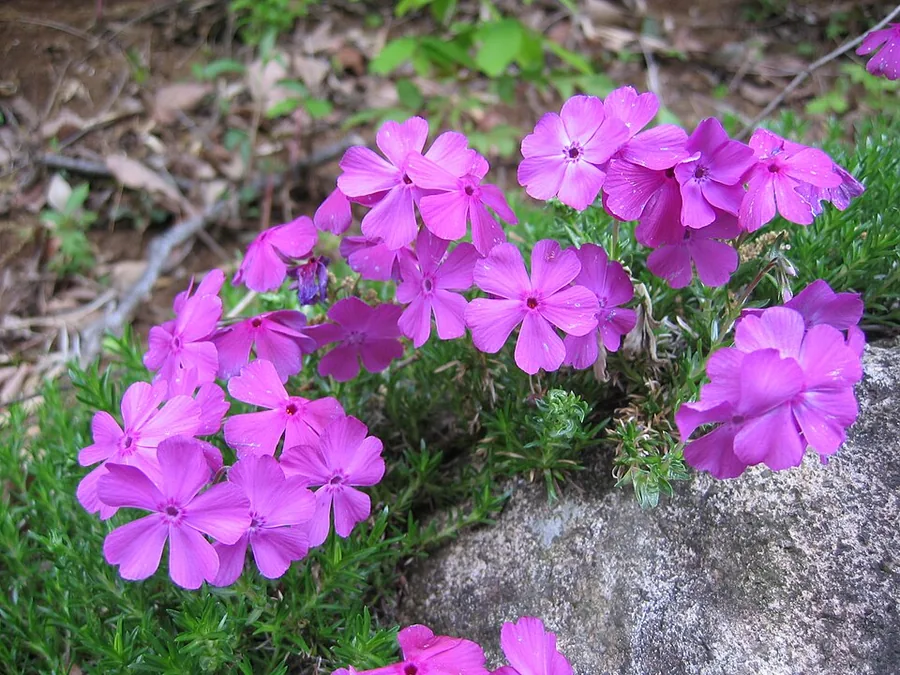
Spring arrives with real flourish wherever creeping phlox is planted. This low, mat-forming perennial spreads into an even carpet of needle-like foliage and then, in early to mid spring, vanishes beneath a tide of bloom that sets the whole season's tone. It belongs in the harder corners of a property, draping the dry, rocky ground of slopes, walls, and rock gardens that nothing softer will cover.
Its appeal is not confined to those few weeks of flower. The evergreen mat keeps a planting looking furnished through hot summers and hard winters, holding its line in cold as deep as -40°F (-40°C). Once it has settled, it folds easily into a low-maintenance routine, asking little beyond sun and soil that drains.
It should not be mistaken for garden phlox, the tall summer perennial that shares the name and plays a wholly different part in a border. Creeping phlox stays ankle high and creeps outward instead of rising, the very habit that makes it such a polished filler between paving stones and along the front edge of a bed.
Care
The short version: site it in full sun and sharp-draining sandy or gravelly soil, and once it has settled, water only through long dry spells. A shearing by half once the flowers fade keeps the carpet looking full and composed.
Light
Creeping phlox gives its fullest display in full sun, and while it accepts partial shade, the flowering thins as the light drops. An open, sunny setting is what turns it into a true sheet of color.
Water
Once settled, the plant is drought tolerant and wants water only through long dry spells, which makes it a fitting companion for a relaxed garden routine. It favors fast-draining ground and even takes dry, rocky sites, so let the top half of the soil dry between waterings.
Soil
Set it in sandy or gravelly, humus-rich soil that drains freely, since standing water is the one thing that undoes it. A pH from 5.5 to 7.0 suits it, and a slope or raised bed both flatters the planting and sheds excess water.
Temperature
This is a remarkably hardy plant that stands up to -40°F to 95°F (-40°C to 35°C). It needs no winter dressing anywhere in its range and returns each spring to take its place in the garden again.
Humidity
Ordinary outdoor air suits it, so there is no level to manage. What counts for the look of the planting is good drainage and airflow, because damp, stagnant settings are what invite foliar trouble.
Feeding
It keeps its form on lean soil and asks for little at the table. A light feed of balanced general-purpose fertilizer in spring is plenty, while overfeeding only produces soft, sprawling stems that lose the tidy line.
Pruning
Once the flowers fade, cut the stems back by about half. That single shearing holds the carpet dense and compact, keeps the center from going woody and bare, and leaves the planting looking deliberate.
Size & spacing
The mat stays low, just 4 to 6 inches (10 to 15 cm) tall, while each plant reaches 24 to 35 inches (60 to 90 cm) across. Allow that spacing and the plants close into a single, unbroken carpet that anchors a bed.
When to plant
Creeping phlox is a plant for the spring chapter of the garden, so its year revolves around setting it out and giving it one well-timed trim. Plant in spring or early fall, let the display unfold from April into May, and shear the mat once the flowers have passed.
Northern hemisphere
Southern hemisphere
Typical months for a temperate climate: start earlier in warm zones, later where spring frosts linger.
- Sow: Usually propagated vegetatively rather than from seed; not typically sown indoors.
- Plant: Plant in spring or early fall in a sunny, well-drained site.
- Harvest: Blooms in early to mid spring, roughly April to May.
Hardiness
USDA hardiness zones: 3–9
Temperature: down to -40°C
Troubleshooting
Creeping phlox stays a quiet, undemanding part of the garden most years, with the rare issue showing on the foliage or in a thinning mat. Knowing the few signs below lets you keep the planting looking its best. Match what you see, then step in while it still helps.
Foliage turning dull and flecked beneath faint webs
A planting that loses its luster in high summer, going speckled and dull with a faint webbing beneath, has usually picked up spider mites during a hot, dry stretch. A firm rinse from the hose and steady moisture restore the look before the season slips away. Should the mites linger, insecticidal soap or horticultural oil settles the matter.
Fix:
- Spray foliage with a strong jet of water to dislodge mites
- Improve airflow and avoid drought stress
- Treat with insecticidal soap or horticultural oil if needed
Foliage misshapen and stained after a rainy stretch
A long, muggy stretch can let foliar nematodes into the leaves and leave the carpet looking blotched and uneven, which spoils the clean line that makes the plant such an asset. Lifting away and discarding the marred growth keeps the planting looking composed. Watering at the base and giving the bed room to breathe brings the mat back to form.
Fix:
- Remove and destroy affected foliage
- Avoid overhead watering and improve drainage
Growth shorn away right at ground level
When the tidy carpet starts to look nibbled, with clean cuts low to the soil, rabbits are usually the visitors. A discreet fence or a repellent keeps the planting looking its best. Fresh plantings tempt them most, so those are the ones to shelter first in a garden where rabbits roam.
Fix:
- Use fencing or repellents to deter rabbits
The heart of the carpet going sparse and woody
Over the years a planting can develop a woody, hollow center while the edges keep drifting outward, which breaks the seamless look the carpet is prized for. A shearing by about half right after the flowers fade brings the fullness back and keeps the bed reading as one even sweep. Resetting a few of the strong outer pieces into the gap restores the polish even faster.
Fix:
- Shear stems back by about half after bloom to promote dense regrowth
- Divide and replant vigorous outer sections
Toxicity
For a home that includes pets or grazing animals, creeping phlox is an easy choice: it is safe across the board. The ASPCA lists moss phlox as non-toxic to cats, dogs, and horses, and it poses no risk to other animals or to people. That frees you to place it wherever the garden looks best.
Safe for
People · Cats · Dogs · Horses · Rabbits · Livestock · Birds
Cats Safe
A household cat can wander the garden in peace, since the ASPCA lists moss phlox as non-toxic and a passing nibble means nothing.
Dogs Safe
A dog crossing the bed can sniff and chew at the mat with no concern, as the plant holds nothing that would trouble it.
Horses Safe
Horses kept near a planting are at no risk, since creeping phlox carries no poison for them.
Rabbits Safe
Rabbits that drift in to browse will trim the foliage, yet they come to no harm from doing so.
Livestock Safe
Cattle, goats, and sheep can graze nearby in safety, as nothing in the plant is toxic to farm animals.
Birds Safe
Birds drawn to the flowers or seeds come away unharmed by this plant.
People Safe
It poses no danger to people, though its place in the garden is to be admired rather than eaten.
Varieties
A good range of named cultivars exists, told apart mostly by flower color and how well they resist disease. The few below are the ones worth seeking out.
Emerald Blue
An enduring choice whose bluish purple flowers settle thickly across a low, even carpet.
Fort Hill
A dependable cultivar that resists Phytophthora, the root and stem rot that undoes lesser plants.
White Delight
A refined white-flowered selection that also turns aside southern blight.
How to propagate
Creeping phlox lends itself to easy increase, whether you divide an established mat or root a handful of cuttings to carry the look into another part of the garden.
DivisionEasy
Divide in early spring or after flowering. · One growing season
The most graceful way to extend a planting is to lift and divide a settled mat in early spring or once the flowers fade. Easing the strong outer growth from the tired center and resetting it in well-drained soil lets you carry the same sweep into a new corner, where it knits in over a single growing season.
Stem cuttingsEasy
Take cuttings in late spring or early summer. · Several weeks to root
Stem cuttings taken in late spring or early summer offer an elegant alternative. Set into moist, well-drained media, they root in a few weeks and give you fresh plants true to the original, ready to repeat the look elsewhere in the garden.
Myths
The creeping and garden forms of phlox are one and the same.
The two trade on a single name but suit entirely different roles in a garden. Creeping phlox keeps low and mat-forming and flowers in spring, while garden phlox rises tall and upright and flowers in summer. They are two different species with their own habits, so the label is the surest guide when you shop.
A pet that samples creeping phlox risks being poisoned.
Households with pets can set this concern aside. The ASPCA lists moss phlox as non-toxic to dogs, cats, and horses, so an animal that samples the foliage is in no danger. That leaves the planting free to go wherever the garden calls for it, even where pets roam.