Ornamental · Polemoniaceae
Cup-and-saucer Vine
Cobaea scandens
Set it against full sun and a tall, sturdy support, and this fast climber turns a bare wall into a late-summer feature in flower.
Full sun
Every 3–7 days
75–120 days
USDA 9–11
Overview
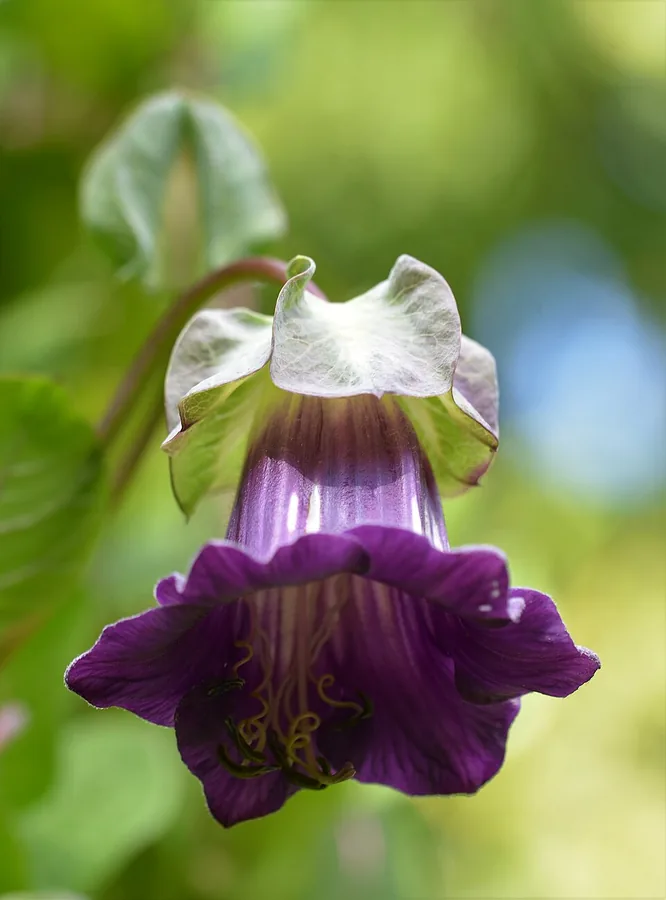
Few climbers carry a scheme the way cup-and-saucer vine does, and the name tells you why: a deep bell of a cup poised on a wide, leafy green saucer of a calyx. The flowers open a soft creamy green and settle into a rich violet-purple, so a single plant offers a shifting two-tone display across a wall or arbor. It comes from the highlands of Mexico, which is why cooler gardens treat it as a tender plant for the season rather than a permanent fixture.
Its real gift to a garden is scale, and quickly. From a late-winter sowing it reaches 10 to 20 feet or more in one season, taking hold of whatever it meets through branched tendrils at the leaf tips. Train it over a fence, an arbor, or a tall trellis and it transforms the structure into a green-and-purple backdrop by late summer.
For all that drama, it makes a relaxed companion to a planting once settled. It asks only for a strong support, full sun, and a measured hand at feeding, since rich soil and heavy nitrogen leave a wall of leaf and little color. Strike that balance and it furnishes the garden with flowers from summer until the first frost.
Care
The short version: give it full sun, a tall sturdy support, and steady even moisture in fertile but not over-rich soil, keeping the nitrogen light so it earns its place with flowers rather than a mass of leaf.
Light
Place this vine in full sun for the fullest flowering, though it will accept a touch of afternoon shade. A warm, sunny wall is the spot it loves, since the gathered heat lifts both the growth and the bloom.
Water
Keep the soil evenly moist through the season and water on a regular rhythm while the vine is climbing. Don't let it parch in hot weather, but see that the ground drains freely, because it has no patience for soggy soil.
Soil
It settles into loam, sand, or clay wherever drainage is sound, across a pH of 5.5 to 7.5. Choose fertile ground over heavily enriched soil, since too much richness turns the display toward leaf at the expense of flower.
Temperature
The vine takes a wide swing of roughly 25°F to 90°F (-4°C to 32°C), but it cannot stand a hard frost. Treat it as tender and bring it outdoors only once the cold has truly cleared.
Humidity
Everyday outdoor humidity suits it, so there is no figure to chase. What counts more is air moving through the foliage, which keeps the sap-feeding pests it attracts in check.
Feeding
Feed monthly through spring and summer with a balanced or lower-nitrogen liquid feed. Keep the nitrogen light, because too much grows a leafy plant that flowers poorly and undoes the whole effect.
Pruning
Grown for a single season, it barely needs pruning. Pinch the young tips to encourage branching and tie the stems to their support as they rise. Where it lives on as an evergreen, cut it back in late winter to shape it and clear any diseased growth.
Repotting
Pot the seedlings on as they grow, then set them out once the frost has passed. For a container, move it to a roomier pot when the roots fill the old one or begin to slip out the drainage holes.
Size & spacing
This is a generous climber, reaching 10 to 20 feet (3 to 6 m) in one season with a spread of 3 to 6 feet (91 to 183 cm). Allow it that much space and a support tall enough to carry the display.
When to plant
This is a vine for the warm half of the year, and frost draws the curtain on it. Sow the seed indoors in late winter, set the young plants out only after the cold has lifted and the soil has warmed, and the display runs from summer right up to the first frost.
Northern hemisphere
Southern hemisphere
Typical months for a temperate climate: start earlier in warm zones, later where spring frosts linger.
- Sow: Start seed indoors about 8-10 weeks before last frost; sow seeds on edge and keep warm (about 68-72 degrees F), germinating in roughly 14 days.
- Plant: Transplant out after all danger of frost has passed and soil is warm.
- Harvest: Blooms summer into fall until frost; flowers open creamy-green and age to deep violet-purple, each cup sitting on a leafy green calyx saucer.
Hardiness
USDA hardiness zones: 9–11
Temperature: down to -7°C
Troubleshooting
The handful of things that unsettle this vine are easy to read and quick to put right, which keeps the display on track. The common ones are a plant that turns to leaf rather than flower, sap-feeding insects sheltering beneath the foliage, and stems left with nothing to climb. Match the picture below and act early.
A green curtain with too few flowers
A vine that reads as pure foliage misses the whole point, which is the display, and the culprit is usually too much nitrogen steering it toward leaf rather than bloom. A short, cool season or a shaded position dims the show as well. Pull back on the nitrogen, give it a sunny wall where it can bask, and start the seed a little earlier so the flowering season has room to perform.
Fix:
- Reduce nitrogen and switch to a balanced or lower-nitrogen fertilizer
- Site in full sun against a warm wall or trellis
- Start seed earlier indoors (8-10 weeks before last frost) to lengthen the growing season
A would-be feature left sprawling on the ground
A vine meant to dress a wall does nothing for a space when it pools on the ground, and the fix is simply giving it the right structure. It climbs with branched tendrils at its leaf tips, so it needs a tall, sturdy frame to make the most of, or the quick stems wander and smother their neighbors. Set a handsome trellis, fence, arbor, or wall in place before planting, then guide and loosely tie the young stems until the tendrils take the lead.
Fix:
- Install a tall sturdy trellis, fence, arbor, or wall before or at planting
- Guide and loosely tie young stems onto the support until tendrils take hold
Tired-looking foliage with curl and yellowing
When the foliage loses its polish and starts to curl or yellow, sap-feeding insects are usually behind it, dulling the look of the whole display. The undersides may hide soft aphids, fine spider mites with their wisp of webbing, or whiteflies that drift up when the plant is touched. A firm rinse of water clears most of them, and a follow-up of insecticidal soap or horticultural oil on the undersides restores the foliage to its best.
Fix:
- Spray off pests with a strong jet of water
- Apply insecticidal soap or horticultural oil, covering leaf undersides
- Repeat treatment and improve air circulation
Toxicity
Reassuring for households with pets and children: cup-and-saucer vine is not toxic. It does not appear on the ASPCA's poison lists, and no poisoning has been recorded in animals or people, so it can dress a fence or arbor where the whole family passes by. It earns its place as a thing of beauty, not a crop.
Safe for
People · Cats · Dogs · Horses · Rabbits · Livestock · Birds
Cats None
A welcome plant in a home with cats. A curious nibble might bring a passing bout of stomach upset, as any new leaf can, but nothing in this vine holds a toxin that could truly harm one.
Dogs None
Dogs sharing the garden have nothing to fear. A chewed stem or leaf does no harm, though a big mouthful of any plant can leave the stomach briefly unsettled.
Horses Safe
Safe to keep where horses graze, with nothing on record to suggest the foliage troubles a horse that helps itself to a taste.
Rabbits Safe
An easy companion around rabbits, since none of its parts carry a toxin known to give them trouble.
Livestock Safe
Comfortable near grazing stock, with no poisoning reported in cattle, goats, or sheep.
Birds Safe
Safe to grow around birds, whether kept or wild, as the leaves and flowers hold nothing flagged as toxic to them.
People Safe
Harmless to people, and a child who picks up a stray leaf or flower is in no danger, though it earns its place for beauty rather than the table.
No special handling required; wash hands after gardening as a general practice.
Varieties
The straight species drifts from green to purple as the flowers age, while a few named selections settle on a single tone to suit a scheme. These are the ones worth knowing.
'Alba'
A serene white form whose cups stay creamy-white for a softer, more understated scheme rather than aging to violet-purple.
'Key Lime'
A fresh, cool option whose flowers hold a green to chartreuse lime tone instead of turning purple.
'Royal Plum'
A dramatic choice for a moodier palette, carrying the richest, deepest purple the vine offers.
How to propagate
Raise cup-and-saucer vine from seed for a generous, season-long display, or take cuttings when a particular color needs to carry through a planting.
SeedEasy
Start indoors 8-10 weeks before last frost; transplant out after frost. · Germinates in about 14 days at 68-72 degrees F; can be slow to start, then grows rapidly.
Most gardens begin this vine from seed, the simplest route to a full season of bloom. Set each seed on edge and keep the tray warm at 68°F to 72°F (20°C to 22°C), starting 8 to 10 weeks before the last frost. Germination is unhurried at about 14 days, after which the seedlings race ahead, so move them outside only once the frost has passed.
Stem cuttingsModerate
Spring or summer during active growth · Several weeks to root
When a particular color is meant to anchor a scheme, take softwood cuttings in spring or summer while the vine is in full growth, since seed will not reliably hold the shade. Allow the cuttings several weeks to root before they are ready to plant on.
Myths
A vine this exotic and tropical-looking is bound to be hard and slow to grow.
The opulent bell-shaped blooms give it a fussy reputation, yet it is easy and remarkably fast from seed, climbing 10 to 20 feet or more in a single season. In cold climates it simply becomes a warm-season annual, replanted each spring for a fresh display.