Ornamental · Asphodelaceae
Daylily
Hemerocallis fulva
Effortless and quietly generous, the daylily gives a summer garden a fresh bloom every morning to wake up to.
Full sun
Every 7–14 days
USDA 3–9
2–6 ft · 0.8–1.8 m
Overview
The daylily keeps a gentle daily ritual that suits the rhythm of a home. A flower opens with the morning, fades by the time the evening winds down, and the next dawn brings another on the same scape, so the border refreshes itself while you go about your day. A clumping perennial with roots in Asia, it now settles easily across the temperate world, equally at ease anchoring a considered border or softening the wilder edge of a property by a roadside ditch. Few plantings feel this relaxed.
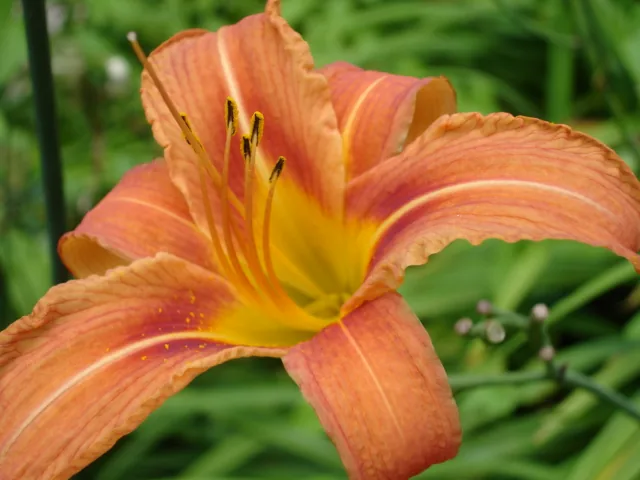
Rising from thick, fleshy roots, it forms arching, grass-like mounds and tall stalks that carry color through the warmest weeks of the year. The plain orange fulva roams freely by rhizome and lends itself to a loose, naturalistic stretch of ground, while named hybrids hold a tidy shape for a structured bed and arrive in nearly every shade but true blue. There is a table-side pleasure to it too, since the flowers and buds are edible, with a sweet, mild taste worth folding into a summer menu.
One consideration shapes where this plant belongs in a household. Daylilies are deadly to cats, and the smallest taste of leaf, flower, or pollen can shut down a cat's kidneys. A home shared with a cat calls for a careful decision before planting, and cut daylilies have no place in an indoor arrangement.
Care
The short version: full sun and average well-drained soil, a moderate drink through the season, and a clump divided every few years to keep the display generous.
Light
A daylily earns its keep in full sun, where 6 or more hours a day keep the display full. It accepts partial shade for a shadier corner of the garden, though dimmer light leaves the plants stretched and the flowers fewer.
Water
A moderate, even drink through the growing season suits it, on the order of every 7 to 14 days once it has settled into a bed. It rides out a dry stretch with more grace than most perennials, yet steady moisture is what carries the fullest, most generous flush of bloom.
Soil
Almost any well-drained loam makes a fine home, and a little organic matter rewards the effort. It prefers a pH of 6.0 to 7.0, though it will hold its own in the poor or heavy clay corners of a garden where choosier plants sulk.
Humidity
Ordinary outdoor air is all it asks, so there is no figure to manage. What pays off instead is open space and good airflow around the crown, since the rots that trouble daylilies settle into warm, stagnant damp.
Feeding
A daylily is a light feeder that keeps maintenance low. One spring dose of balanced general-purpose fertilizer carries most plantings comfortably through to the end of the season.
Pruning
A daily habit of deadheading the spent flowers keeps a planting looking its best, and the flower scapes come off once the show is over. The dead foliage is cut back in late fall or early spring, ahead of fresh growth.
Size & spacing
Plants stand 2.5 to 6 feet (76 to 183 cm) tall by variety and settle into clumps 24 to 30 inches (61 to 76 cm) wide, so they read as a mass in a border. Leave each one breathing room so air moves freely around the crown.
When to plant
As hardy perennials for zones 3 through 9, daylilies return on their own and become a fixture you plant around for years. Settle new plants in during spring or early fall once hard frost has passed, and let the garden build toward its high summer peak across July and August.
Northern hemisphere
Southern hemisphere
Typical months for a temperate climate: start earlier in warm zones, later where spring frosts linger.
- Sow: Not typically grown from seed by home gardeners; hybrids do not come true from seed.
- Plant: Spring or early fall, after the danger of hard frost has passed.
- Harvest: Summer, roughly July to August in the temperate northern hemisphere.
Hardiness
USDA hardiness zones: 3–9
Temperature: down to -40°C
Troubleshooting
Part of the appeal is how little drama this plant brings to a garden, since daylilies stay about as trouble-free as a perennial gets and most issues are merely cosmetic. Match what you notice below and step in before a small problem touches the wider planting.
The crown gives way in warm, humid spells
Southern blight arrives with hot, muggy weather, rotting the crown and casting a white web of threads across the soil studded with tan, seed-sized sclerotia. An infected plant is beyond rescue. Lift it out with the soil around it, then correct the drainage and keep mulch pulled clear of the crown so the trouble does not return.
Fix:
- Remove and destroy infected plants and surrounding soil
- Improve drainage and air circulation
- Avoid burying the crown too deeply
Older clumps crowd in and flower less each season
A fast rhizome spread means that after a few seasons a clump grows so dense that the center thins and the display dims. The remedy is simple division. Lift the clump in early spring or just after bloom, part it into fans, and replant each with the crown at soil level to restore the planting.
Fix:
- Dig and divide the clump in early spring or after bloom
- Replant divisions with the crown at soil level
Pale winding trails marking the foliage
The culprit is the daylily leafminer, a larva that feeds within the leaf and leaves its meandering mines behind. A leaf held to the light shows the tracks plainly. The blemish reads worse than it is and never threatens an established clump, so the badly marked leaves come off and the planting carries on unbothered.
Fix:
- Remove and destroy heavily mined leaves
- Maintain plant vigor with adequate water and division
Toxicity
For a cat-keeping household, this is the line that settles the question. Daylilies are deadly to cats, and swallowing any part, even pollen groomed off the fur or a sip of vase water, can cause fatal kidney failure within hours. Dogs and horses fare far better, and the flowers grace a plate for people, but a cat has no safe margin at all.
Toxic to
Cats · Dogs · Horses · Rabbits · Livestock · Birds
Safe for
People
Cats Severe
For a cat this is an outright emergency. Even a nibble of leaf or flower, a lick of pollen off the fur, or a sip of vase water can set off acute kidney failure that turns deadly within hours. The early signs are vomiting, a refusal to eat, and deepening lethargy, which give way to full renal shutdown. The cat needs a vet at once, because treatment works only when it begins early.
Dogs Mild
Dogs come through far more easily than cats. A dog that chews the plant may drool or have a brief bout of vomiting or loose stools, but it never faces the kidney danger that makes daylilies so deadly to cats.
Horses Mild
In horses, grazing the foliage usually amounts to no more than a mild stomach upset, with a little drooling or loose manure after a larger helping.
Rabbits Caution
How daylilies affect rabbits is not well documented, so the plant is best treated as off limits, with no grazing of the foliage or flowers.
Livestock Caution
Firm data on grazing animals is thin, so keeping cattle, goats, and sheep away from daylily stands is a sensible precaution rather than a gamble on an untested plant.
Birds Caution
The effect on pet and backyard birds is unstudied, so cuttings and pollen are best kept out of reach until more is known.
People Flowers edible
For people the flowers and buds are edible, sweet and mild, with a long place in the kitchen, which makes them safe to enjoy in moderation. That is never a reason to ease up around cats, for whom any contact can be fatal.
A feline emergency: keep all parts of the plant, fallen pollen, and any cut-flower water completely away from cats.
Helpline numbers

United States
ASPCA Animal Poison Control: (888) 426-4435 (fee applies)

United Kingdom
Animal PoisonLine: 01202 509000 (fee applies)

Australia
Animal Poisons Helpline: 1300 869 738
Varieties
The registered hybrids run into the tens of thousands, an embarrassment of choice, yet a few species and enduring favorites anchor the group and give a planting its bones. These are the ones to know first.
Hemerocallis fulva (Orange / Tawny daylily, 'Ditch lily')
A vigorous, rhizome-spreading species in rusty-orange and unscented, it has settled along roadsides so widely across North America that it picked up the everyday name ditch lily.
Hemerocallis fulva 'Kwanso'
A double-flowered form layered with extra petals and lacking working stamens, it sets no seed and travels only by its rhizomes.
Hemerocallis lilioasphodelus (lemon daylily)
An early-season bloomer in fragrant clear yellow, it makes an elegant counterpoint to the unscented orange of the common fulva.
Hemerocallis 'Stella de Oro'
A compact hybrid that reblooms all season, it sends up one wave of golden-yellow flowers after another.
How to propagate
Filling a bed costs almost nothing here, because daylilies multiply with ease and division is the only method most gardeners need to turn one clump into a sweep.
DivisionEasy
Early spring as new growth emerges, or in fall after blooming has finished. · Divisions typically reestablish and resume strong growth within one growing season, often blooming the following year.
Division is the natural way to multiply daylilies, done in early spring as new growth pushes up or in fall once the flowers fade. Lift the clump, ease it apart into fans that each keep roots and a crown, and reset them at the original depth across the bed. Their fast rhizome spread means divisions usually settle in within a single season, often returning to bloom the next year.
Myths
Daylilies are true lilies, so they threaten cats exactly as any other lily does.
On paper the distinction holds: daylilies belong to Hemerocallis and sit outside Lilium, the true lily genus, so the botany genuinely differs. The risk, though, lands in the same place. Both cause acute kidney failure in cats and must be kept well away from them.
Daylily flowers are poisonous to people the way they are to cats.
For people the flowers and buds are edible, with a sweet, mild flavor that has earned them a place at the table for centuries. None of that extends to cats, for whom even a small exposure can be fatal.