Houseplant · Asphodelaceae
Haworthia
Haworthia
Give it bright indirect light and a long dry spell between drinks, and this little windowed succulent asks for almost nothing.
Bright indirect
Every 14–21 days
59–81°F · 15–27°C
USDA 9–11
Overview
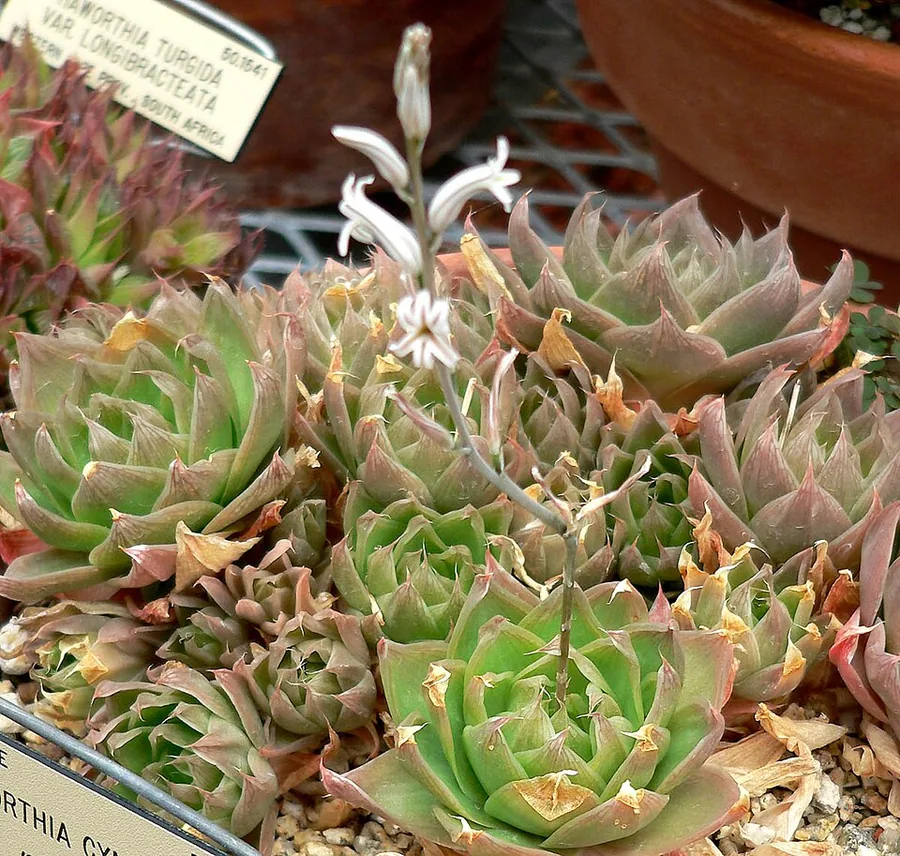
Haworthia is a small rosette succulent from the dry corners of southern Africa, and it has quietly become a favorite of anyone furnishing a home with living things. It brings a composed, low-key presence to a room, small enough to sit on a desk corner, a bathroom ledge, or a shelf of books without ever demanding the spotlight. At just 3 to 6 inches (8 to 15 cm) across, it settles into the odd gaps a larger plant could never fill.
What makes it such an easy houseguest is how little it minds a shaded corner. Rooms that leave a sun-loving echeveria pining stay perfectly comfortable for a plant that grows wild in part shade, so it earns a place on a north-facing sill or an interior shelf where the light is soft. That flexibility lets it anchor a quiet vignette almost anywhere the eye wants a small point of green.
It also asks remarkably little of a daily routine, which is much of its appeal. Because it would rather be left dry than fussed over, it suits a busy household and a hands-off week, slipping easily into the rhythm of a home rather than adding to the to-do list. Over time it offers up a cluster of offset pups, an unforced way to spread the same calm note into other rooms.
Care
The short version: bright indirect light, a gritty fast-draining mix, and one thorough watering only after the soil has dried through. Ease off in winter, feed lightly in the growing season, and never leave it sitting in water.
Light
Place it in bright indirect light near a window that escapes the harsh midday sun. It holds up in medium or even low light better than most succulents, which is what lets it live happily on an interior shelf, though too much direct sun turns the leaves red or brown.
Water
Let the soil dry completely before watering, then soak it until water runs from the base. Through the growing season that lands at roughly every 14 to 21 days, and much less in winter. It is highly prone to root rot, so when the timing is uncertain, hold off.
Soil
Give it a gritty cactus or succulent mix that drains fast and never stays soggy. A pH anywhere from 6.0 to 7.5 suits it, and a pot with drainage holes matters far more to its health than the exact blend.
Temperature
Ordinary room warmth is ideal, somewhere between 59°F and 81°F (15°C to 27°C), which is simply the comfort range of most living spaces. Keep it clear of cold drafts and frost, since it has no tolerance for freezing.
Humidity
Low household humidity is precisely what it prefers, so no tray or mister enters the picture. Dry indoor air suits it well and quietly helps keep rot at bay.
Feeding
Feed lightly through spring and summer while it grows, using a balanced liquid fertilizer at half strength. An occasional feeding across the season is ample for so slow a grower, and none is needed once winter arrives.
Pruning
There is next to nothing to tend here. Simply remove the dead, dried, or damaged outer leaves and trim away spent flower stalks once they fade.
Repotting
Move it up every 2 to 3 years, or sooner once offsets crowd and lift from the pot. Roots emerging at the drainage holes or soil that dries unusually fast are the other signs it is ready for a fresh container.
Size & spacing
This is a small, contained plant, reaching only 3 to 6 inches (8 to 15 cm) tall and about as wide. A snug pot flatters it, and a few together can share one shallow dish with a little breathing room between the rosettes for a considered tabletop grouping.
Troubleshooting
Nearly every haworthia concern traces back to water or light, and the plant makes its needs plain before matters get serious. Take a moment with the leaves and the rosette, then find the match below and set it right.
Soft, blackened leaf bases and a collapsing center
The trouble here is root and crown rot, the single failure that undoes more haworthias than anything else, and it sets in when the roots linger in wet, slow-draining soil. Ease the plant from its pot, pare away every soft brown root with a clean blade, and let the cuts dry. Return it to a dry gritty mix and it can begin again.
Fix:
- Stop watering immediately
- Unpot and cut away all soft, rotted roots and tissue with a clean blade
- Allow cuts to callus, then repot into fresh dry gritty mix
- Resume watering only sparingly once established
Softening, wrinkled leaves that have thinned
A wrinkled rosette is simply an underwatered plant living off the reserves it keeps in its own leaves. Confirm the soil has gone dry to the base, then give it a slow, generous drink until water clears the drainage holes. Within a few days the leaves recover their fullness and the plant looks composed again on the shelf.
Fix:
- Water thoroughly until it drains from the bottom
- Allow excess to drain fully
- Return to a regular dry-then-water cycle
A red, orange, or brown cast across the leaves
A warm flush across the rosette is sun stress rather than disease, and it settles first on the side that meets the window. Draw the plant back into bright indirect light and the change stops there. The marked leaves keep their color, but the growth that follows returns to its usual calm green.
Fix:
- Move the plant to bright indirect light
- Shade from intense midday sun
- Damaged leaves will not recover but new growth returns to normal color
A pale, stretched rosette losing its tidy form
When a room runs dim the plant reaches toward the light, a loosening known as etiolation, and its composed silhouette gives way. The rosette pales, tips toward the window, and the once-snug leaves drift apart. Move it to a spot with strong indirect light and turn the pot now and then so it settles back into an even, shapely form.
Fix:
- Move to a brighter spot with bright indirect light
- Rotate the pot regularly for even growth
Toxicity
A reassuring note for a home with pets or children: haworthia is non-toxic and pet-safe. It is absent from the ASPCA's toxic list, and nothing in the leaves poses a hazard to a cat, dog, or inquisitive child. A stray nibble may bring a passing stomach ache from the fibrous tissue, but never poisoning.
Safe for
People · Cats · Dogs · Horses · Rabbits · Livestock · Birds
Cats None
A welcome addition to a home with a cat. Should one steal a nibble, expect nothing worse than a fleeting bit of stomach upset, never anything poisonous.
Dogs None
No poisoning risk where a dog shares the room. A committed chewer might feel briefly unsettled by the fibrous leaves, and that is all.
Horses None
Harmless to horses, and far too small a plant to ever draw one's attention in the first place.
Rabbits None
No cause for concern should a rabbit take a bite, as the thick succulent leaves carry no toxins.
Livestock None
No risk to grazing animals, and as an indoor piece it seldom finds its way into their surroundings.
Birds None
Safe alongside pet birds, with no toxic compounds in the leaves to give a second thought.
People None
No poisoning risk to people, children included. It is kept for its looks rather than the table, so there is no call to taste it, and a stray nibble does no harm.
Varieties
The genus holds dozens of species, though only a few turn up regularly in homes and shops. These are the ones worth recognizing when you go looking.
Haworthia cooperi
Its plump, rounded leaves finish in translucent windows that seem to glow whenever light reaches them from behind.
Haworthia cymbiformis
Boat-shaped leaves gather into a tidy rosette, each carrying faint window markings toward the tip.
Haworthia retusa
A star-shaped rosette of triangular leaves whose flattened upper faces stay clear and translucent.
Haworthia truncata
Its leaves read as sliced off flat across windowed tops, arranged in a line reminiscent of a horse's teeth.
How to propagate
Haworthia multiplies with almost no effort, and one settled plant tends to furnish every other shelf in the house before long.
Offsets & pupsEasy
Spring to summer during active growth · 4 to 8 weeks to root
The simplest way to build a collection is to lift the offsets, the small pups that gather at the base, during spring or summer while growth is active. Ease each away from the parent, let the cut end dry for a day or two, and settle it into dry gritty mix. Roots take hold in about 4 to 8 weeks.
DivisionEasy
Spring, often at repotting · 4 to 8 weeks
When a clump has filled out into several crowded rosettes, spring repotting is the moment to divide it. Work the roots gently apart so each rosette keeps its own, then give them separate pots. They settle in over roughly 4 to 8 weeks.
Leaf cuttingsModerate
Spring to summer · Several weeks to a few months
A single leaf can also become a new plant in spring or summer. Remove a healthy leaf in full, let it callus, and rest it on dry mix. It is the slower and less certain route beside the pups, sometimes taking several weeks to a few months to root.
Myths
Haworthia needs full, direct sun all day like a desert cactus.
In its native range it lives sheltered in part shade among rocks and grasses, not exposed to open glare. It looks its best in bright indirect light, while harsh direct sun scorches and discolors the leaves.
Haworthia is a kind of aloe.
The two were once grouped together and still share the family Asphodelaceae, which is where the confusion takes root. In truth, haworthia is its own genus of small rosette succulents, quite apart from the true aloes.