Houseplant · Asphodelaceae
Zebra Haworthia
Haworthiopsis attenuata
Set it in bright indirect light and forget it between waterings, and this striped succulent brings quiet structure to any shelf.
Bright indirect
Every 14–21 days
50–77°F · 10–25°C
USDA 9–11
Overview
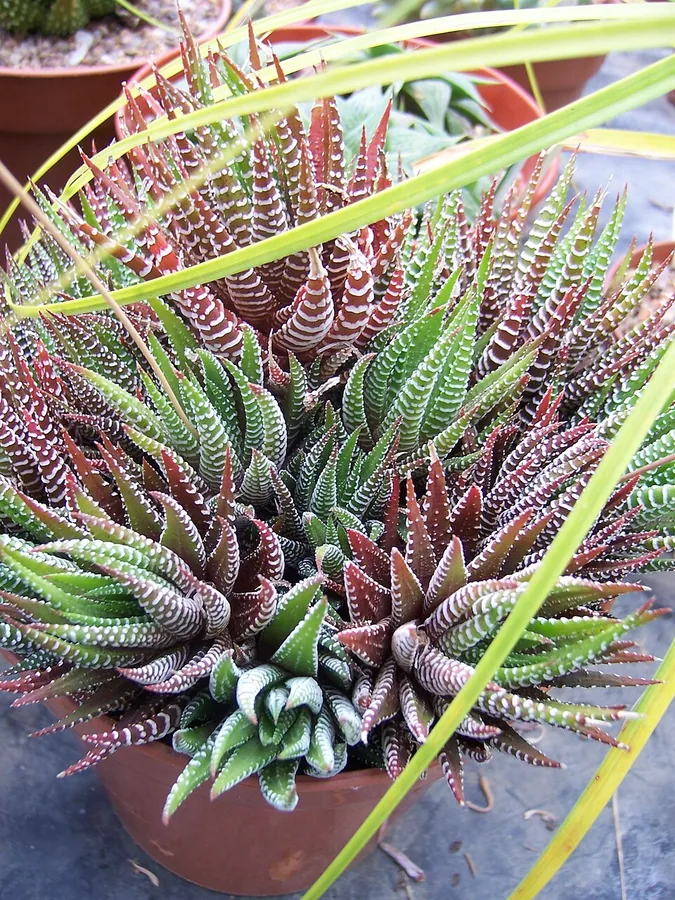
The zebra haworthia is a small, unhurried succulent, its dark leaves marked with the pale white stripes that give it a graphic, tailored look. Everything gathers into a tidy rosette that keeps its shape for life and rarely stretches beyond 4 to 6 inches (10 to 15 cm), which is precisely why it earns a place on a sunlit windowsill, a working desk, or a low bowl among other succulents.
A member of the Asphodelaceae from South Africa, it grew up in the filtered shade of taller plants rather than open desert, and that pedigree shapes where it looks its best at home: a spot with bright indirect light rather than a scorching sill. In spring or summer a settled plant may lift a slim stalk of small tubular white flowers, a fleeting flourish, though its real appeal is the year-round poise of the foliage.
Part of its charm is how little it asks of a busy household. The thick leaves keep their own water, so it takes a forgotten watering in stride and prefers to run dry between drinks, an easy fit for anyone who travels or simply forgets. The one thing to design around is drainage, since standing moisture is what undoes it.
Care
The short version: give it bright indirect light, a gritty mix that drains freely, and a generous soak only once the soil has dried out. Pull back in winter, and it settles into the background of daily life without fuss.
Light
Position it in bright indirect light, the soft glow beside a window that never takes the full midday glare. Partial sun and medium indirect light suit it as well, but keep it clear of harsh direct rays, which scorch the leaves and drain their color from a display.
Water
Water it deeply, then let the mix dry out completely before the next round, a rhythm that usually lands every 14 to 21 days. The plump leaves keep their own reserve, so leaning dry always flatters it more than leaning wet. Scale right back in winter, when lingering moisture turns quickly to rot.
Soil
Plant it in a gritty cactus or succulent mix that drains freely and never sits wet. A pH of 6.0 to 7.5 suits it, which means the feel of the mix matters far more to its long-term look than any fine-tuning of chemistry.
Temperature
Ordinary room warmth keeps it content, ideally between 50°F and 77°F (10°C to 25°C). Keep it well away from frost and cold drafts, since a chill is one thing it cannot weather.
Humidity
This is a low-humidity plant, entirely at ease in the dry air of a heated or air-conditioned room. There is no misting to schedule and no gadget to buy, and damp, stagnant corners only work against it.
Feeding
Feeding barely registers on the calendar. Through spring and summer, offer a dilute, half-strength low-nitrogen cactus or succulent fertilizer now and then across the season. Set it aside through autumn and winter while the plant rests.
Pruning
Upkeep stays minimal. Ease away the withered outer leaves and any spent flower stalk at the base, and the tidy silhouette looks after itself. There is no shaping or cutting back to schedule.
Repotting
Repot only every 2 to 3 years, or a little sooner once pups fill the pot. The cues are simple: offsets pressing at the rim, roots slipping through the drainage holes, or a mix that dries almost as soon as you water.
Size & spacing
It stays small by design, reaching about 4 to 6 inches (10 to 15 cm) tall and roughly as wide, an ideal scale for a shelf or a grouped vignette. A single rosette anchors a small pot, while a cluster of pups makes an easy, low arrangement in one shallow dish.
Troubleshooting
Nearly every misstep with this plant comes down to water or light, and the rosette wears its history plainly. Read the early cues on the leaves, match them below, and a quick adjustment usually restores its composure.
Base leaves turning soft, mushy, and translucent
Soft, translucent leaves at the base signal root and crown rot, almost always from water pooling in a mix that drains too slowly. Stop watering, ease the plant from its pot, and cut away every soft brown root with a clean blade. Let the wounds callus, settle it into dry gritty mix, and offer only a light drink once it has found its footing again.
Fix:
- Stop watering immediately
- Remove the plant and cut away all soft, rotted tissue with a clean blade
- Allow cut surfaces to callus, then replant in fresh dry gritty mix
- Resume watering sparingly only once re-established
Pale, stretched growth with widening gaps between leaves
The stretching is etiolation, the plant leaning toward light it is not receiving. The neat rosette loosens and the whole form tips toward the window, and the tidy look goes with it. Move it into steady bright indirect light and turn the pot from time to time so it fills back out evenly.
Fix:
- Move to a brighter location with bright indirect light
- Rotate the pot periodically for even growth
Leaves flushing red, orange, or bleaching to white
That flush of color is sunburn, surfacing on whichever side meets the strongest light, usually after a move to a brighter spot. Return it to bright indirect light and shield it from fierce midday sun. When a brighter position is the goal, build up the exposure over a week or two so the plant can adjust in step.
Fix:
- Move to bright indirect light
- Shade from intense midday sun
- Acclimate gradually to brighter spots over one to two weeks
Toxicity
For homes with pets, it is an easy choice. The zebra haworthia is non-toxic and pet-safe, at home alongside cats, dogs, and the rest of the household. It never appears on the ASPCA toxic list, and nothing in the leaves will poison a curious visitor. The most a determined chewer might feel is a passing stomach upset from the sheer firmness of the leaves.
Safe for
People · Cats · Dogs · Horses · Rabbits · Livestock · Birds
Cats None
It is safe company for cats, with no toxic reaction to expect. Should one gnaw a leaf or two, the worst is a brief upset stomach, no different from any plant it was never meant to sample.
Dogs None
Dogs face no poisoning risk. A curious dog that chews the firm rosette may drool or bring a little back up from the bulk, yet nothing in the plant can do harm.
Horses Safe
Nothing here is toxic to horses, and as a small windowsill succulent it rarely crosses their path in the first place.
Rabbits Safe
It is safe for rabbits, its thick, tough leaves holding no toxins, even if they hardly amount to a tempting snack.
Livestock Safe
Grazing animals such as cattle, goats, and sheep are in no danger, as it carries nothing that would trouble them.
Birds Safe
Pet birds are perfectly safe alongside it, since it holds nothing toxic, and the dense leaves are too firm for most to bother with.
People Safe
It is harmless to people, children included. No one keeps it to eat, but a curious taste brings nothing worse than a possible mild stomachache.
Varieties
Only a few forms reach the market, and they are easily confused, not least with the unrelated namesake that borrows its common name. These are the ones worth knowing before you shop.
Haworthiopsis attenuata var. attenuata
This is the classic form, its raised white tubercles banding cleanly across both the upper and lower surfaces of each leaf.
Haworthiopsis attenuata 'Concolor'
Its white tubercles scatter evenly over the leaf rather than resolving into the crisp stripes most people picture.
Haworthiopsis fasciata (true zebra haworthia)
True fasciata keeps smooth inner leaf surfaces with tubercles only on the outside, though nearly every plant offered under that name turns out to be H. attenuata.
How to propagate
Once it feels at home, expanding a collection costs nothing at all. Lift the pups that gather at its base, or divide a crowded clump the next time it is repotted, and a single plant quietly becomes several.
Offsets & pupsEasy
Spring to summer during active growth · 4 to 8 weeks to root once potted
The simplest route to more plants is lifting the offsets, the pups that gather at the base of the parent. Take them in spring or summer during active growth, let any cut surface callus, then set each pup into dry gritty mix. A light drink once it takes hold sees roots follow within about 4 to 8 weeks.
DivisionEasy
At repotting in spring or summer · 4 to 8 weeks
A mature clump can also be divided when it is repotted in spring or summer. Ease it into rooted sections, keep each one dry until it establishes, and it settles comfortably over roughly 4 to 8 weeks.
Myths
The zebra haworthia is simply another name for the zebra plant, Aphelandra.
The two are unrelated plants that merely share a nickname. This one is a small Asphodelaceae succulent with striped, fleshy rosettes, while Aphelandra squarrosa is a leafy Acanthaceae plant grown for its large veined leaves and yellow bracts.
Zebra haworthia is a cactus that thrives in full desert sun.
It is a succulent in the Asphodelaceae, not a cactus at all, and in the wild it often keeps to partial shade. Indoors it looks its best in bright indirect light, and harsh direct sun will scorch the leaves.