Ornamental · Asphodelaceae
Red-hot Poker
Kniphofia uvaria
In full sun with sharp drainage, red-hot poker lifts a summer border with flame-colored spikes that carry the eye across the garden.
Full sun
Every 7–14 days
USDA 5–9
2–4 ft · 0.6–1.2 m
Overview
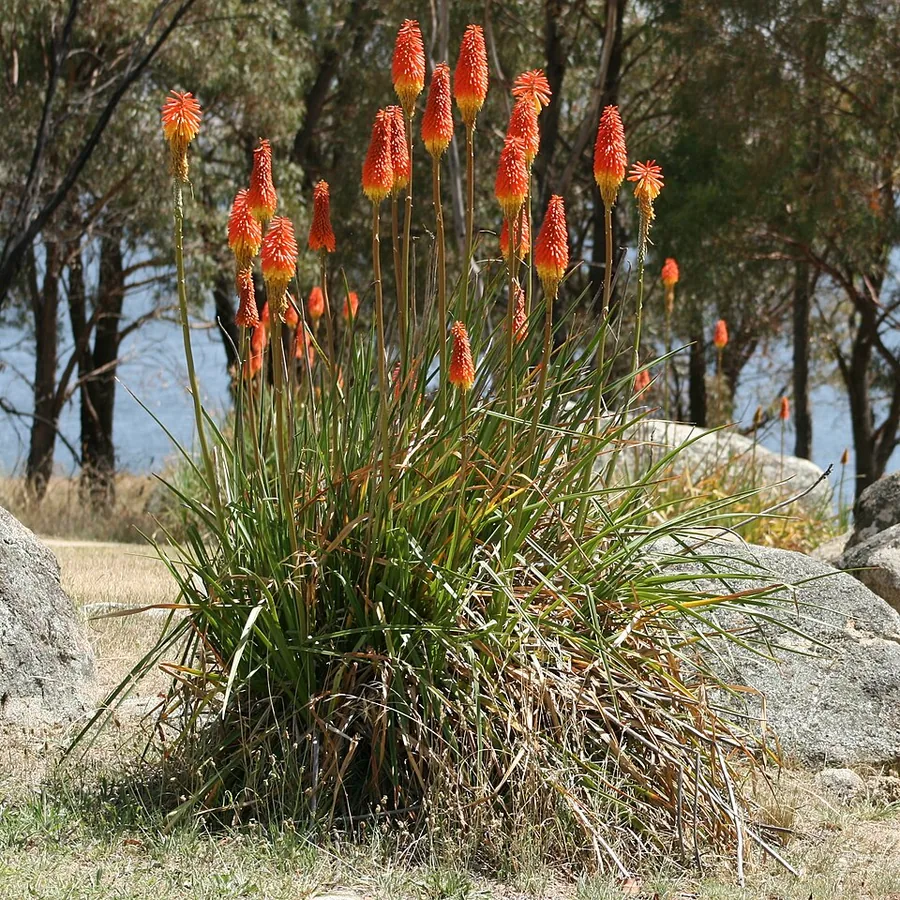
Red-hot poker earns its name and earns its keep in a border. Each stem raises a slender torch of tubular flowers that open red in bud and settle to yellow, so a spike holds two tones at once and gives a planting real movement. It grows as a grassy clump of arching leaves, an aloe relative with the same tough, fleshy character.
As a border perennial it is refreshingly easy, hardy through USDA zones 5 to 9 and content in a sunny spot with little fuss once it has taken hold. Heat, drought, and lean sandy ground leave it unbothered. The one setting it will not accept is wet, heavy soil pooled around its crown, so choose the site with that in mind.
It brings life as well as color. Hummingbirds and butterflies visit the nectar-rich spikes through the warm months, while deer and rabbits keep their distance. One practical note before planting: the species has turned invasive in some parts of the U.S., so consult local guidance first.
Care
The short version: give it a sunny, free-draining place and the rest follows. Water while it establishes, then let it stand on its own, keep the crown dry through winter, and remove finished spikes to keep the display going.
Light
Give red-hot poker full sun, ideally at least 6 hours of direct light, and place it where that light falls unbroken through the day. A little partial shade is tolerated, but a shaded spot trades the signature spikes for a mound of plain foliage.
Water
Keep the soil evenly moist while the plant settles, then step back, since an established clump carries itself through dry weather with ease. What undoes it is wet, heavy, or soggy ground, above all in winter, so choose a site that never stays waterlogged.
Soil
Set it in well-drained loam or sand of average to rich fertility, lightened with compost. Soil reaction hardly matters, since it accepts 6.0 to 8.0, acidic to alkaline, so the one thing to secure is a bed where water drains away quickly.
Humidity
Open garden air is all it wants, so there is no humidity figure to manage. The point that matters for placement is a spot where the crown and roots stay dry rather than damp.
Feeding
An all-purpose balanced fertilizer across the growing season, applied as needed, keeps it content. This is a plant at home in lean ground, so a restrained hand suits it far better than heavy feeding.
Pruning
Clip away spent flower spikes as they fade and fresh ones follow to extend the show. Leave the foliage in place over winter to shelter the crown, and in colder gardens mulch it or tie the leaves together so water cannot gather and freeze at the crown.
Size & spacing
In bloom a clump stands 2 to 4 feet (60 to 120 cm) tall and reaches 24 to 35 inches (60 to 90 cm) across, so it reads as a bold vertical accent. Allow each plant that footprint to keep its silhouette clean and the air moving through it.
When to plant
The plant keeps time with the warm season, and its calendar shapes the garden's high summer. Seed goes in indoors in late winter, plants or divisions settle into the border in spring once frost has cleared or in fall, and the spikes take center stage from early summer into early autumn.
Northern hemisphere
Southern hemisphere
Typical months for a temperate climate: start earlier in warm zones, later where spring frosts linger.
- Sow: Start seed indoors in late winter, about 6 to 8 weeks before the last frost
- Plant: Transplant or divide in spring after frost danger passes, or in fall
- Harvest: Late spring to early fall, with main flush from early summer; spikes are red in bud and mature to yellow
Hardiness
USDA hardiness zones: 5–9
Temperature: down to -29°C
Troubleshooting
For all its drama in the border, red-hot poker is undemanding, and nearly every setback traces to ground that holds too much water. A glance at the crown, the foliage, and the flower count keeps the display on track. Find the symptom below and address it before it spreads.
A soft, browning crown and a collapsing clump
The trouble is root rot, and it grows out of waterlogged ground rather than any pest or disease. Heavy soil and winter wet lingering in the crown are what bring it on. Open the bed with sand or compost, water with a lighter hand, and lift the plant to a raised, free-draining position if the site refuses to dry.
Fix:
- Improve drainage by amending with organic matter or sand
- Avoid overwatering and standing water
- Relocate to a raised or well-drained site if soil stays wet
A season with few spikes to show
The usual reason the spikes stay scarce is too little sun. Move the plant to an open, full-sun position with at least 6 hours of direct light and the flowers return. An old, crowded clump can also ease off, so leave a settled plant in place and divide it only once it grows congested.
Fix:
- Site in full sun with at least 6 hours of direct light
- Leave established clumps undisturbed
- Divide only when clumps become overcrowded
Silvered, mottled foliage losing its finish
The culprit is thrips, small insects that rasp the leaves and leave a silvery scarring behind. A close look turns up the slender bodies on the foliage. A sharp jet of water clears a light visitation, the worst-marked leaves are best removed, and an insecticidal control is worth reaching for only when they linger.
Fix:
- Hose off light infestations with water
- Remove and destroy heavily damaged foliage
- Treat persistent infestations with an appropriate insecticidal control
Toxicity
It earns its place in a family garden with an easy conscience, because red-hot poker is non-toxic throughout. The ASPCA clears torch lily for cats, dogs, and horses, with no poison to concern other animals or children. At most, a large mouthful of foliage leaves a passing stomach upset, as any greenery might.
Safe for
People · Cats · Dogs · Horses · Rabbits · Livestock · Birds
Cats None
The ASPCA lists torch lily as non-toxic to cats, so a curious taste in the border is no cause for worry. A cat that overindulges on any greenery may bring a little back up, though the leaves hold no poison.
Dogs None
Dogs may browse the foliage without harm, the plant being rated non-toxic to them as well. The most a leafy indulgence brings is a brief, passing stomach upset.
Horses None
Horses are safe in its company, cleared by the ASPCA alongside cats and dogs. Neither the leaves nor the flower spikes carry a toxin to trouble a grazing mouth.
Rabbits Safe
Nothing in the plant is poisonous to rabbits, and they tend to pass it over in any case, since it is noted as rabbit resistant. Most clumps go untouched in the border.
Livestock Safe
Cattle, goats, and sheep face no risk of poisoning from it. The tough, fibrous leaves rarely tempt a grazer, and a mouthful does no harm.
Birds Safe
No toxin here would trouble a bird. Hummingbirds and other pollinators are drawn to the nectar-rich spikes, one of the plant's quiet pleasures in a garden.
People Safe
Red-hot poker is safe to handle and to grow where children play. No part of it is eaten, yet a touch of the leaves or a fallen flower holds nothing to fear.
Varieties
The named selections trade mainly on color and scale, from mellow oranges to neat dwarfs that suit a smaller planting. These are the ones most often chosen for the border.
Echo Mango
A selection that softens the usual fiery red into warm, mango-orange spikes.
Redhot Popsicle
A compact Popsicle-series plant carrying bright red-and-yellow spikes across a notably long season of bloom.
POCO Orange
A dwarf of roughly 20 to 24 inches with clear orange flowers, a natural fit for a small bed or the front of a border.
How to propagate
A single clump can furnish a whole drift over time, whether divided or grown from seed, though either route rewards a patient gardener before the flowers arrive.
DivisionModerate
Spring or fall · One to two growing seasons
Dividing an established clump is the surest way to spread it through a border, undertaken in spring or fall. The root system is tough and vigorous enough that a spade, a saw, or even an axe may be needed to part a mature plant. New divisions find their footing over one to two growing seasons, so a thriving clump is best left where it stands.
SeedModerate
Start indoors in late winter or sow when ripe · Seed-grown plants may take a few years to reach flowering size
The species also rises from seed, sown indoors in late winter or fresh at ripeness. Patience is the price, since seed-grown plants often need a few years to reach flowering size. Seed taken from a hybrid rarely comes true, so the seedlings tend to stray from the parent.
Myths
Red-hot poker is a hazard to household pets.
The fiery palette suggests danger, yet none is there. The ASPCA lists torch lily (Kniphofia) as non-toxic to dogs, cats, and horses, so a curious taste calls for no alarm and no vet.
Cutting the plant back hard in fall is what keeps it safe.
The reverse holds true. Leave the foliage standing over winter to wrap the crown, and where cold sets in, bind the leaves together or mulch across them so water cannot pool and freeze at the plant's heart.