Shrub · Caprifoliaceae
Honeyberry
Lonicera caerulea
Set two cultivars together in the garden and gather the season's first berry, sweet-tart and frost-tough.
Full sun
Every 5–7 days
USDA 2–7
4–6 ft · 1.2–1.8 m
Overview
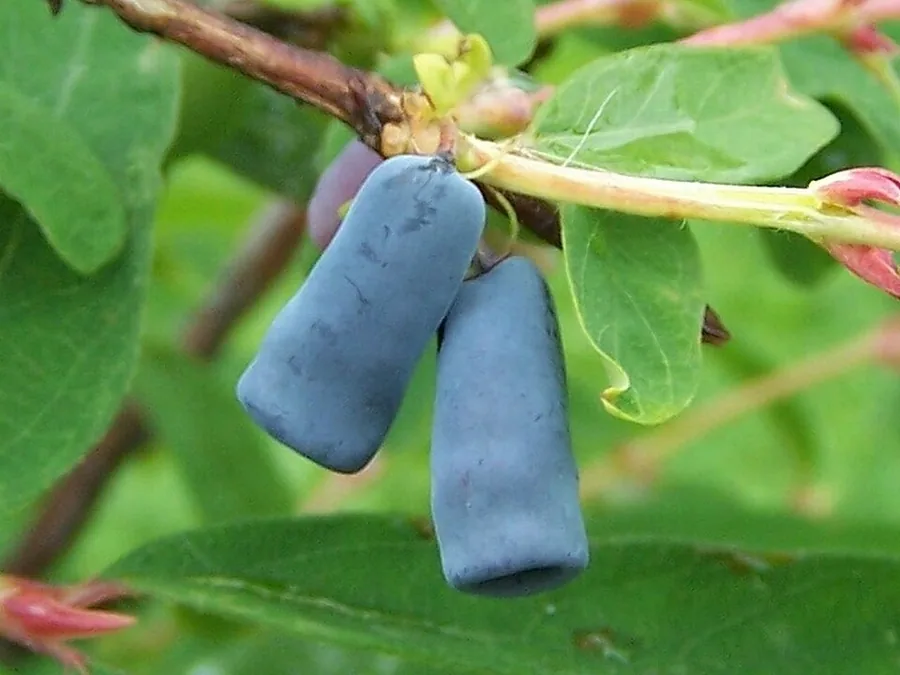
Honeyberry, or haskap, is the edible-fruited honeysuckle, and it earns its keep by handing over the first fruit of the whole year. It belongs to the honeysuckle family and grows wild along riverbanks and damp northern ground, a heritage that tells you where it wants to live: somewhere with steady moisture rather than a parched back corner. The flavor sits between blueberry and raspberry, at home in a morning bowl or set aside in the freezer for later.
As a garden presence, this shrub is quietly dependable, and that comes down to its toughness. The wood carries through cold to -45°C (-49°F), and the early flowers take frost to about 19°F, so a late chill rarely undoes the season. It settles into almost any bed as well, from acidic ground to chalky, limey soil, sparing you the fuss a blueberry would demand of a border.
The one thing it asks of a planting is companionship. A single bush blooms handsomely and then gives almost no fruit, because honeyberry cannot pollinate itself. Place two unrelated cultivars that flower together, let the bees drift between them, and the reward by late spring is heavy clusters of berries to bring indoors.
Care
The short version: give it full sun and steady moisture, settle a second compatible cultivar close by for pollination, and drape the bushes in netting against the birds as the early berries begin to color.
Light
Honeyberry fruits at its best in full sun, though it will accept partial sun or light shade with good grace. Where the summers run warm, a little afternoon shade is a kindness, easing the heat this cool-country shrub was never built for.
Water
This is no plant for a dry corner. Its riverbank heritage means it wants a deep soak every 5 to 7 days, and more through a heat wave. A quiet run of drip irrigation keeps the moisture even and the foliage dry.
Soil
Give it moist, well-drained loam and it asks little else. Honeyberry is remarkably adaptable across a pH from 5.0 to 8.0, at ease even in chalky, calcareous ground that most berries turn away from, so a border rarely needs amending on its account.
Temperature
Few fruiting shrubs match this one for hardiness. The wood carries through from -45°C to 30°C (-49°F to 86°F), and the spring flowers take frost to about 19°F, though a long, hot summer past zone 6 leaves it looking weary.
Humidity
The everyday outdoor range of 40% to 70% suits it perfectly well. Open air around the planting counts for more than any figure, since crowded, still conditions are what invite powdery mildew late in the year.
Feeding
A single early-spring feed of a balanced granular such as 16-16-16, about a half cup per plant, is all it wants. Late-season nitrogen is best avoided, as it draws out soft growth that will not firm up before winter.
Pruning
Let a young bush find its shape over its first 3 to 4 years, taking only dead or damaged wood. From around year 6, thin up to 25 percent of the oldest branches each dormant winter to keep the canopy open, airy, and cropping well.
Repotting
This is a shrub for the open ground, not the container, so repotting scarcely enters the picture. Should you begin one in a pot, move it to its lasting place once roots start to circle or water runs straight through.
Size & spacing
A settled bush stands about 4 to 6 feet (120 to 180 cm) tall and spreads to match. Allow that same width when placing it, so air moves freely through the planting and a pollination partner sits within the bees' easy reach.
When to plant
Honeyberry keeps to an early rhythm through the garden year. Set new plants in during early spring or early fall, look for cream-yellow flowers in the first mild days, and gather the ripe blue berries from late May into mid June, often before the strawberries arrive at the table.
Northern hemisphere
Southern hemisphere
Typical months for a temperate climate: start earlier in warm zones, later where spring frosts linger.
- Plant: Early spring or early fall
- Harvest: Blooms very early spring with cream-yellow flowers that tolerate frost to about 19°F; berries ripen late May to mid June, often just before strawberries
Hardiness
USDA hardiness zones: 2–7
Temperature: down to -46°C
Troubleshooting
Nearly every honeyberry concern comes back to one of three things: a missing pollination partner, birds at the early fruit, or summer heat in a spot that runs too warm for it. Read what the bush is telling you against the notes below and the answer is usually an easy one. Attend to it early and the season's harvest stays intact.
A garden full of flowers, a harvest of almost nothing
A lone honeyberry makes a lovely show and then leaves the fruit bowl empty, because the plant cannot pollinate itself. The graceful solution is to plant in pairs, setting a second, unrelated cultivar that blooms on the same schedule, such as Tundra with Aurora or Honey Bee, within about 6 feet of each other so the bees can move easily between them. A drift of early flowers nearby draws those pollinators into the scene while the season is still cool.
Fix:
- Plant at least two unrelated cultivars that bloom together (for example Tundra with Aurora or Honey Bee)
- Site them within about 6 ft of each other to aid bee transfer
- Encourage early-spring bees with companion flowers
A pale film dulling the late-summer foliage
The chalky bloom on the leaves is powdery mildew, which tends to arrive after harvest when the air turns warm and unmoving. It rarely spoils the fruit, though it can leave a bush looking bare before its time. Clear away the worst of the foliage, open up the planting so air can move through it, and favor a resistant cultivar like Tundra for a tidier look through the season.
Fix:
- Remove and dispose of badly affected foliage
- Improve spacing and airflow
- Choose mildew-resistant cultivars such as Tundra
Tired, scorched foliage where the summers run warm
Honeyberry belongs to cool country, so heat stress tells on it beyond zone 6, most of all in the Russian-type cultivars. The leaves brown at their edges and fall early, leaving the bush looking spent. A spot with afternoon shade and reliably moist soil keeps it comfortable, and the Japanese or Kamchatka types wear the warmth far more gracefully.
Fix:
- Provide afternoon shade and steady soil moisture
- Use Japanese or Kamchatka-type cultivars better suited to warmth
The season's first fruit disappearing to the birds
Birds discover honeyberry ahead of everything else in the garden, drawn by fruit that colors up so early in the year. The remedy is a simple one: lay bird netting over the bushes before the berries deepen to blue, and leave it through late May and June until the picking is done.
Fix:
- Drape bird netting over plants before fruit ripens
- Net in late May through June
Toxicity
Here the news is entirely welcome: every part of the honeyberry is safe. Its ripe blue fruit is grown as a food crop for people, and the leaves carry nothing that would harm pets, livestock, or wildlife. The only care worth taking is not to confuse it with the ornamental honeysuckles, whose red berries are not for eating.
Safe for
People · Cats · Dogs · Horses · Rabbits · Livestock · Birds
Cats None
A household cat is safe alongside honeyberry. A curious taste of leaf or berry carries no poison, though a large helping of any plant may leave a cat briefly out of sorts.
Dogs None
A dog is in no danger here. The blue berries are the very fruit the household eats, and the foliage holds nothing harmful.
Horses Safe
A horse can graze beside a honeyberry planting without worry, since fruit and foliage alike are free of toxins.
Rabbits Safe
Rabbits are at ease around honeyberry. A little browsing on the leaves does no harm, and a ripe berry or two is a gentle treat.
Livestock Safe
Cattle, goats, and sheep may browse the shrub safely, as it holds no poisonous compound to give a keeper pause.
Birds Safe
Birds delight in the early fruit and take no harm from it. The real challenge is simply keeping a share of the berries for the table.
People Safe
The ripe blue berries are raised as a food crop and enjoyed fresh, frozen, or folded into preserves. They ask for no special caution at the table.
No special handling required; ripe berries are edible and safe to pick by hand.
Varieties
Most honeyberry cultivars trace to breeding programs in Russia, Japan, and Canada, and a fruitful planting wants at least two that bloom together. These are the ones worth knowing as you plan a bed.
Tundra
Its firm fruit holds its shape through machine harvest, and it resists powdery mildew more dependably than most.
Borealis
It carries large berries with a sweet-tart flavor counted among the finest for eating fresh.
Indigo Gem
It crops heavily with small, tangy berries that find their place in jams, juice, and other processing.
Aurora
A vigorous University of Saskatchewan cultivar of large fruit and long bloom that serves as a reliable pollinizer for the Boreal and Honey Bee group.
Honey Bee
A University of Saskatchewan pollinizer with tart fruit and an extended bloom that overlaps gracefully with its partners.
Companions
Honeyberry's best neighbors are the ones that help it set fruit: a second compatible cultivar to cross-pollinate, and early flowers that pull bees in while the bloom is still cold.
Plant near
A second unrelated haskap cultivar: Required cross-pollinizer that must bloom at the same time for good fruit set
Early-spring flowering plants such as crocus: Draw bumblebees and bees during haskap's very early bloom, improving pollination
How to propagate
There are two ways to raise more honeyberry, from cuttings or from seed, and only one of them returns a faithful copy of the plant you began with.
Stem cuttingsModerate
Softwood cuttings in early summer or hardwood cuttings taken during dormancy · About 4 to 8 weeks to root; transplant out the following season
Cuttings are the dependable route to a plant that mirrors its parent. Take softwood in early summer or hardwood while the shrub rests in dormancy, dip the cut ends in rooting hormone to better the odds, and look for roots in about 4 to 8 weeks. Grow the young plants on and give them their place in the garden the following season.
SeedModerate
Sow after cold stratification in spring · Several years to first fruiting
Seed is the breeder's path rather than the gardener's way to echo a favorite bush. Cold-stratify it and sow in spring, but the seedlings arrive varied, decline to match the parent, and wait several years before their first fruit.
Myths
All honeysuckle berries are poisonous, so honeyberries are unsafe to eat.
The unease is understandable, since many ornamental honeysuckles, L. tatarica and L. maackii among them, do bear mildly toxic, inedible berries. Honeyberry is a different plant entirely, L. caerulea, grown deliberately as a food crop. Its ripe blue fruit is non-toxic and eaten fresh, frozen, and in preserves.
Honeyberries need acidic soil like blueberries.
That expectation belongs to the blueberry, not to haskap. Honeyberry accepts a wide pH range and settles happily even into chalky, calcareous ground up around 7.7 or higher, which makes it one of the most obliging berries a garden can hold.
A single honeyberry plant will produce a full crop on its own.
Honeyberry cannot fertilize its own flowers. It relies on a second, unrelated cultivar blooming at the same time nearby to cross-pollinate, and without that partner the bush offers plenty of blossom and almost no fruit.