Shrub · Caprifoliaceae
Honeysuckle
Lonicera sempervirens
Set it against full sun and a support to climb, and trumpet honeysuckle turns a plain wall into a coral-flowered gathering place for hummingbirds.
Full sun
Every 5–10 days
USDA 4–9
8–20 ft · 2.4–6.1 m
Overview
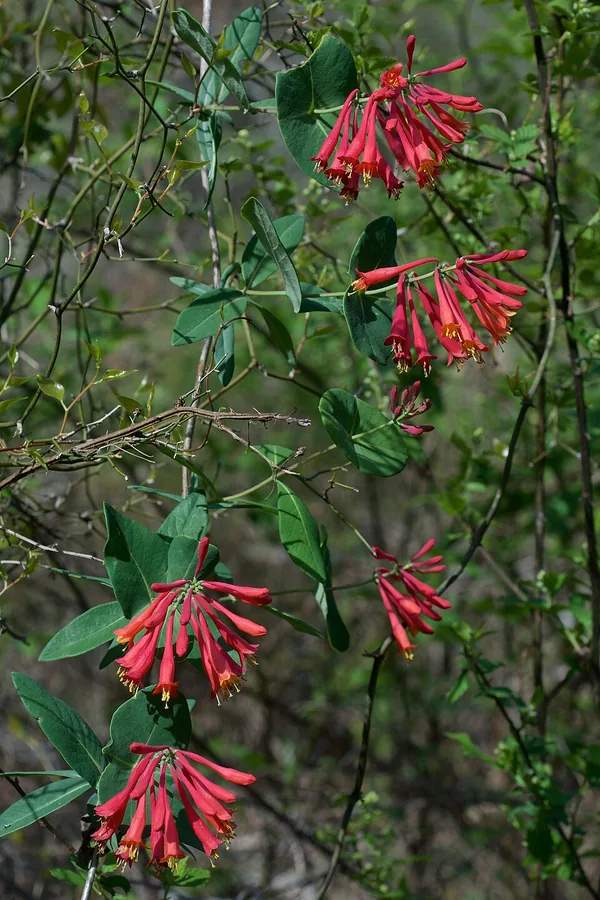
Trumpet honeysuckle is a native flowering vine that brings the romance of a cottage garden without the guilt of its invasive relative. Trained along a porch rail, an arbor, or a boundary fence, its whorls of slim, coral-red to orange tubular flowers carry the look from late spring into summer, often with an encore in fall. Hummingbirds come to the blooms, and the red berries that follow keep the wildlife scene going.
As a piece of the garden it earns its keep by being easy and adaptable. It settles into most soils, holds through a punishing cold, and asks for little attention once established, which frees a busy household to enjoy it rather than fuss over it. Give it a trellis, an arbor, or a fence and its fast climb soon dresses a bare vertical surface well above head height.
The single decision that shapes the whole planting is which honeysuckle goes in. The native trumpet type, Lonicera sempervirens, is the one that belongs in a considered garden. Steer clear of Japanese honeysuckle, the runaway white-flowered vine that overruns wild ground across much of the country.
Care
The short version: place it in full sun on a support it can climb, in average well-drained soil, and keep the moisture steady while it settles, after which it largely looks after itself.
Light
Honeysuckle gives its fullest show in full sun, though it will take partial shade and still flower. Sun keeps the foliage dry as well, which helps hold powdery mildew at bay and keeps the planting looking fresh.
Water
Keep the soil evenly moist while the vine roots into its new spot, watering every 5 to 10 days. An established plant handles dry spells with ease, but steady moisture rewards you with the fullest flush of flowers.
Soil
It asks little of the ground, settling into average to rich, well-drained loam or clay loam. A generous pH window of 5.5 to 8.0 suits it, so most garden beds will do as long as the drainage is sound.
Temperature
A hardy vine, it stands from a bitter -29°F (-34°C) up to about 100°F (38°C). That range carries the planting through cold winters and hot summers across most temperate gardens.
Humidity
Ordinary outdoor humidity suits it, with no figure to chase. Airflow is the thing that matters, since still, damp air around crowded foliage is what invites mildew into the display.
Feeding
A light spring feed with a balanced fertilizer is all it wants. Lean heavy on nitrogen and you trade flowers for leaves, so keep the hand light and the color coming.
Pruning
Prune just after the main flush to shape the vine and keep it in proportion to its support. It flowers on new growth, so a light trim spurs reblooming. Save a hard cutback for late winter, and only when the plant needs renewing.
Repotting
In the ground it never needs repotting, and even in a container it moves up only rarely. Roots circling the pot or slipping out the drainage holes, along with thinner flowering, tell you it has outgrown its home.
Size & spacing
With a support to climb, the vine reaches 8 to 20 feet (2.4 to 6 m) tall and spreads 3 to 6 feet (91 to 183 cm) wide. Give it a sturdy trellis or arbor and room to fill the space you have in mind.
When to plant
As a hardy perennial vine, honeysuckle asks you to think about establishment rather than a race against frost. Set new plants in place in spring or fall, then look forward to the first wash of coral flowers from late spring into summer, a display that carries on with a little light pruning.
Northern hemisphere
Southern hemisphere
Typical months for a temperate climate: start earlier in warm zones, later where spring frosts linger.
- Plant: spring or fall
- Harvest: late spring into summer, often reblooming into fall
Hardiness
USDA hardiness zones: 4–9
Temperature: down to -34°C
Troubleshooting
Trumpet honeysuckle keeps its composure through most seasons, and the little that goes wrong is cosmetic rather than serious. Two things ask for a glance, both of them fond of warm, muggy weather. Match the sign below and you can step in before the display loses its polish.
A pale film settling over the foliage in humid weather
When a chalky white haze dulls the greenery during a muggy stretch, that is powdery mildew, a fungus that arrives where the air hangs warm and still. A quick check sorts it out, since the coating wipes away while leaf blight leaves fixed dark marks behind. Open the planting to a breeze, direct water to the base, and place the vine in full sun so the leaves dry and the display stays clean.
Fix:
- Improve air circulation by thinning and providing support such as a trellis or arbor
- Remove and discard severely affected foliage
- Avoid overhead watering and water at the base of the plant
- Site the vine in full sun where foliage dries quickly
Soft insects gathering on the fresh growth with a sticky sheen
Small soft-bodied clusters massing on the new tips and buds point to aphids, whose sticky honeydew often invites a train of ants to the scene. A firm jet of water clears the colonies, and insecticidal soap settles any that stay behind. A well-kept vine carries them lightly, so a restrained hand with nitrogen keeps the lush growth they favor from taking over the picture.
Fix:
- Dislodge aphids with a strong spray of water
- Apply insecticidal soap or horticultural oil to affected growth if needed
- Encourage natural predators such as lady beetles and lacewings
- Reduce plant stress through adequate watering and avoiding excess nitrogen
Toxicity
Honeysuckle sits at the low end of the risk scale, which makes it an easy fit for a lived-in garden. The leaves, flowers, and sweet nectar give little cause for concern, and a child sipping a drop from a bloom comes to no harm. The one caveat is the red berries, which hold saponins that can upset a stomach if eaten in quantity, so keep pets and children from grazing on the fruit.
Toxic to
Cats · Dogs · Horses · Rabbits · Livestock · People
Safe for
Birds
Cats Mild
A cat that grazes a leaf or flower along the patio comes to little harm. The fruit is the exception, since a mouthful of the saponin-rich berries can bring on vomiting or loose stools.
Dogs Mild
The leaves and nectar sit well with most dogs padding past the trellis. The red berries are the part to steer them from, because eating a fair few can lead to drooling, an upset stomach, and diarrhea.
Horses Caution
Honeysuckle is not counted among the serious horse poisons, yet the berries hold the same saponins that upset other grazers, so a curious horse is best kept from stripping the fruit near a paddock fence.
Rabbits Mild
A rabbit that samples a leaf in the border is unlikely to suffer for it. The berries are another matter and can leave it with a sour gut, so the fruit should never stand in as a treat.
Livestock Caution
Cattle, goats, and sheep tend to pass the vine by in the pasture. A grazer that overindulges on the berries may meet mild digestive upset from the saponins, so valued stock is best fenced clear of a heavy fruit set.
People Caution
A drop of nectar drawn from a bloom on a summer evening does nothing at all. The berries, though, are not food and can upset a stomach in any real amount, so children are best taught to leave the fruit be.
Birds Safe
Birds take the bright red berries with no harm at all and carry the seed off as they visit, which is how the vine finds its way into new corners of the garden. For them the fruit is welcome fare, never a hazard.
The sweet flower nectar that children sometimes sip is harmless in tiny amounts, but discourage anyone from eating the berries. Keep pets from grazing on the fruit.
Helpline numbers

United States
ASPCA Animal Poison Control: (888) 426-4435 (fee applies)
Poison Control: (800) 222-1222



Canada
Poison Centres: 1-844-764-7669
Varieties
Garden honeysuckle comes down to a short list of dependable selections, nearly all of them native trumpet types or well-mannered hybrids. These are the ones worth designing around, along with one to leave off the plan.
Lonicera sempervirens 'Major Wheeler'
A native trumpet honeysuckle beloved for a lavish flush of reddish-orange flowers that reblooms strongly and keeps hummingbirds circling the garden all season.
Lonicera sempervirens 'John Clayton'
A compact native selection whose clear yellow flowers repeat through the season and give way to a generous crop of red berries.
Lonicera × heckrottii (Gold Flame honeysuckle)
A fragrant, refined hybrid whose showy two-toned blooms pair rose-pink on the outside with yellow within.
Lonicera × brownii 'Dropmore Scarlet'
An exceptionally cold-hardy Brown's honeysuckle that carries bright red flowers over a long season and holds its vigor without ever overstepping.
Lonicera japonica 'Halliana' (Hall's honeysuckle)
An aggressive Japanese honeysuckle whose fragrant white flowers mellow to yellow, discouraged or banned in many regions and best set aside for the natives above.
Companions
Keep apart
Lonicera japonica (Japanese honeysuckle): Invasive non-native that smothers desirable plants and the native honeysuckle alike; should not be planted near or in place of native species.
How to propagate
Honeysuckle takes willingly to propagation, and the rooting routes deliver a flowering vine to the arbor far sooner than seed. Choose the method that suits your patience and the season at hand.
Stem cuttingsEasy
Late spring to summer (softwood/semi-hardwood) · Several weeks to a few months
Softwood or semi-hardwood cuttings taken from late spring into summer, kept humid, take root over the following several weeks to a few months. It is the fastest and most dependable way to carry a favorite vine to a new spot along the fence or the porch.
LayeringEasy
Spring to summer · One growing season
From spring through summer, a low, flexible stem pinned against the soil will root at the buried node with no fuss. A full growing season sees it settled, and the new plant can then be cut free once it stands on its own roots.
SeedModerate
Fall sowing or after cold stratification · A season or more
Seed cleaned from the ripe red berries and sown in fall, or given a spell of cold stratification to answer its need for chilling, will come along over a season or more. It is the slow route, which is why the rooting methods suit anyone eager to see the vine at the arbor sooner.
Myths
Every honeysuckle vine is an invasive weed that should never be planted.
The plant behind that reputation is Japanese honeysuckle, Lonicera japonica, a non-native with fragrant white-to-yellow flowers that smothers native plants across much of the eastern, central, and southern US and is regulated or banned in some states. The native trumpet or coral honeysuckle, Lonicera sempervirens, with its whorls of coral-red to orange tubular blooms, keeps to its place in a designed garden. It is non-invasive and the recommended alternative.
Sources
- NC State Extension Gardener Plant Toolbox
- Missouri Botanical Garden
- USDA National Invasive Species Information Center
- USDA Forest Service Fire Effects Information System
- NC State Extension Gardener Plant Toolbox
- Penn State Extension
- Lady Bird Johnson Wildflower Center
- NC State Extension Gardener Plant Toolbox