Houseplant · Crassulaceae
Mother of Thousands
Kalanchoe daigremontiana
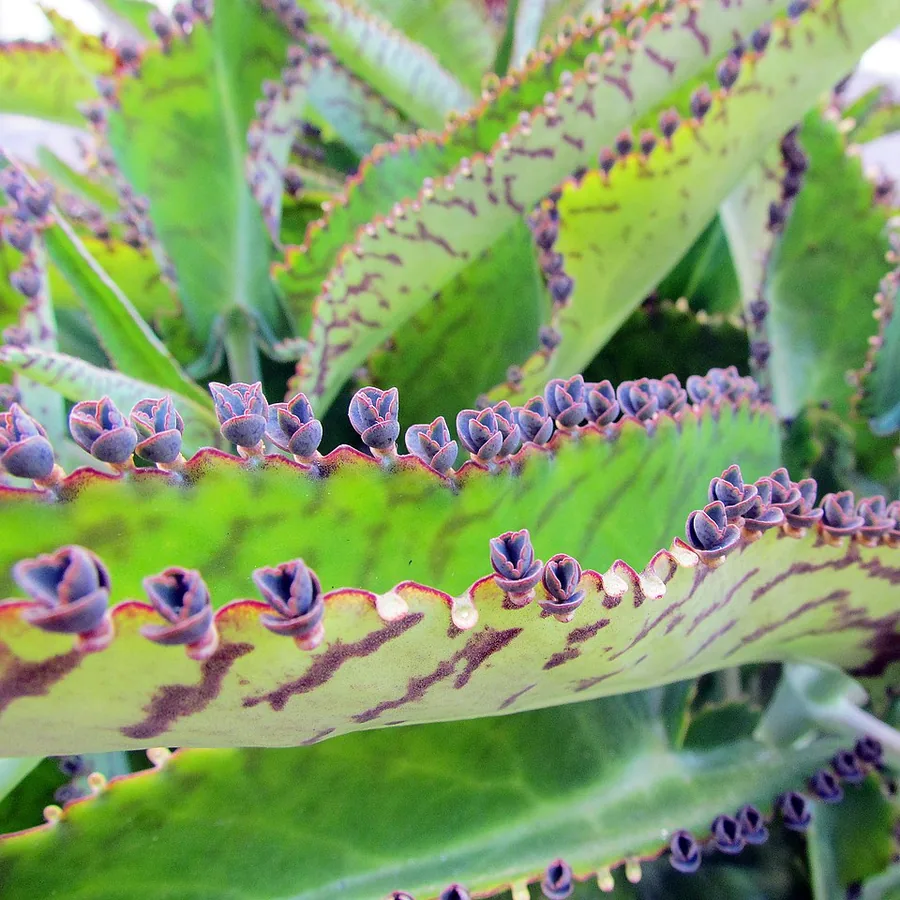
An easy succulent that raises its own babies along every leaf edge, best styled well away from pets.
Bright indirect
50–86°F · 10–30°C
USDA 9–11
12–35 in · 30–90 cm
Overview
Mother of thousands carries a quiet architectural presence that suits a pared-back room. Its upright form and cool, blue-green leaves settle naturally onto a sunny sill, a bright shelf, or a minimal desk, lending structure without clutter. Drawn from the dry southwest of Madagascar, it keeps a composed, sculptural look with almost none of the fuss a leafier plant demands.
It earns its keep in a home that leans toward calm, ordered surfaces. Set by a bright window in a simple gritty pot, it rises to an upright 12 to 35 inches (30 to 90 cm), a scale that reads well grouped with terracotta or standing alone as a sculptural accent. Its one quirk shapes where it belongs: the tiny plantlets it drops root in any pot within reach, so a stand-alone spot with clear space around it flatters the plant and spares the ones beside it.
For all its easy grace, it comes with a firm condition on placement. Every part of it holds bufadienolides, cardiac glycosides toxic to pets and people alike. In a home without animals or small children it is a handsome, low-demand piece, and the styling answer is simple: give it a high shelf or a room they never enter.
Care
The short version: bright indirect light, a gritty fast-draining mix, and water only once the soil has dried out completely. Feed it lightly through the growing season, keep it warm, and lift off the plantlets before they wander into the pots beside it.
Light
Place it in bright indirect light and it holds a compact, well-colored shape that anchors a shelf. It takes some partial sun, though harsh afternoon glare scorches the leaves, while a dim corner leaves it pale and stretched and softens its upright line.
Water
Water it as the succulent it is. Soak the mix thoroughly, then let it dry out completely before the next drink, easing off further through winter dormancy. Standing moisture leads straight to root rot, which this plant is prone to, so restraint keeps it looking its best.
Soil
Set it in a gritty cactus or succulent mix that drains in seconds, paired with a pot you like the look of. Ordinary potting soil holds far too much water around the roots, so a drainage hole matters as much as the container's finish.
Temperature
Keep it in the range of 50°F to 86°F (10°C to 30°C), which suits most rooms across the year. It is not frost hardy, so bring any summered plant back indoors well before the cold arrives.
Humidity
Low humidity is exactly its preference, so there is no figure to chase and no need to mist. The ordinary dry air of a styled interior suits it better than any steamy spot.
Feeding
Feed it lightly from spring through summer, about once a month, with a diluted balanced or cactus fertilizer. It thrives on very little, so a restrained hand keeps it neat, and feeding pauses through the winter rest.
Pruning
Pinch back leggy stems to hold its tidy shape and snip away spent flower stalks. The task that keeps a display clean is lifting the tiny plantlets from the leaf edges before they drop into neighboring pots.
Repotting
Move it up a pot size every 2 to 3 years, or once it crowds its container. Roots at the drainage holes, the plant lifting from the pot, and water rushing straight through all signal the moment to refresh it.
Size & spacing
Indoors it reaches 12 to 35 inches (30 to 90 cm) tall with a spread of 12 to 24 inches (30 to 60 cm), a footprint that styles well on its own. Leave a little clear space around it so the dropped plantlets do not root into whatever pot sits alongside.
Troubleshooting
Nearly every issue traces back to two things: water and light. Overwatering rots the roots, while a spot too dim stretches the plant pale and thin and spoils its clean upright line. Match what you see below and address the cause, not just the look of it.
Soft blackened stems and a droop despite damp soil
A plant that sags over wet soil is showing root rot, the near-inevitable result of watering a succulent as though it were a fern. Slip it from the pot and the roots read the story: brown, soft, and sour. Trim away all that has gone, settle it into a dry gritty mix, and leave the watering can well alone until it stands firm.
Fix:
- Cut away all rotted tissue
- Repot into dry gritty succulent mix
- Withhold water until the plant recovers
White cottony tufts and a sticky sheen on the leaves
White cottony tufts settled in the leaf joints, with a sticky sheen beneath them, are the mark of mealybugs. Touch each one with a cotton swab dipped in isopropyl alcohol, then see off the stragglers with insecticidal soap. Give every newcomer a quiet corner of its own for a while first, and the collection stays clear.
Fix:
- Wipe with isopropyl alcohol on a swab
- Treat with insecticidal soap
Brown scorch marks on the window-side leaves
Dry brown patches gathering on the side that faces the glass are a case of harsh afternoon sun scorching the foliage. Draw the plant back into bright indirect light, clear of that fierce midday hour. Should a sunnier corner be the goal, introduce direct sun by degrees so the leaves have room to settle into it.
Fix:
- Move to bright indirect light
- Avoid the hot midday sun
Pale, stretched form with leaves set far apart
A pale, leggy silhouette with leaves drifting apart is the plant leaning toward a light it cannot reach. The giveaway is new growth angling toward the window. Reset it in a brighter spot with bright indirect light and give the pot an occasional turn, and the shape draws back into balance.
Fix:
- Move to a brighter spot with bright indirect light
- Rotate the pot periodically
Toxicity
Style this plant into a home only on the understanding that it is toxic to every animal there. All of it holds bufadienolides, cardiac glycosides that bring on drooling, vomiting, and diarrhea, and in any real amount can throw off the heartbeat. No part is safe to eat and the sap can irritate skin, so keep it well out of reach of pets and small children.
Toxic to
Cats · Dogs · Horses · Rabbits · Livestock · Birds · People
Cats Toxic
A cat that samples a leaf tends to drool and vomit, with loose stools following soon after. A larger mouthful is the true concern, as the bufadienolides can unsettle the heartbeat, so place it well beyond a cat's reach.
Dogs Toxic
In a dog, heavy drooling, vomiting, and diarrhea arrive within a few hours of a chew. Since a real mouthful carries the same heart-rhythm danger, a call to the vet beats waiting it out.
Horses Toxic
Horses take the cardiac glycosides hard. Drooling and a troubled gut come first, and a genuine dose can disturb the heartbeat enough to threaten a horse's life.
Rabbits Toxic
Keep it entirely clear of rabbits. The same toxin unsettles the gut and strains the heart, and a small animal needs only a little to fall into trouble.
Livestock Toxic
Cattle, goats, and sheep can be poisoned where it slips into pasture. Stomach upset opens the picture, giving way to dangerous heart effects once any quantity is taken.
Birds Toxic
Treat it as off-limits around birds. Their small frame means even a nibble of leaf can carry a meaningful dose of the heart-acting glycosides.
People Caution
No part of this plant belongs on a plate, and the bufadienolides make even a taste unsafe. The sap can irritate skin as well, so handle it in gloves and set it beyond the reach of small children.
Sap can cause contact dermatitis; wear gloves when handling the plant or removing plantlets.
Helpline numbers

United States
ASPCA Animal Poison Control: (888) 426-4435 (fee applies)
Poison Control: (800) 222-1222



Canada
Poison Centres: 1-844-764-7669
Varieties
Beyond the species itself, one variety is worth a mention, a hybrid that carried the parent's spreading habit even further.
Kalanchoe × houghtonii
A hybrid of K. daigremontiana and K. delagoensis with slimmer leaves that spreads even more freely than its parent and has since become a global invader.
How to propagate
Filling a shelf with more of this plant asks nothing of you. The real work is holding it back, since it propagates itself whether invited to or not.
Offsets & pupsEasy
Spring · 2-4 weeks
The plantlets along the leaf edges let go with tiny roots already formed and settle wherever they land, taking hold within 2 to 4 weeks in spring. It is propagation without effort, the very habit that lets the plant travel so freely. Gather up any you would rather not keep before they root.
Leaf cuttingsEasy
Spring to summer · 3-6 weeks
Rest a whole leaf on gritty mix in spring or summer and, across the next 3 to 6 weeks, plantlets and roots emerge along its edges. Keep the mix barely moist, since too much water rots the leaf before it can establish.
Myths
Mother of thousands is safe around pets because it is a common houseplant.
A familiar place on the windowsill says nothing about safety. The ASPCA lists it as toxic to cats and dogs because of bufadienolides, cardiac glycosides that upset the gut and can disturb the heartbeat. Keep it out of reach of every animal in the house.
The plantlets are harmless and will not spread.
Every little plantlet lands already rooted and takes hold wherever it falls. That is the whole reason it travels so quickly and naturalizes across warm regions, so gather up the fallen ones rather than leaving them where they drop.