Vegetable · Brassicaceae
Radish
Raphanus sativus
The radish is the kitchen garden's opening act: cool weather and steady water, and the table is set within weeks.
Full sun
Every 3–5 days
39–75°F · 4–24°C
22–60 days
Overview
Few crops set the tone of a kitchen garden as quickly as the radish. A member of the cabbage family, it turns from seed to harvest faster than almost anything on the plot, with the quick salad types ready in three to five weeks. That pace makes it the perfect crop to open a season, to fill an idle patch, or to hand a new gardener an early, encouraging result.
The radish also brings variety to the table. There are the round spring types that brighten a salad bowl, the long white daikon that asks for a longer season and deep, loose soil, and the curiosities grown for their spicy seed pods rather than a root at all. Whatever the form, they share a preference for cool weather, since heat is what trades a crisp, mild radish for something woody and sharp.
As a garden companion, the radish asks little and gives a rhythm worth building a week around. Keep the soil evenly moist, thin the seedlings so each root has its space, and gather them on time. Let those small rituals slip and the reward changes: cracked skins, a sharp edge, or a flush of leaves standing over nothing.
Care
The short version: a sunny, cool corner, soil kept evenly moist with about an inch of water a week, loose ground and a light touch with feeding, and roots gathered the moment they are ready for the kitchen.
Light
Radishes want a sunny spot, at least 6 hours a day, with only a little afternoon shade welcome in warm spells. Give them a corner that catches the light, or the plant drifts toward leaves and away from the root that earns its place at the table.
Water
Keep the soil evenly moist, about an inch of water a week, with a little more in sandy ground or a heat wave. That steady rhythm is what keeps the roots crisp for the kitchen and saves them from cracking or turning hot and woody.
Soil
Set radishes in loose, well-drained sandy loam, cleared of stones and hard ground so the roots can fill out in comfort. A pH between 6.0 and 7.0 makes for an easy home.
Temperature
This is a cool-season crop by temperament, most at ease between 39°F to 75°F (4°C to 24°C). Once summer turns up the heat, radishes bolt and the roots lose their charm, so the spring and fall calendar suits them best.
Humidity
Humidity is one thing to leave off the list here, since ordinary outdoor air is all it takes. The quiet work happens in the soil, where even moisture shapes the crop far more than the air around it.
Feeding
A little compost or well-rotted manure worked in before sowing sets the stage, and that is usually plenty. Keep a light hand with nitrogen, since a rich feed grows a handsome canopy of leaves and a disappointing root beneath.
Pruning
There is no pruning to keep up with, only thinning, and it pays off. Once the seedlings arrive, thin to about 2 inches apart, or 4 to 6 inches for daikon, giving each root the room to come into its own.
Size & spacing
By type, the plants stand 6 to 35 inches (15 to 90 cm) tall, the long daikon lending the row some height. Thin to around 2 inches apart, more for the winter radishes, so roots have room to fill and the bed keeps its airy look.
When to plant
Radishes belong to the cooler chapters of the gardening year, not the heat of high summer. Sow the quick types into the ground in early spring the moment the soil loosens, then return from late summer into fall, and let the stately daikon and winter types close the season with a fall harvest.
Northern hemisphere
Southern hemisphere
Typical months for a temperate climate: start earlier in warm zones, later where spring frosts linger.
- Plant: Direct sow in early spring (April-May) as soon as soil can be worked, and again in late summer to early fall (August-September); winter/daikon types are sown for fall harvest
- Harvest: Spring/salad types harvested 3-5 weeks after sowing; daikon and winter types harvested in fall
Hardiness
USDA hardiness zones: 2–11
Temperature: down to -46°C
Troubleshooting
Even the most obliging crop has its off days, and with radishes the story is almost always written in the root or in tops that overreach. The signs are easy to read, and the remedies simpler still. Find the picture that matches, then adjust the timing, watering, or feeding.
Roots spoiled by tunnels within
White legless grubs and brown tunnels through a root are the signature of cabbage root maggots, and a root they reach is no longer for the table. Lift and discard the affected ones, rotate away from brassicas, cover the bed at sowing, and pass over ground that was lately manured.
Fix:
- Remove and discard affected roots
- Practice crop rotation away from brassicas
All leaf, little root
A radish that gives you a lush canopy and next to no root has usually had too much nitrogen, often in a row that went unthinned. Heat, long days, and shade steer it the same way. Ease off the rich feeding, thin to spacing, and choose a cool stretch with at least 6 hours of sun.
Fix:
- Thin seedlings to recommended spacing
- Stop applying high-nitrogen fertilizer
- Sow during cool spring or fall weather in full sun
The row runs to flower too soon
When a flower stalk rises ahead of the harvest, the crop is bolting, prompted by warmth and lengthening days and hurried by drought or crowding. The root turns woody and sharp as the stem climbs. Gather what is still worth having, then begin again in the gentler cool of spring or fall.
Fix:
- Harvest promptly before quality declines
- Replant in cooler spring or fall conditions
Roots gone woody and fiercely sharp
A radish held too long loses its appeal, growing tough and pithy with a harsh, peppery edge, and heat and drought only quicken the change. Once the texture goes, it will not return. Gather the roots at their peak and keep the soil evenly moist as they grow.
Fix:
- Harvest at peak size
- Keep soil consistently moist during growth
Roots that split along their length
Splitting is the mark of uneven watering, most often a heavy soak after a dry spell, along with roots left standing too long. Water at a steady pace to keep growth even, and lift the roots at their proper size before a crack sets in.
Fix:
- Harvest at proper size
- Maintain even watering
Young leaves stippled with small holes
Those neat little holes are the work of flea beetles, dark specks that scatter as you pass the row. The seedlings bear the brunt, so lay a floating row cover over the young plants and move the brassicas to a new part of the plot each year.
Fix:
- Use floating row covers over seedlings
- Monitor and manage early pressure
Toxicity
There is a certain ease to growing something wholly edible. Every part of the radish belongs on the plate, root to leaf to flower to seed pod, and it keeps company with pets and livestock without concern. The single footnote: a freshly cut root can sting sensitive skin.
Safe for
People · Cats · Dogs · Horses · Rabbits · Livestock · Birds
Cats None
Radish sits easily with cats. A stray taste of leaf or root might bring a little gas or a soft stool, and nothing beyond that.
Dogs None
Radish poses no trouble for dogs. A few plain pieces are a fine treat in moderation, though a generous helping of the peppery root may leave one gassy.
Horses Safe
Horses take radish and its greens in stride. As with any fresh indulgence, a modest portion keeps it a small part of the diet.
Rabbits Safe
Rabbits relish the leafy tops, and a little of the root suits them too, though the greens are the finer share.
Livestock Safe
Cattle, goats, and sheep graze the tops and roots without harm, and radish is sometimes grown deliberately as forage.
Birds Safe
Backyard hens make short work of the greens and roots, and the leaves are a welcome bit of green in the run.
People Safe
For the cook, radish is a staple eaten raw or cooked, with root, leaves, flowers, and seed pods all fair game. Handling a cut root may sting sensitive skin a little.
Leaves and roots contain isothiocyanates that may cause mild skin irritation in sensitive individuals when handling, and the raw root is pungent.
Varieties
Hundreds of radishes exist, but a handful have earned a lasting place on the seed rack and in the garden. These are the names worth keeping in the rotation.
Cherry Belle
The quintessential round, bright red salad radish, ready for the bowl in about three to four weeks.
Easter Egg
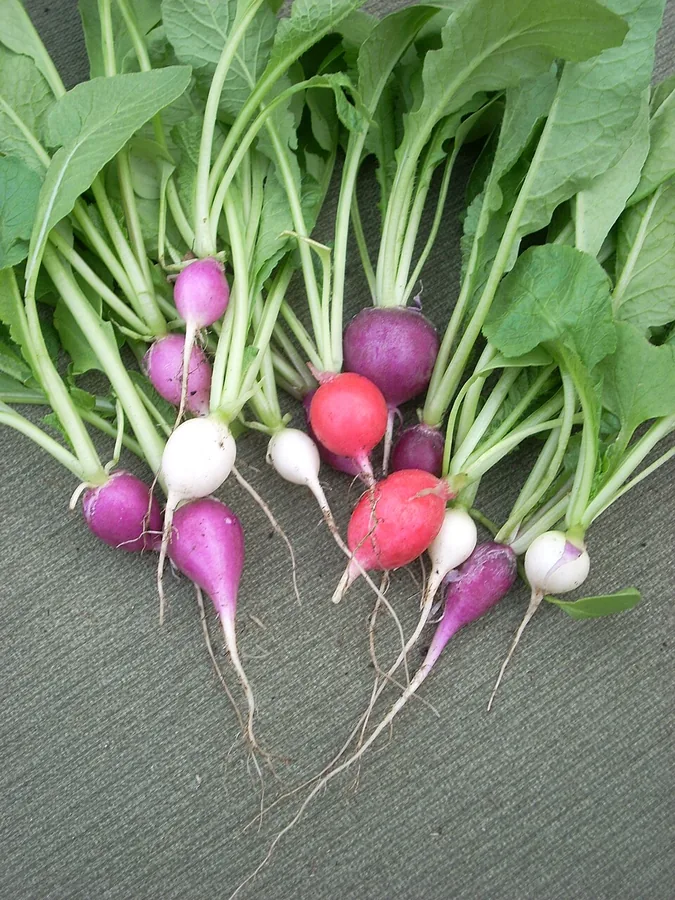
A single sowing that fills the basket with roots in white, pink, red, and purple.
Sparkler
A round red radish finished with a crisp white tip at its base.
Daikon (var. longipinnatus)
The long white winter radish, which calls for a longer season and deep, loose soil to reach its length.
Rat's Tail (var. caudatus)
An unusual choice grown for its edible, spicy seed pods rather than a root.
Companions
Radishes earn their keep beside slower crops, holding space and marking rows before they're pulled and the neighbors fill in.
Plant near
Lettuce: Quick-maturing radishes interplant well with lettuce, using space before the lettuce fills in.
Carrots: Radishes are sown as a fast marker crop with slow-germinating carrots and are pulled before the carrots need the room.
Cucumbers: Radishes are commonly interplanted with cucumbers as an early quick crop in the same bed.
How to propagate
Radishes begin and end with seed, set directly into the bed where they will live out their short, satisfying season.
SeedEasy
Direct sow in early spring and again in late summer/fall · Germinates in about 3 to 7 days under cool, moist conditions
Radishes are sown straight into their final place, since they have little patience for being moved. Tuck the seeds about 1/4 to 1 inch deep in early spring and again from late summer into fall, and in cool, moist soil they appear in just 3 to 7 days. Thin the seedlings early so every root has the space to make something of itself.
Myths
A radish needs rich, well-fed soil to reach a good size.
Quite the opposite. Heavy nitrogen brings a burst of leaves and a root that never arrives. Radishes are at their best in moderately fertile, well-prepared soil, not a richly fed one.
Radishes will keep in the ground until the kitchen calls for them.
Left past their moment, the roots grow woody, pithy, and cracked, and the flavor sharpens to a bite. Gather them promptly at size to catch them at their finest.