Houseplant · Piperaceae
Ripple Peperomia
Peperomia caperata
A small, unhurried plant with pet-safe ease, ripple peperomia settles into a bright corner of a considered room.
Bright indirect
USDA 11–12
6–10 in · 15–25 cm
Overview
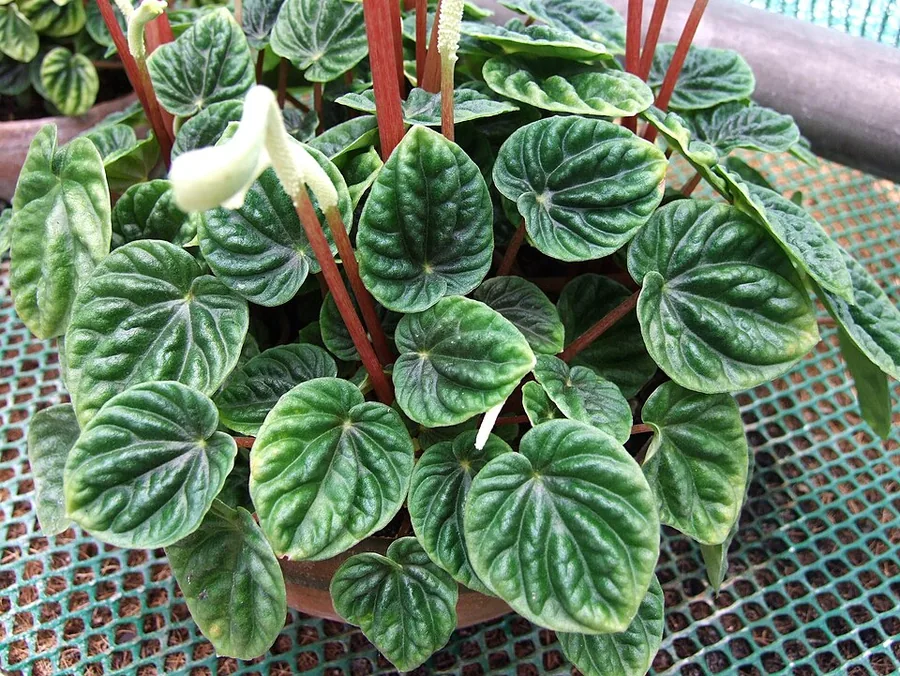
Ripple peperomia has the kind of quiet presence that suits a considered room. Named for the gentle ripple of its heart-shaped leaves, it belongs to the pepper family and comes from the forests of southeast Brazil. Indoors it keeps to a modest 6 to 10 inches (15 to 25 cm), a scale that reads as a finishing touch rather than a statement.
Across its cultivars the foliage shifts from deep emerald green to burgundy red and soft silver, so there is a version to echo almost any palette. Slow growth keeps it tidy and predictable, at home on a desk, a bookshelf, or a bright sill where it never demands rearranging. That it sits on the ASPCA's list of plants safe around cats and dogs makes it easy to place in a lived-in family space.
The appeal is how little it asks of a day. The thick, water-holding leaves mean the watering can comes out rarely, which suits a slower household rhythm. Set it in bright indirect light, let the soil dry between drinks, and it holds its composed, compact shape season after season.
Care
The short version: a bright, indirect spot, a free-draining mix, and water only once the top half of the soil has dried. Keep the watering restrained and the air a touch humid, and this is a plant that mostly styles and keeps itself.
Light
Give it bright indirect light from an east or south window, where it looks its best. Medium light suits it too, and it endures low light for a while, though a dim placement leaves the stems stretched and the coloring muted. Keep it clear of direct hot sun, which scorches the leaves.
Water
Let the top half of the soil dry before watering again, since the plump leaves keep a reserve of their own. Overwatering is the surest way to spoil the plant. Empty the saucer once it has drained, keep water out of the crown, and ease off through the cooler months.
Soil
Choose a porous, well-draining peaty houseplant or cactus mix so nothing stays waterlogged. If a generous watering hand is the habit, a little extra perlite keeps the roots comfortably dry.
Temperature
Keep the room warm, no cooler than about 61°F (16°C). This is a tropical plant, so a cold draft or a chilly winter sill is the one setting to avoid.
Humidity
It prefers high humidity, a nod to its rainforest origins. In a dry room, especially over winter, a cluster of plants or a nearby humidifier keeps it content.
Feeding
Feed monthly through spring and summer with a diluted liquid houseplant fertilizer, or set out slow-release granules once a year. Let it rest through fall and winter, when growth quiets down.
Pruning
Remove tired or damaged leaves as they appear to keep the plant looking its best. For a fuller, bushier silhouette, trim a stem just above a leaf node and it branches from there.
Repotting
This is a plant content to stay put, happy in the same pot for several years. Move it up a single size only when roots reach the drainage holes or the soil dries far too quickly.
Size & spacing
At its fullest it stays compact, 6 to 10 inches (15 to 25 cm) tall and about as wide. That restraint is exactly what makes it such an easy finishing piece for a shelf or desk.
Troubleshooting
Most of what unsettles this plant traces to water. A pot left too wet invites rot and dropped leaves, while a dim corner leaves it stretched and faded, losing the neat form that makes it worth displaying. Match the symptom below, and the remedy is usually a small shift in placement or routine.
A collapsing plant with a soft, dark base
A base gone soft and dark, with the plant sinking in on itself, is root and crown rot, brought on by soil left soggy or water lingering in the crown. The roots turn dark and slimy in place of firm and pale. Stop watering, cut back to clean tissue with sterile tools, and repot into fresh, quick-draining mix. Should the crown be past saving, a few healthy leaf or stem cuttings keep the plant in the room.
Fix:
- Stop watering and remove the plant from wet soil
- Cut away rotted roots and mushy crown tissue with clean tools
- Repot into fresh, fast-draining mix in a clean pot with drainage holes
- Take healthy leaf or stem cuttings as insurance if the crown is badly affected
Yellowing, drooping leaves on a soggy plant
Yellow, sagging leaves on a waterlogged plant usually signal rot taking hold at the roots or stem base. Lift the plant from its pot, study the roots, and remove any that are dark and soft before settling it into fresh, quick-draining mix. The real correction is the watering routine, since both a soaked pot and a long dry stretch lead here.
Fix:
- Check roots and soil moisture
- Trim affected roots and repot into fresh fast-draining mix if rot is present
- Correct the watering routine to avoid moisture extremes
Leaves shedding from a wet pot
Leaves falling while the soil stays wet almost always point to overwatering. Let the soil dry out completely, then improve the drainage with added perlite or a repot into a more porous mix. Once the plant steadies, return to a light, careful watering hand.
Fix:
- Allow the soil to dry out
- Improve drainage by adding perlite or repotting into a porous mix
- Resume light, careful watering once the plant recovers
Webbing or white cottony tufts among the leaves
Fine webbing over stippled leaves means spider mites, while white cottony tufts set into the leaf axils mean mealybugs. Move the plant away from its neighbors so nothing spreads, wipe off what is visible, and treat with insecticidal soap or horticultural oil. A repeat over several weeks sees off the life cycle for good.
Fix:
- Isolate the affected plant
- Wipe off mealybugs and treat with insecticidal soap or horticultural oil
- Repeat treatments as needed to break the pest life cycle
Stretched stems and fading color
Stems drawn toward the window and color draining from the showier forms both mark too little light. Move the plant into brighter, indirect light at an east or south window, or add a fluorescent lamp when daylight is thin. Trimming the leggy stems above a node brings back the compact, gathered shape.
Fix:
- Move to a brighter spot with bright indirect light from an east or south-facing window
- Supplement with fluorescent lighting if natural light is limited
- Prune leggy stems above a node to restore a compact, bushy shape
Spotting across the foliage
Distinct spots that surface once the leaves have stayed wet are fungal leaf spots. Remove the marked leaves, water at the soil so the foliage stays dry, and give the plant a little more air around it. Since wet leaves are what the fungus needs, keeping them dry is the whole of the prevention.
Fix:
- Remove affected leaves
- Keep foliage dry when watering by watering at the soil level
- Improve air circulation
Toxicity
For a home with pets, this is a reassuring choice: ripple peperomia is non-toxic through and through. The ASPCA and NC State Extension both list it as safe for cats, dogs, and horses, with no toxic compound to concern other animals or people. It earns a spot on a low shelf without a second thought.
Safe for
People · Cats · Dogs · Horses · Rabbits · Livestock · Birds
Cats None
The ASPCA and NC State Extension both list this plant as non-toxic to cats, and no toxic compound appears on record. A curious nibble comes to nothing.
Dogs None
It is set down as non-toxic to dogs as well, with no harmful principle noted. A dog that mouths a leaf takes no harm from it.
Horses None
The same sources rate it safe for horses, so a stray taste is of no concern.
Rabbits Safe
No toxin resides in the leaves or stems, leaving no poisoning risk to a rabbit that takes a bite.
Livestock Safe
Grazing animals meet nothing harmful in it. As an indoor plant it stays out of their reach, and it holds no toxic compound regardless.
Birds Safe
With no known toxic principle, a pet bird that perches or pecks at the foliage remains out of harm's way.
People Safe
The plant is not poisonous to people, children included. It is not grown to eat, so there is no call to, but a stray taste does no harm.
Varieties
The named forms are chosen mostly for leaf color, which is what lets you match one to a room. These are the cultivars worth knowing.
'Emerald Ripple'
The original the species is named for, with deeply furrowed, quilted green leaves in the classic heart shape.
'Rosso'
A cultivar NC State Extension notes for red leaf undersides set against a green upper surface.
'Red Ripple'
A burgundy-red form that carries its deep color across the whole leaf.
'Red Luna'
One of the red-toned selections NC State Extension lists for its distinctive coloring.
'Variegata'
A variegated form, its green leaves patterned with silver.
How to propagate
One plant readily becomes a small collection, which is part of its charm on a styled shelf. A leaf, a stem tip, or a divided clump each roots with little effort, ready to fill a matching pot or two.
Leaf cuttingsEasy
Spring to summer · Several weeks to root
The classic peperomia approach. A healthy leaf taken with its stalk in spring or summer and set into moist mix roots over several weeks into a new plant, ready for a pot of its own.
Stem cuttingsEasy
Spring to summer · Several weeks to root
Tip and stem cuttings root just as willingly in water or moist mix. Taken in spring or summer, they need a few weeks to root before moving into a pot.
DivisionEasy
Spring at repotting · Several weeks
A mature clump divides neatly into smaller plants. Done in spring alongside a repot, each division finds its footing over a few weeks.
Myths
Ripple peperomia, like most houseplants, is toxic to cats and dogs.
The ASPCA and NC State Extension both classify it as non-toxic to cats, dogs, and horses. This is a truly pet-safe houseplant, welcome in rooms where other greenery would give pause.
Peperomias want their soil kept steadily moist.
The thick, semi-succulent leaves carry their own water, so the plant prefers to dry out between drinks. Overwatering is the leading cause of leaf drop and root rot, which makes a restrained hand the safer approach.