Houseplant · Piperaceae
String of Turtles
Peperomia prostrata
A trailing peperomia that turns a bare shelf into a living green cascade, patterned like rows of tiny turtles.
Bright indirect
Every 7–14 days
68–75°F · 20–24°C
USDA 10–12
Overview
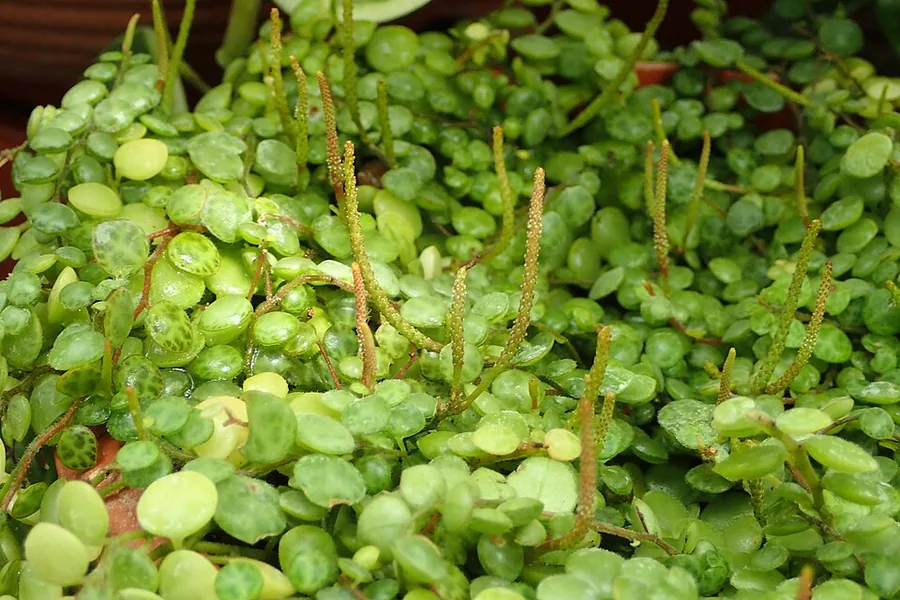
String of turtles has become a favorite of small-space plant lovers, and the reason is easy to see once it drapes from a shelf. A trailing peperomia from the rainforests of Ecuador, it forms a slow, tidy curtain of round, fingernail-sized leaves patterned like a turtle's shell. It rarely exceeds a trail of 9 to 12 inches (23 to 30 cm), which keeps it graceful rather than unruly, ideal for a bookcase, a mantel, or a hanging planter by a window.
Part of its charm is how little it asks of a busy household. A spot with bright, indirect light and a well-draining pot are the essentials, and its semi-succulent leaves hold enough water that a forgotten watering during a hectic week does no lasting harm. It slots naturally into a low-maintenance corner, a desk you pass each morning, or a shelf you tend on weekends.
The one habit to avoid is keeping it constantly wet, which quickly undoes those roots. Give it room to dry between waterings and a bright position, and a single plant matures into a soft green trail that stays elegant for years and softens the hard lines of a shelf or windowsill.
Care
The short version: set it in bright, indirect light with a fast-draining pot, and water only after the top half of the soil has dried. Keep it warm, feed it lightly through the growing season, and let it dry between drinks rather than overwatering.
Light
Position it in bright, indirect light, the kind found a little way inside a window facing east or south. It will live with medium or low light, but the turtle-shell markings fade in a dim corner, so a well-lit spot keeps the pattern crisp. Shield it from direct sun, which marks the small leaves.
Water
Allow the upper half of the mix to dry before the next watering, which tends to fall every 7 to 14 days. The semi-succulent leaves carry their own reserve, so the plant forgives a dry spell far more readily than a soggy one. Overwatering is the surest way to spoil it.
Soil
Choose a freely draining houseplant or cactus mix that lets water move through rather than pool. A loamy or sandy blend suits it, and it settles happily into a pH of 5.5 to 7.5. Drainage, above all, keeps it looking its best.
Temperature
Keep it in the easy comfort of 68°F to 75°F (20°C to 24°C), ordinary room warmth for most homes. It has no defense against frost or cold drafts, so through winter it belongs away from chilled windows and open doorways.
Humidity
Everyday household humidity is enough, so there is no figure to chase. It welcomes a little extra moisture in the air, yet it looks perfectly content in ordinary room air, with no misting or humidifier.
Feeding
Feed it gently through spring and summer, its season of active growth. A weak liquid fertilizer about once a month is plenty, or a slow-release granular feed once a year. As a slow grower, it needs only a light touch.
Pruning
An occasional pinch of the trailing stems encourages fuller, bushier growth and a rounder silhouette. Trimming away any leggy or damaged stems keeps the plant looking neat on display.
Repotting
It prefers to stay snug in its pot, often for several years, which suits anyone who would rather not repot often. Move it up only when roots appear at the drainage holes, water runs straight through, or growth slows, and then only by a single size.
Size & spacing
It stays compact, trailing 9 to 12 inches (23 to 30 cm) with a slim spread of 3 to 4 inches (8 to 10 cm). That restraint is exactly what makes it such a natural fit for a styled shelf, a desk, or a small hanging planter.
Troubleshooting
Most of what goes wrong with this plant comes down to water or light, and both show on the leaves and roots before real damage sets in. Read the early signals, and a quick adjustment usually restores its look. Match the symptom below to what you see.
Dropping, yellowing leaves and stems turning soft
Leaves that fall and yellow while the stems soften almost always point to root rot, the quickest way this plant declines, and it comes from overwatering. Left sitting in wet soil, the roots go brown and soft and the foliage drops away. Cut back on water, move it into a fresh, well-draining mix, and remove any rotted roots before the problem widens.
Fix:
- Reduce watering frequency
- Let soil dry partway before watering again
- Repot into fresh well-draining mix and trim rotted roots if rot is present
Sticky residue, webbing, or small insects on the plant
Sticky sap, fine webbing, or small insects are the calling card of sap-sucking pests such as mealybugs, spider mites, scale, and whiteflies, usually gathered on leaf undersides and stem joints. Wipe them away, treat with insecticidal soap, and set the plant apart from others until it clears. This peperomia usually resists pests, so trouble tends to arrive on a newly bought plant.
Fix:
- Wipe off pests
- Treat with insecticidal soap
- Isolate the plant to prevent spread
Leaves fading to a washed-out pattern
When the turtle-shell markings flatten and lose definition, the plant is simply short on light, having sat too long in a dim spot. A move to bright, indirect light beside an east or south-facing window brings the pattern back into focus.
Fix:
- Move to a spot with bright, indirect light from an east or south-facing window
Toxicity
For a home shared with pets or young children, this is a plant to relax around. The ASPCA lists the trailing peperomia as non-toxic, so no part of it will harm a cat, a dog, or a curious child. That makes it an easy choice for a low shelf, a coffee table, or a child's room.
Safe for
People · Cats · Dogs · Horses · Rabbits · Livestock · Birds
Cats None
Cats can share a room with it safely. The ASPCA lists this peperomia as non-toxic to them, so an occasional nibble is nothing to fear.
Dogs None
Dogs are equally safe. The ASPCA rates the plant non-toxic to them, and a stem caught between curious teeth will do no harm.
Horses Safe
Horses are in no danger from it, and a small trailing houseplant of this kind seldom finds its way into a stable.
Rabbits Safe
A rabbit that helps itself to a few leaves comes to no harm, since the plant holds nothing toxic to them.
Livestock Safe
Grazing animals like cattle, goats, and sheep have nothing to fear from this peperomia either.
Birds Safe
A pet bird can perch and nibble without concern, since the plant carries no toxins for them.
People Safe
It is safe around children as well, so a stray leaf that finds a small hand calls for no alarm.
How to propagate
Filling a home with string of turtles costs almost nothing, since one plant supplies all the cuttings you need. A single leaf or a length of stem will root, both taken during the warm growing months, ready to share or to start a second pot.
Leaf cuttingsEasy
Spring or summer during active growth · Several weeks to a few months to root and establish
A single healthy leaf, lifted with its short stalk and settled into damp, free-draining mix, is all it takes to begin. Do this through spring or summer, while the plant is in growth, and expect a patient wait, since roots and a small new plant may need several weeks, and sometimes a month or two.
Stem cuttingsEasy
Spring or summer during active growth · Several weeks to root
A stem cutting works just as well: take a piece several inches long in spring or summer and rest it on damp mix. A little rooting hormone hastens the process, and roots usually form within a few weeks.
Myths
It is often said that string of turtles is a true succulent, best watered like a cactus and kept bone dry.
That misses the mark. This is a semi-succulent, so while the leaves store a little water, the plant prefers to dry only partway between waterings rather than go bone dry. Too little water leaves it sulking, but overwatering is the far greater risk and the usual reason a plant is lost to rot.