Vegetable · Brassicaceae
Rutabaga
Brassica napus subsp. rapifera
Sow it in high summer and it settles into the autumn table quietly, its sweetness deepening after the first frost, ready to keep the pantry stocked.
Full sun
Every 3–7 days
41–77°F · 5–25°C
90–100 days
Overview
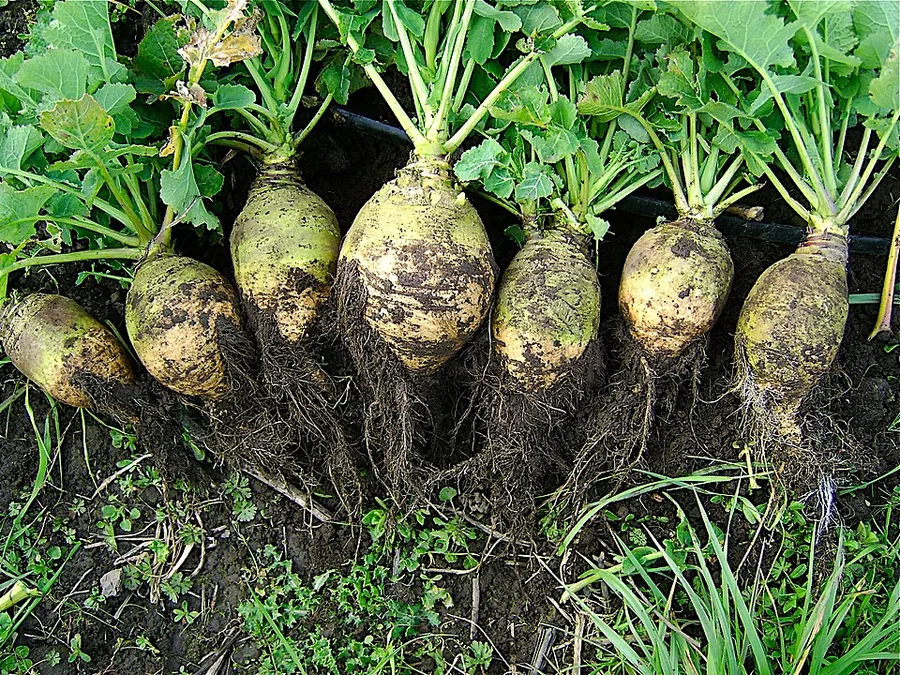
Rutabaga belongs to the cabbage family and holds a quiet, dependable place in the cool-season kitchen garden, valued for the heavy, yellow-fleshed root that rises to meet the soil. It traces back to an old union of turnip and wild cabbage, and it has anchored northern kitchens and winter tables for generations. Known just as often as the swede or Swedish turnip, it belongs to gardens where the summers stay gentle and the autumns turn cold.
This is a crop that rewards a slower rhythm. It asks for a long, cool season of around 90 to 100 days, far more than the hurried turnip, and it comes into its own as the household turns toward autumn cooking. Once lifted, the roots settle into a cool cellar for months, the pantry insurance that made rutabaga a fixture long before the refrigerator.
Its appeal in the garden is how gracefully it fits around everything else. Give it deep, loose ground, steady watering, and a little room, and the season carries it the rest of the way. A few hard frosts turn its starch to sugar, so the root that comes to the late-autumn table is far sweeter than one gathered in haste, and it slips easily into the roasts and stews of the season.
Care
The short version: rutabaga wants full sun and deep, loose, well-drained soil, with about an inch of water a week to keep the roots tender. Sow through summer, thin the seedlings to 8 inches apart, and bring the harvest in through autumn after a hard frost or two.
Light
Rutabaga settles best into a sunny, open spot, the kind of position that gathers 6 or more hours of direct light each day. It will accept a little partial shade, though the roots size up more slowly and stay smaller where the light thins out, so the brightest corner of the plot serves it best.
Water
Keep the ground in even, steady moisture, about an inch of water a week, with a closer eye through the weeks the roots are filling. Left to swing between parched and soaked, the roots turn woody, cracked, and bitter, a poor showing on any plate, so consistency is what tells in the end.
Soil
Give rutabaga deep, loose, fertile loam that drains freely and holds its share of organic matter, the stones lifted out so the root can run straight down. A pH of 6.0 to 7.0 suits it, and a leaning toward the higher end also keeps clubroot at a comfortable distance.
Temperature
This is cool-weather company, at ease between 41°F and 77°F (5°C to 25°C) and growing sweetest as the season cools. Warmth leaves the roots tough and sharp, while the frosts of autumn are what turn the starch to sugar for the table.
Humidity
Ordinary outdoor air is all rutabaga asks, so there is no figure to chase. What matters more to a good crop is steady soil moisture and open airflow through the foliage, keeping leaf troubles from taking hold.
Feeding
A side-dressing of nitrogen, whether calcium nitrate or a balanced fertilizer, about 3 to 4 weeks after planting encourages leafy growth before the roots begin to fill. Where compost has been worked in ahead of time, the ground carries much of the feeding on its own.
Pruning
There is no pruning to speak of. Simply thin the seedlings to about 8 inches apart so each root has the room to fill out handsomely, and lift away any diseased leaves as the season goes.
Size & spacing
In leaf, the plants reach about 12 to 18 inches (30 to 45 cm), the swollen root resting at the soil line below. Allow each one roughly 8 inches (20 cm) of room, and the roots come to full, rounded size in good order.
When to plant
Rutabaga keeps an unhurried seasonal calendar, planted in the warmth of summer and gathered as the cold settles in. Sow it from late spring into mid-summer, allow it the long cool stretch it needs, and lift the roots only after one or more hard frosts have sweetened them for the table.
Northern hemisphere
Southern hemisphere
Typical months for a temperate climate: start earlier in warm zones, later where spring frosts linger.
- Plant: Direct sow in late spring to early summer (late May to early June in northern gardens; mid-summer to early fall in the South) for a fall harvest
- Harvest: Harvest in fall after one or more hard frosts, which sweetens the roots
Hardiness
USDA hardiness zones: 3–9
Temperature: down to -40°C
Troubleshooting
Rutabaga tends to keep its troubles out of view, down in the root or among the youngest seedlings. A little attention to the signs above ground lets you step in before a soil pest or disease undoes a season's work. Read the symptoms below, find the match, and act while it still counts for something.
Brown tunnels boring through the root with wilting outer leaves
Channels winding through the flesh near the crown, with the outer leaves beginning to wilt, are the signature of the cabbage maggot, whose larvae feed inside the root. Lift and destroy any affected root rather than sending it to the compost. A floating row cover set over the bed at sowing, along with fresh ground for brassicas each year, keeps the egg-laying flies from settling.
Fix:
- Remove and destroy infested roots
- Avoid planting brassicas in the same bed in successive years
Stunted plants with swollen, club-shaped roots
Swollen, misshapen roots and a plant that wilts through the midday heat point to clubroot, a soil-borne disease that lingers for years once it arrives. There is no undoing it, so lift the affected plants and discard them rather than composting. A soil pH near 7.0, better drainage, and a wide rotation away from cabbage-family crops keep it from spreading.
Fix:
- Remove and destroy infected plants
- Do not compost infected material
Small round shot-holes across the young leaves
Those neat round holes scattered across the leaves, worst on seedlings in warm, dry spells, are the mark of the flea beetle; a tap at the foliage sends the little black beetles springing away. A row cover from the moment the seedlings appear keeps the beetles off, and steady watering carries the plants along faster than the damage can catch them.
Fix:
- Cover seedlings with row cover
- Keep plants well watered and vigorous to outgrow damage
Brown, watery core within an otherwise sound root
A grey-brown, corky center hidden inside a sound-looking root, often with a bitter edge, is brown heart, brought on by a shortage of boron. Cut the root through and the core shows its breakdown while the skin looks untouched. A soil test should come before any boron, since too much turns toxic, and even watering serves the crop well on lighter ground.
Fix:
- Apply boron-containing fertilizer only per a soil test
- Maintain even soil moisture
Toxicity
Rutabaga is, first and last, food for the table, and every part of it is safe for the household and its animals alike. Roots and leafy tops have fed people and livestock for generations, so it brings nothing to worry over beyond the good sense of moderation.
Safe for
People · Cats · Dogs · Horses · Rabbits · Livestock · Birds
Cats None
Cooked or raw, rutabaga is safe for a cat, though most take little notice of it. A small nibble of root or leaf does no harm.
Dogs None
A little plain rutabaga makes a welcome treat for a dog, many glad of a cooked piece. Keep the helping modest, so the extra fiber does not unsettle a sensitive stomach.
Horses Safe
Horses take rutabaga without trouble. Offer it in small chunks rather than as a whole root, which is too easily choked on.
Rabbits Safe
Both the root and the leafy tops suit rabbits within a varied diet. Bring in any new vegetable slowly, giving the gut time to adjust.
Livestock Safe
Rutabaga has long served as winter feed for cattle and sheep, roots and tops together. Heavy grazing on the raw brassica day after day can press on thyroid function through its natural goitrogens, so it belongs alongside other forage.
Birds Safe
Chickens and other backyard birds happily peck at root and greens with no ill effect. Chopped small, it is the easier for them to manage.
People Safe
At the table, rutabaga is a wholesome vegetable, at home roasted, mashed, or folded into a stew. Both the roots and the young leaves are edible and safe to eat.
Like other brassicas, rutabaga contains glucosinolate goitrogens; very large raw quantities may affect thyroid function, so it is best fed in moderation and cooked.
Varieties
The seed catalogs offer only a short list of rutabaga varieties, close cousins more alike than not. These few are the ones worth knowing by name.
American Purple Top
The familiar standard of the plot, its globe-shaped roots wearing purple shoulders over yellow flesh that warms to orange on the stove.
Laurentian
A uniform purple-top prized for fine-grained, sweet yellow flesh, the sort of root that earns its keep in fall storage.
Joan
An early, smooth-skinned purple-top that brings a welcome measure of tolerance to clubroot.
How to propagate
Rutabaga comes from seed alone, sown in the place it will spend its season. It has no patience for being moved, so there is no shortcut here worth the taking.
SeedEasy
Direct sow outdoors in late spring to mid-summer for a fall crop · Seedlings emerge in 1 to 2 weeks; roots mature in about 90 to 100 days
Sow rutabaga directly into its place, setting the seed about a quarter to half an inch deep from late spring into mid-summer for a fall crop. The seedlings rise within a week or two, and thinning them to roughly 8 inches apart gives each root the room to swell to full size across the following 90 to 100 days. Leave transplanting aside, since rutabaga resents the disturbance and always fares better sown where it will finish.
Myths
Rutabaga and turnip are one and the same vegetable.
They are separate species with habits of their own. Rutabaga is the larger, yellow-fleshed, sweeter root that keeps a long cool season, while the turnip is a quicker, smaller, white-fleshed crop ready within weeks.
Rutabagas must come out of the ground before frost or they spoil.
Frost is the making of them, not the ruin. A hard freeze or two turns the root's starch to sugar, so the flavor deepens after frost, and the finest harvest waits for the cold nights to do their work.