Ornamental · Asteraceae
Stokes Aster
Stokesia laevis
A refined native perennial that brings summer-long blue to a relaxed garden scheme.
Full sun
Every 5–10 days
USDA 5–9
12–24 in · 30–61 cm
Overview
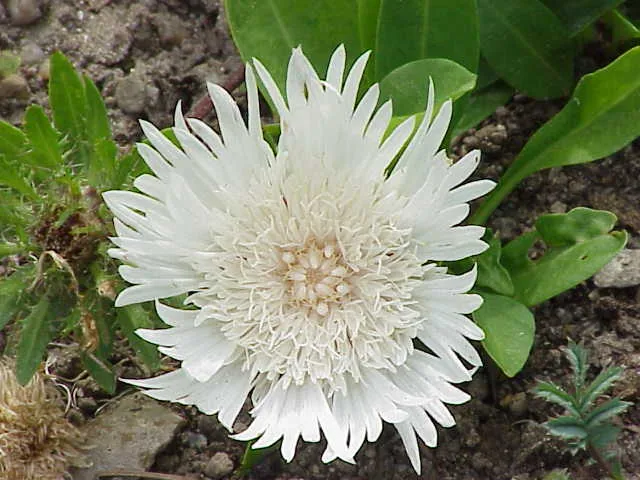
Stokes aster has the easy grace that makes a border feel considered rather than fussed over. A clump-forming perennial from the southeastern United States, named for the botanist Jonathan Stokes, it offers fringed, daisy-like flowers in lavender-blue, white, and creamy yellow that settle into almost any color scheme. It reads as delicate, yet it holds its composure through the heat and humidity of high summer.
In a planting, the flowers do the social work. Opening to as much as 5 inches (13 cm) across in early summer, they carry the display for weeks when the spent heads are removed, and they keep the border alive with bees and butterflies. Once the flowering winds down, the evergreen rosette keeps a quiet, tidy presence, so the bed never looks bare.
It suits the gardener who wants beauty without a demanding routine. Give it full sun, sharp drainage, and the occasional division, and it fits neatly into a low-effort planting plan. The one indulgence it will not tolerate is standing water through winter, the detail that decides whether a clump becomes a long-term fixture or a passing disappointment.
Care
The short version: place it in full sun and average, well-drained soil, water it through the growing season, and keep it dry over winter, since cold, waterlogged soil is what undoes it.
Light
A spot in full sun brings out the sturdiest stems and the fullest flowering, which is exactly what a border wants from it. Partial shade is workable, but a shadier position leaves plants stretched, leaning, and shy on bloom, so give it the open, sunlit place in the scheme.
Water
Keep the soil at average to medium moisture through the growing season, watering around every 5 to 10 days when rain is scarce. Drainage matters far more than a strict routine, because it is standing winter water, not the odd dry week, that quietly ends the planting.
Soil
Average, well-drained soil suits it best, and it takes sandy ground and a little summer wetness in stride. Aim for a pH of 5.5 to 7.0, and on a site that holds water, improving the drainage is the first move worth making.
Temperature
This is a dependable perennial for a wide range of gardens, hardy from about -20°F to 95°F (-29°C to 35°C) and steady across USDA zones 5 through 9. It carries southern heat and humidity with ease, and a winter mulch sees it comfortably through the colder gardens in its range.
Humidity
Ordinary outdoor humidity is entirely within its comfort, so there is no level to manage. What serves the planting is open airflow, which keeps the foliage dry and the crown sound.
Feeding
A light touch is all the feeding it wants. One spring application of balanced fertilizer, or a topdressing of compost, keeps it looking its best, while a heavier hand only brings soft, leaning stems that spoil the line of the bed.
Pruning
Removing the spent flowers keeps the display going and the planting looking cared for, and tidying any tattered leaves does the same through the season. Every few years, lift and divide the clumps to keep them full and well-shaped.
Repotting
A container plant needs moving only when it fills the pot or the crown grows crowded and the flowering falls off. In a border, dividing every 3 to 4 years gives the planting the same lift.
Size & spacing
Plants reach 12 to 24 inches (30 to 61 cm) tall and 12 to 18 inches (30 to 46 cm) wide, an easy scale for the front or middle of a bed. Set them about that far apart so each clump has room to look its best and air moves freely between them.
When to plant
Stokes aster keeps a warm-season calendar that fits an unhurried gardening year. Seed goes indoors in late winter, young plants move outside in spring after frost, and the fringed flowers arrive from early summer into July, often returning for a second showing in fall.
Northern hemisphere
Southern hemisphere
Typical months for a temperate climate: start earlier in warm zones, later where spring frosts linger.
- Sow: Late winter to early spring (about 6-8 weeks before last frost)
- Plant: Spring after danger of frost has passed
- Harvest: Early to mid summer (May to July), sometimes reblooming into fall
Hardiness
USDA hardiness zones: 5–9
Temperature: down to -29°C
Troubleshooting
Stokes aster asks very little and rewards a relaxed hand, so the occasional issue is easy to place. Leaning stems and nibbled leaves stay purely cosmetic, while winter crown rot is the one problem worth heading off. Match what you see below and give the serious one your attention.
A gap in the border after a wet winter
A clump that never returns in spring has usually been lost to crown rot, the result of soggy winter soil that troubles this plant more than anything else. Roots and crown left wet through the cold go soft and dark, and the plant collapses or simply fails to reappear. Lift out the rotted crowns, rework the drainage on a raised bed or slope, and mulch the planting where winters are hard.
Fix:
- Improve drainage by amending soil or planting on a raised bed or slope
- Remove and discard rotted crowns
Stems leaning across the border after rain
When the bloom turns top-heavy with rain or wind, the stems bow and spill across the bed and break the tidy line of a planting. Shade or over-rich soil makes it worse by encouraging soft growth that never firms. Set the plant in full sun, keep feeding restrained, and place a grow-through support beneath taller cultivars before they flower.
Fix:
- Provide light staking or grow-through support for tall cultivars
- Site in full sun to promote sturdier stems
- Avoid over-fertilizing
Ragged leaves interrupting the display
Holed, ragged foliage with a few dark specks nearby points to caterpillars at work. It disturbs the look more than the plant, which carries on and keeps feeding pollinators through the season. Pick the caterpillars off as you find them and let the planting settle back into shape.
Fix:
- Handpick caterpillars
- Tolerate minor feeding as the plant supports pollinators and is generally pest-free
Toxicity
For a home shared with pets or children, the verdict is comforting: Stokes aster is entirely non-toxic. No extension or botanical source lists it as poisonous, and none note any skin irritation, so it can take a place anywhere the household naturally gathers.
Safe for
People · Cats · Dogs · Horses · Rabbits · Livestock · Birds
Cats None
There is no toxicity on record for cats, so a curious nibble is nothing to unsettle a household. A cat that overindulges on any plant may bring a little back up or have a brief upset stomach, much as it would with lawn grass.
Dogs None
Dogs share the space safely, since the plant holds no poisonous compounds. A large mouthful might bring nothing more than mild, passing stomach upset.
Horses Safe
No toxicity warnings attach to horses, so the plant is at home along a pasture edge or in any bed within their reach.
Rabbits Safe
Rabbits can browse the foliage without harm, as it carries no toxins. They will graze the leaves and flowers with enthusiasm, though, so a low fence keeps the clump blooming.
Livestock Safe
Cattle, goats, and sheep face no poisoning risk near this plant. No extension or botanical source counts it among those that trouble grazing livestock.
Birds Safe
Birds come to no harm here. The flowers draw bees and butterflies, and seed-eating birds can work the spent heads in perfect safety.
People Safe
The plant is non-toxic to people, with no reports of poisoning or skin irritation. It is not grown as food, so nothing is meant to be eaten, but a child's accidental taste does no harm.
No special handling precautions noted; wash hands after gardening as general practice.
Varieties
The named Stokes asters set themselves apart mostly by flower color and how tidily they sit in a bed, and these are the selections you will meet most often.
Blue Danube
A compact form whose oversized lavender-blue flowers, up to about 5 inches (13 cm) across, make it a natural focal point in a bed.
Alba
A white-flowered selection for the gardener composing a cool, restrained palette rather than the usual blue.
Mary Gregory
Its soft creamy-yellow blooms bring an unexpected warmth to a plant that otherwise leans blue.
Peachie's Pick
A compact, free-flowering favorite that keeps a border in deep blue over a long season.
How to propagate
Stokes aster lends itself to being multiplied and shared, whether by dividing a clump, saving seed, or rooting a cutting.
DivisionEasy
Spring (or early fall) · One growing season
The simplest way to spread it through a garden is to lift and split an established clump in spring, or early fall if that suits the season better. Repeated every few years, it also refreshes an aging clump as the center thins, and each division settles in over a single growing season.
SeedModerate
Spring; readily self-sows in the garden · Blooms typically in the second year from seed
Seed can be started indoors in late winter or sown outdoors in spring, and the plant readily self-sows around the garden, weaving itself gently through a border. The patience it asks for is modest, since seedlings usually wait until their second year to flower.
Stem cuttingsModerate
Growing season · Several weeks to root; root cuttings are also effective
Stem cuttings taken in the growing season need several weeks to root and make new plants for the garden. Root cuttings work just as well, so a piece of the rootstock will also grow on into a fresh plant.
Myths
Stokes aster is a true aster, planted among the genus Aster.
The common name flatters it. The plant keeps its own genus, Stokesia, named for the English botanist Jonathan Stokes, and it shares only the wider daisy family with the true asters. The flower plays the part beautifully in a border, but its lineage is that of a cousin rather than a true Aster.
Stokes aster wants soil that stays wet, since it grows wild in bogs and savannas.
It does welcome damp ground while in active growth, which is where the bog reputation began. Still, good drainage is essential, and wet winter soil is the plant's greatest undoing. Offer moisture through summer and a dry footing through winter, and it settles in for the long term.