Houseplant · Crassulaceae
String of Buttons
Crassula perforata
In bright light and a dry, gritty mix, this stacked succulent rises into sculptural little towers a shelf can be built around.
Bright indirect
50–77°F · 10–25°C
USDA 9–11
8–18 in · 20–45 cm
Overview
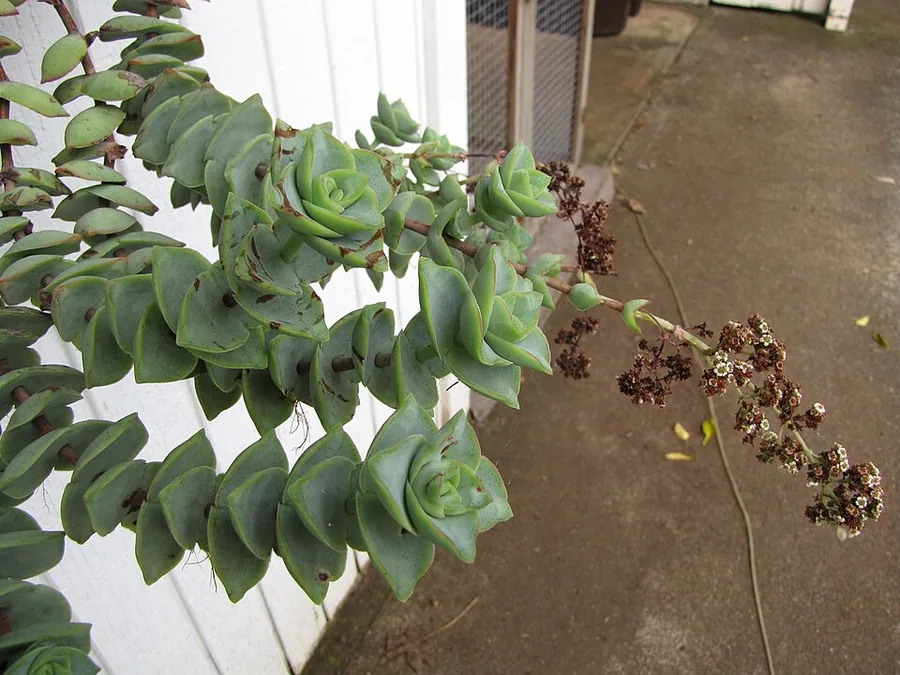
String of buttons takes its name from the triangular leaves that stack up the stem like beads strung in a row, and that stacked, architectural line is what makes it such a natural on a sunlit shelf. A member of the Crassulaceae family alongside jade and stonecrop, it stays gracefully small indoors at 8 to 18 inches (20 to 45 cm) tall. Give it good light and the geometry stays crisp, the kind of quiet detail that lifts a whole corner.
It suits a busy household as easily as a considered one, since it counts as an easy plant that asks only for strong light and a restrained hand with water. The leaves keep their own reserve, so a routine of letting the soil dry fully between drinks fits a life that isn't built around plant care. Come spring, small star-shaped flowers in pale yellow to white arrive like a seasonal accessory above the foliage.
Settled into the right spot, the stems branch and trail to about 12 to 24 inches (30 to 60 cm) across, spilling over a pot lip or the edge of a hanging basket for an easy, relaxed drape. Let the light fade and the stems stretch and lean, and the composed silhouette loosens into something sprawling. Position it where the light is generous and it holds its poise.
Care
The short version: a bright spot, a gritty fast-draining mix, and water only once the soil has dried through. Keep it warm, ease off in winter, and it slips into a room with almost no upkeep.
Light
Set it in bright light, ideally bright indirect with a few hours of direct sun, the sort of position a west or south window offers. Once hardened off it takes full sun, but a dim corner draws the stems out and the tidy stacked shape unravels.
Water
Let the soil dry out completely between waterings, since the leaves carry their own supply, which makes it a forgiving fit for a sunny sill you pass now and then. Water sparingly through winter dormancy. It rots quickly in soggy soil, so when in doubt, leave it be.
Soil
Plant it in a gritty cactus or succulent mix that drains in seconds rather than minutes, ideally in a vessel that shows off the stacked stems. A slightly acidic pH around 6.0 to 6.5 suits it, and the grit is what keeps the roots from sitting wet.
Temperature
Keep it in the easy comfort of 50°F to 77°F (10°C to 25°C), ordinary indoor warmth. It is not frost-hardy, so bring it in from a porch or patio well before the season turns cold.
Humidity
There's no misting routine to keep here, since low household humidity is exactly what this succulent prefers. Dry air and good airflow suit both the plant and an uncluttered shelf, and they help hold rot at bay.
Feeding
Feed only in spring and summer during active growth, with a diluted balanced or low-nitrogen succulent fertilizer. A light seasonal feed is all it wants, and heavy nitrogen only brings soft growth that spoils the crisp line.
Pruning
Pinch or trim any leggy, stretched stems to coax a fuller, more tightly stacked shape that reads well on display. The pieces you remove root without trouble, so a quick tidy quietly becomes a second plant.
Repotting
Repot every 2 to 3 years, or once it outgrows its container, in spring. Watch for roots at the drainage holes, soil that dries unusually fast, or a top-heavy plant crowding the edges, then move it to a pot that still flatters the trailing stems.
Size & spacing
Indoors it reaches about 8 to 18 inches (20 to 45 cm) tall and trails to roughly 12 to 24 inches (30 to 60 cm) wide. Give it room to spill across a shelf, or hang it so the stacked stems can drape into the space below.
Troubleshooting
Almost every misstep with string of buttons circles back to two things, light and water, and both are easy to read in how the plant carries itself. Too little light and the stems stretch, too much water and the roots suffer, and a sudden turn in the sun marks the leaves. Match what you notice below, and the remedy is rarely more than a small adjustment to where it sits.
Yellow, mushy leaves and a soft base
Soft, translucent leaves and a dark, squishy base point to root rot, the price of too much water in soil that drains too slowly. Stop watering and let everything dry out. If the base is already lost, lift the plant, cut away the slimy brown roots, and repot the firm sections in fresh gritty mix, or take cuttings from any growth still worth keeping on display.
Fix:
- Stop watering and let soil dry fully
- Unpot, cut away rotted roots and stems, and repot healthy portions in fresh gritty mix
- Take cuttings from firm growth if the base is lost
Stems stretching out and losing their stacked shape
The culprit is etiolation, the plant reaching for light a shady corner can't supply. New growth comes in pale and elongated, the stems tip toward the nearest window, and the composed silhouette goes slack. Move it to a much brighter spot, then prune the drawn stems and root the cuttings to restore that neat, sculptural stack.
Fix:
- Move to a brighter spot with several hours of direct or very bright indirect light
- Prune stretched stems and root the cuttings to restart compact growth
Brown or reddish scorch marks on the leaves
Those marks are sunburn, which appears when strong direct sun meets a plant that hasn't adjusted to it. The damage settles on the surfaces facing the light, usually just after a move to a patio or a hot window. Return it to bright indirect light, remove the worst leaves, and reintroduce full sun slowly over a week or two.
Fix:
- Move to bright indirect light and remove badly damaged leaves
- Reintroduce direct sun gradually over one to two weeks
Toxicity
For a home with pets, this one settles in without worry: string of buttons is generally considered non-toxic and safe. A cat, dog, or rabbit that investigates a leaf should be none the worse for it. The foliage is there to be admired rather than eaten, so there's no call to invite tasting, yet the plant needs no hiding away on a high shelf.
Safe for
People · Cats · Dogs · Horses · Rabbits · Livestock · Birds
Cats None
A cat sharing the shelf is safe with string of buttons, and an idle nibble won't cause harm.
Dogs None
This succulent can live in a room with dogs untroubled, since a chewed leaf isn't known to poison them.
Horses None
Horses take no harm from the plant, which carries no toxic effect for them.
Rabbits None
A rabbit that tastes a stem stays fine, as the plant holds no toxins known to affect them.
Livestock None
Grazing animals like goats and sheep are unbothered by string of buttons.
Birds None
The plant poses no recognized danger to pet birds sharing the space.
People None
For people it's non-toxic, though the leaves are meant for the shelf, not the plate.
Helpline numbers

United States
ASPCA Animal Poison Control: (888) 426-4435 (fee applies)

United Kingdom
Animal PoisonLine: 01202 509000 (fee applies)

Australia
Animal Poisons Helpline: 1300 869 738
Varieties
The plain green species fills most shelves, but one named selection is worth seeking out for a room that wants a little more color.
Crassula perforata 'Variegata'
Set in bright light, its leaves take on creamy-yellow to pinkish variegation and blush pink at the margins for a softer, prettier palette.
How to propagate
String of buttons shares itself freely, and a single plant offers all the cuttings needed to style another pot or send one home with a guest.
Stem cuttingsEasy
Spring through summer during active growth · 2 to 4 weeks to root
Stem cuttings are the simple route to a matching second pot. Take a stem segment in spring or summer, let the cut end callus over for a day or two, then rest it on or in gritty mix. Roots settle in over about 2 to 4 weeks.
Leaf cuttingsModerate
Spring through summer · 4 to 8 weeks to root and sprout
A single leaf can start a new plant too, for anyone happy to wait. Remove a whole healthy leaf, let it callus, and lay it on dry succulent mix in spring or summer. Give it 4 to 8 weeks to root and sprout, at a lower success rate than stem cuttings.
Myths
String of buttons must be poisonous because it looks like other toxic succulents.
Crassula perforata is generally treated as non-toxic and safe around cats and dogs. Many succulents do carry toxins, so the family's careful reputation is fair enough, but this one doesn't belong on the dangerous list. The leaves earn their place as decoration rather than a snack, though a stray nibble is no cause for alarm.