Houseplant · Acanthaceae
Polka Dot Plant
Hypoestes phyllostachya
Set it where the light falls soft, give it steady moisture, and its freckled color reads all year.
Bright indirect
61–81°F · 16–27°C
USDA 10–11
12–30 in · 30–76 cm
Overview
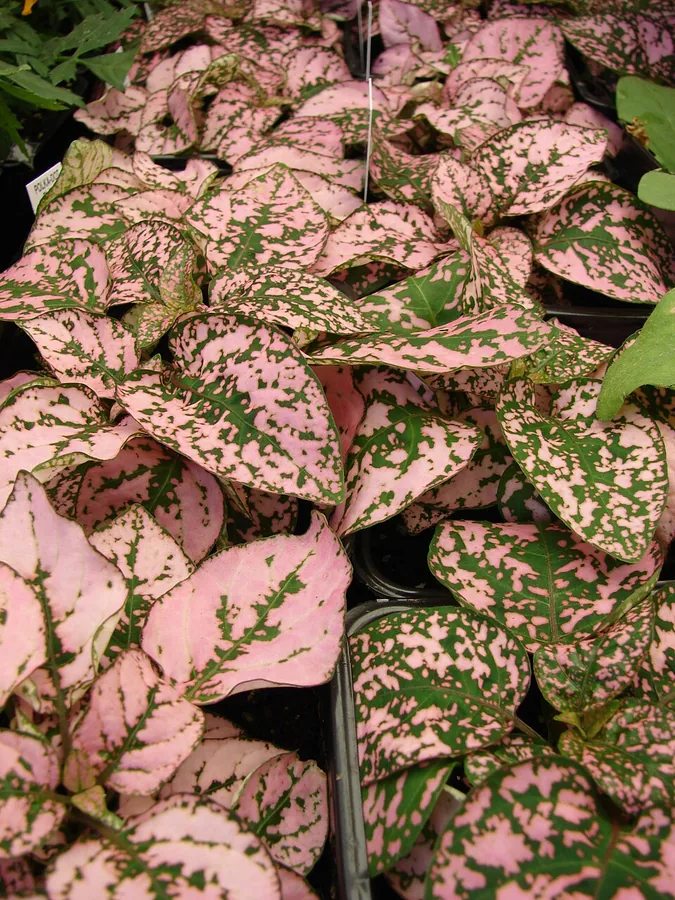
The polka dot plant brings a quiet dose of color to a room, its green leaves flecked with pink, rose, or white. A native of Madagascar in the Acanthaceae family, it has become a fixture on shelves and desks the world over. The flowers are a minor affair, small and lilac, and most people pinch them away so the patterned leaves stay the focus.
This is a compact plant, holding to about 12 to 30 inches (30 to 76 cm), and it grows fast enough to make a difference in a season. That pace suits a home that likes a little change. A pot fills out quickly for a fuller look, and a plant past its prime is simply cut back or replaced from a cutting, no ceremony required.
Think of it as an easy houseplant that earns its spot with almost no fuss. Give it bright filtered light, keep the soil evenly moist, and pinch it now and then to keep the shape trim. The color holds where the light is good. Let a corner go dim and the spots quietly fade, a cue to move it toward the window.
Care
The short version: bright filtered light for the truest color, soil kept evenly moist but never soggy, warmth above 60°F (16°C), and a regular pinch to hold its shape.
Light
A spot in bright, filtered light is where the color reads best, so place it near a window softened by a sheer. Harsh direct sun bleaches and scorches the leaves, while a dim corner drains the pattern, so steer clear of both extremes. Get the light right and the plant looks its part on a shelf or sill.
Water
Keep the soil evenly moist through the growing season, watering well and letting the surface dry just slightly before the next round. It tolerates a short dry stretch, handy for a busy week, but it looks and grows best with steady moisture, so keep it off the bone-dry end.
Soil
Set it in a porous, organic-rich mix that drains freely, one built with peat moss or leaf mold. It is relaxed about pH, content anywhere from 5.5 to 7.5, provided water never lingers around the roots.
Temperature
Everyday room warmth suits it, ideally 61°F to 81°F (16°C to 27°C). It slows and sulks once the room dips below about 60°F (16°C), so keep it away from cold drafts and a chilly pane of glass.
Humidity
This plant favors humid air, more than most rooms naturally hold. Cluster it with other greenery, rest the pot on a pebble tray, or mist through the dry months, and the leaf edges stay clean rather than crisping.
Feeding
Feed through spring and summer while the plant is growing. A dilute balanced liquid fertilizer about once a month is enough, and feeding can pause once growth settles for the year.
Pruning
Pinch the stem tips often to keep the plant full and well-shaped rather than leggy, which matters for how it presents in a room. Remove the small flower spikes as they appear so the plant channels its energy into the foliage.
Repotting
Move it up a size once a year, or when roots crowd the drainage holes. Many growers skip the long haul and simply root fresh cuttings, since the plant grows fast and tends to tire within a couple of years.
Size & spacing
Expect a neat mound around 12 to 30 inches (30 to 76 cm) tall and roughly 9 to 30 inches (23 to 76 cm) across, an easy scale for a desk, shelf, or windowsill. Give a grouping some space, since crowded, still air invites powdery mildew.
Troubleshooting
Nearly every problem here traces back to light, water, or a stray pest, and none of it is hard to read. The faded color and the leggy reach tell their own story once you know the signs. Match what the plant is showing below and set it right before it slips.
Wilting with mushy stems or a white dusty film
Soggy soil and stems collapsing at the base signal root rot from overwatering, while a white powdery dusting is powdery mildew taking hold in still, humid air. A porous, well-drained mix and a dry surface before the next watering set the roots right. Better airflow around the plant keeps the mildew from spreading.
Fix:
- Use a porous, well-drained mix and let the surface dry between waterings
- Improve air circulation to limit mildew
Sticky residue, twisted growth, or small insects
Sticky leaves and puckered new growth usually mean whiteflies, aphids, or mealybugs, the pests this plant tends to attract indoors. Check the undersides of the leaves for clustered insects or white cottony tufts, and note whiteflies that scatter when the foliage is brushed. Treat with insecticidal soap or neem oil, repeat as directed, and keep the plant apart from the rest until it clears.
Fix:
- Treat with insecticidal soap or neem oil
- Repeat applications as directed and isolate affected plants
Long, leggy stems with thin, faded leaves
A plant that leans toward the glass and sheds its lower leaves is either short on light or simply aging without a trim. Shift it into bright, filtered light and pinch the tips often to bring back full, shapely growth. When it has grown too gangly to save, a fresh start from tip cuttings is the tidiest route.
Fix:
- Move to bright, filtered light
- Pinch back stem tips regularly to force branching
- Take and re-root tip cuttings to renew an old, leggy plant
The pink and white color fades or looks scorched
Washed-out spots are a light issue at both ends of the scale. Strong direct sun bleaches and scorches the leaves, and a shadowy corner drains the color just the same. The pattern is richest in bright filtered light or gentle partial shade, so a move there brings it back.
Fix:
- Relocate to bright, filtered light rather than full sun or deep shade
Toxicity
For a home shared with pets or small children, the polka dot plant sits easy: it is non-toxic. The ASPCA clears it for cats, dogs, and horses, and extension sources agree. A curious nibble amounts to no more than a brief, mild stomach upset from the plant fiber.
Safe for
People · Cats · Dogs · Horses · Rabbits · Livestock · Birds
Cats None
The ASPCA lists it as non-toxic to cats. A stray nibble might prompt a little vomiting from the plant fiber, which passes on its own.
Dogs None
Dogs are covered too, placed on the ASPCA non-toxic list. The most a chewed leaf brings on is brief, mild stomach upset.
Horses None
Horses share the same clearance from the ASPCA, so a grazing mouthful is nothing to be concerned about.
Rabbits Safe
No toxin troubles rabbits here. Even so, introduce it gradually as with any new green, so a sudden change of diet does not unsettle them.
Livestock Safe
Goats, sheep, and other grazers can browse it safely, the plant carrying nothing poisonous.
Birds Safe
Pet birds are at ease around it. The leaves hold no toxic compounds, so a tasted leaf does no harm.
People Safe
It is harmless to people, children included. No one grows it to eat, but a leaf in a small mouth is no cause for worry.
As with any non-food plant, ingestion may cause mild, self-limiting vomiting or diarrhea simply from the plant material.
Varieties
Most polka dot plants come labeled by color rather than a strict cultivar, though a few named selections are worth a look.
'Splash Select Pink'
A compact selection with pink-spotted leaves rising over small purple flowers.
'Confetti Compact White'
A refined, compact form freckled in white rather than pink, finished with small purple blooms.
Pink Splash / Freckle Face types
Green leaves scattered with rose, pink, or white, their spotting heavier or lighter depending on the seed-grown strain.
How to propagate
Adding to a collection could hardly be simpler. A favorite plant travels from a cutting in a glass of water, or a whole new set can be raised from seed.
Stem cuttingsEasy
Any time during active growth · Roots in a few weeks
Cuttings are the simplest way to carry a plant forward. While it is growing, take a tip about 4 inches (10 cm) long, strip the lower leaves, and stand it in water or moist mix, where it roots within a few weeks. The new plant comes up as a match for the original.
SeedEasy
Sow indoors 8-10 weeks before the last frost · Germinates in as little as 4 days at about 68°F (20°C)
Seed is just as reliable and the way many plants are sold. Sow indoors 8 to 10 weeks before the last frost, keep the tray warm at around 68°F (20°C), and sprouts can show in as little as 4 days. Seed-grown plants differ in how thickly they are spotted, so each one arrives a little different.
Myths
The polka dot plant is the same as the polka dot begonia.
They are two distinct plants from two different families. The polka dot plant is Hypoestes phyllostachya in the Acanthaceae, and the polka dot begonia is Begonia maculata in the Begoniaceae. Only Hypoestes is the true polka dot plant.
The polka dot plant is poisonous to cats and dogs.
Not so. The ASPCA lists Hypoestes phyllostachya as non-toxic to dogs, cats, and horses. A curious pet faces nothing worse than a mild, passing stomach upset from a chewed leaf.