Houseplant · Droseraceae
Venus Flytrap
Dionaea muscipula
Give a sunny sill full sun, rainwater, and a cold winter rest, and the flytrap rewards it as a living conversation piece.
Full sun
Every 1–3 days
USDA 7–10
2–5 in · 5–13 cm
Overview
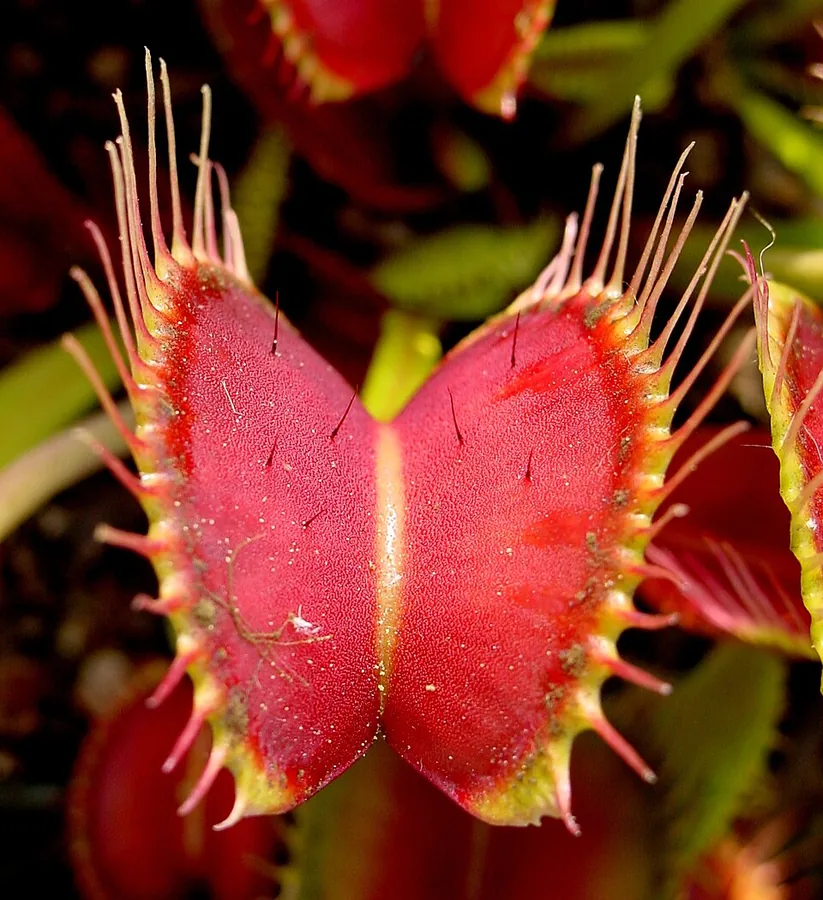
Few plants earn a place on the windowsill quite like the Venus flytrap, that instantly recognizable curiosity with hinged traps that close on a passing insect. It comes from a small patch of Carolina bog, where the poor soil pushed it to hunt for a living. That backstory is part of the appeal, and it is also why the plant asks to be treated as its own thing rather than slotted in beside the usual leafy houseplants.
It keeps a modest footprint, only a few inches across, sitting as a low rosette of traps rather than reaching upward, which makes it a natural for a bright kitchen sill or a sunny desk corner. It is a true perennial with a seasonal rhythm worth planning around. Spring and summer are its lively months, then it wants a cold winter rest, and honoring that pause is what keeps it in the room year after year.
Style it well and the care follows a short, easy rhythm. Give it the sunniest spot you have, water it with rain caught in a jar, keep it in its lean acidic mix, and let it cool down each winter. Because it feeds itself, the daily routine it asks for is refreshingly light, so the best display comes from leaving it largely alone.
Care
The short version: set it on your sunniest sill, water only with distilled, reverse-osmosis, or rainwater, keep it in a lean peat-and-sand mix, never fertilize or feed it meat, and let it rest cold and dormant for 3 to 4 months each winter.
Light
The flytrap belongs in your brightest spot, wanting full, direct sun for at least 6 hours a day and gladly more. Denied it, the plant stretches pale and floppy and the traps stay small and lose their red, so a south-facing sill or a summer place outdoors flatters it far more than a shaded shelf.
Water
Water it with only distilled, reverse-osmosis, or rainwater, never tap or bottled mineral water, since the salts build up and kill the plant. Through the growing season, stand the pot in a tray holding about 1 to 2 cm of water and keep the mix damp, a tidy routine that suits a busy kitchen sill. Come winter dormancy, ease back so the media stays just barely moist rather than wet.
Soil
Keep it in a lean, acidic carnivorous mix of sphagnum peat with perlite or silica sand, nothing richer. Ordinary potting soil, compost, or any fertilized blend burns the roots and rots the plant, so leave those for other pots. The right mix sits at a strongly acidic pH of 3.5 to 5.0.
Temperature
It lives easily across a wide span through the year, from about 41°F to 95°F (5°C to 35°C). Summer warmth keeps it growing, but the plant also needs a true cold spell in winter to rest, so resist the urge to keep it cozy in a heated room all year.
Humidity
Ordinary room humidity of 50% to 70% suits it fine, and the constantly damp tray keeps the air around it moist enough. There is no need to mist or seal it into a terrarium, which can invite mold and dull the display.
Feeding
Skip fertilizer entirely. A flytrap feeds itself by catching insects, and fertilizer in the soil burns the roots and kills it. The traps gather every nutrient the plant needs without any help.
Pruning
With clean scissors, trim blackened or dead traps and spent leaves at the base to keep the plant looking sharp and mold at bay. On a young or stressed specimen, cut the tall flower stalk in spring as well, since flowering pulls energy the small rosette would rather keep for its traps.
Repotting
Refresh the pot every 1 to 2 years in early spring with new carnivorous mix. Do it when the rhizomes crowd the pot edge, the media has broken down and compacted, or several offsets have gathered, and use the moment to divide.
Size & spacing
This is a compact plant, only 2 to 5 inches (5 to 13 cm) tall and about as wide, which is exactly what makes it such an easy fit on a sill or side table. A single flytrap is content in one small pot, so spacing matters only when you group several in a shared bog planter.
Troubleshooting
Almost every flytrap hiccup comes down to one of four things: the wrong water, too little light, ordinary potting soil, or a skipped winter rest. The notes below help you read the signs and place the cause. Spot it early and the plant usually returns to form without much fuss.
A sudden collapse and a soft, failing crown
When a plant folds without warning, lifting it usually reveals a soft brown rhizome, the near-certain result of ordinary soil or a well-meant dose of fertilizer. Repot at once into a lean sphagnum peat and perlite or sand mix, pare away the spoiled tissue, and return to mineral-free water. Any firm white rhizome left behind still holds the promise of a comeback.
Fix:
- Repot into nutrient-poor sphagnum peat and perlite/sand mix
- Resume mineral-free water only
- Remove rotted tissue; healthy white rhizome may still regrow
A gradual, season-by-season fade toward death
A flytrap kept warm and on show all year eventually loses its spark, because it never took its winter dormancy. Build a cold rest of 3 to 4 months into the routine at roughly 35°F to 50°F (2°C to 10°C), with the light and water pulled back. A sheltered spot outdoors suits a mild region, while a cool unheated room or the refrigerator carries it through a harder winter.
Fix:
- Provide a 3-4 month cold dormancy at roughly 2-10°C (35-50°F) with reduced light and watering
- Overwinter outdoors in mild zones or in an unheated cold space/refrigerator in colder climates
Traps darkening and foliage fading away
Most often the trouble is mineral buildup from tap or bottled water, which leaves a chalky crust on the soil and slows the fresh growth you want on display. Move to distilled, reverse-osmosis, or rainwater and flush the pot to carry those salts away. A few older traps darkening on an otherwise thriving plant is simply the natural cycle, since each trap steps back after several catches.
Fix:
- Switch immediately to distilled, reverse-osmosis, or rainwater
- Flush the media with mineral-free water to leach out salts
- Trim off fully blackened traps at the base
- Stop hand-feeding and let the plant catch its own insects
Leggy, washed-out growth and small, feeble traps
A flytrap that has drifted into a dim corner shows it at once, and the cause is too little light. The stalks lengthen and flop while the traps stay small and green rather than compact with the red centers that make the plant a talking point. Give it the brightest sill in the house, a full 6 hours of direct sun or more, and let it settle in over a week so the leaves do not scorch.
Fix:
- Move to full direct sun (a minimum of 6+ hours, ideally outdoors or a very bright sunny window/grow light)
- Acclimate gradually over a week to avoid scorch
Toxicity
A reassuring note for a shared home: the Venus flytrap is non-toxic to people and animals. The ASPCA clears it for cats and dogs, and the snap-traps are far too small and weak to harm anything larger than a fly. The only real casualty is the plant, which loses energy whenever someone keeps triggering the traps for fun.
Safe for
People · Cats · Dogs · Horses · Rabbits · Livestock · Birds
Cats Safe
A household cat has nothing to fear from this plant, which the ASPCA lists as non-toxic to cats. The traps are far too small and delicate to pinch a paw or a curious nose exploring the windowsill.
Dogs Safe
The plant is safe for dogs, with nothing poisonous in the leaves or traps. A dog that noses in might earn a small startle as a trap closes, but the moment passes without harm.
Horses Safe
No toxins are present, so a horse runs no risk from a stray taste. A bog plant only a few inches across was never destined for a stable in any case.
Rabbits Safe
Nothing in a flytrap will poison a rabbit, and the traps are far too flimsy to cause harm. There is simply no reason to let a rabbit graze a slow-growing specimen down to nothing.
Livestock Safe
Cattle, goats, and sheep face no poisoning from this plant. It belongs on a bright sill as a conversation piece, not anywhere near a pasture.
Birds Safe
Birds are in no danger from a flytrap. The traps close on insects, not feathers, and hold nothing toxic.
People Safe
The plant is harmless to handle, children included. A trap closing on a fingertip offers only the lightest pinch and cannot break skin, so the sole cost is the energy wasted when someone triggers it for fun.
Touching the trigger hairs makes traps close; repeatedly poking traps for fun wastes the plant's energy and should be avoided.
Varieties
Beyond the classic green-and-red flytrap, growers have selected cultivars for color, trap size, and tooth shape, each bringing a slightly different mood to a sill. A few stand out.
'Akai Ryu' (Red Dragon)
This cultivar takes on a deep maroon-red throughout, foliage and traps together, for a moodier look than the usual green leaves with red-lined jaws.
'B52'
Grown for presence, 'B52' carries some of the largest traps of any flytrap you can bring home.
'Dente'
In place of the long bristle teeth most flytraps show, 'Dente' finishes its traps with short, triangular tooth-like spines for a neater silhouette.
How to propagate
Growing your collection is part of the pleasure: divide a clump, root a leaf, or raise plants from seed. Division is the quick, satisfying route, while seed is the slow project that pays off over a few years.
DivisionModerate
Early spring, during or just after dormancy when repotting · Several weeks to a few months
The simplest way to build a little collection is to split a clump in early spring, during or just after dormancy while the plant is already out for repotting. Ease the offsets apart so each keeps its own roots and growth point, then set them into carnivorous mix. They find their feet over several weeks to a few months.
Leaf cuttingsModerate
Spring to early summer during active growth · About 1-3 months for plantlets to form
Leaf cuttings are worth trying in spring or early summer while growth is strong. Draw a whole leaf away with a little of the white rhizome base attached, lay it flat on damp media, and keep it bright. Small plantlets appear from the base over about 1 to 3 months.
SeedDemanding
Sow after cold-moist stratification in late winter to spring · 3-5 years to reach mature size
Seed is the unhurried route, a project for the patient. Sow in late winter or spring after a cold-moist stratification to break dormancy. The seedlings rise readily, yet they need 3 to 5 years to reach full-size traps, so most people start with a division instead.
Myths
Raw hamburger or chicken makes a fine meal for a flytrap.
Meat is too fatty and rich for a flytrap, so it rots inside the trap and turns it black, spoiling the display. The plant evolved to digest insects and spiders, which it catches perfectly well on its own.
A flytrap is a tropical plant that craves warmth every month.
They are not tropical at all. They are temperate bog plants from the Carolinas, and they need a cold winter dormancy of 3 to 4 months to carry on past a season or two.
Tap water serves a flytrap perfectly well.
The minerals and salts in tap and bottled water build up in the soil and slowly poison the roots. Use only distilled, reverse-osmosis, or rainwater, and nothing else.
A flytrap needs regular hand-feeding to keep going.
Set on a bright sill in full sun, a flytrap makes its own food and catches plenty of insects with no help from you. Hand-feeding is optional and never required, and fussing over it only wears the traps out.