Houseplant · Lentibulariaceae
Butterwort
Pinguicula moranensis
Give it bright light, rainwater, and a lean gritty mix, and the butterwort earns its shelf by clearing your gnats for free.
Bright indirect
Every 2–5 days
41–86°F · 5–30°C
USDA 10–11
Overview
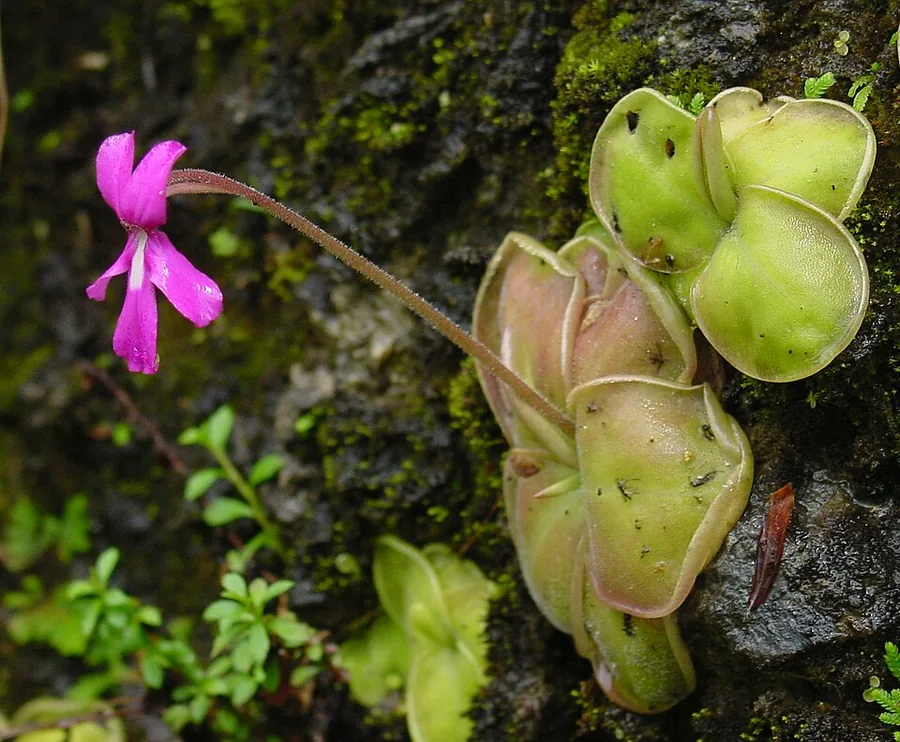
The butterwort is the rare houseplant that pulls its weight as both decoration and quiet pest control, hunting with glue rather than snapping jaws. Its flat rosette of greasy, sticky leaves gathers fungus gnats and small flies and turns them into the nourishment its lean soil withholds. This Mexican species, Pinguicula moranensis, hails from volcanic country and looks entirely at ease on a bright windowsill in a sunlit room.
Part of its appeal is how it shifts with the calendar, giving a kitchen or studio sill two distinct moods. Through spring and autumn it opens into a generous rosette and floats slender stalks of pink-violet flowers above the leaves, an understated splash of colour. As the light shortens, it draws into a compact, non-sticky succulent rosette and rests through winter on almost no water, a tidy footprint for a cooler season.
What it asks of you reads more like an editing exercise than a chore: strip away the usual houseplant fuss. Butterworts want no fertilizer, no tap water, and no rich potting mix, and once those three habits are set aside, the plant slips into a daily routine that barely registers.
Care
The short version: a bright spot, only distilled or rainwater, and a lean gritty mineral mix. Keep it evenly damp through the growing season, let it dry into its winter rosette, and leave the soil unfed.
Light
Butterworts want bright light, ideally bright indirect with a few hours of sun, which makes a sunny windowsill their natural home. They take anything from full sun to partial shade, but a dim corner leaves them pale and dull, with the leaves giving up their sticky sheen.
Water
Pour only distilled, reverse-osmosis, or rainwater, never tap, since dissolved minerals build up and slowly kill the plant. Keep the gritty mix evenly damp through the growing season, most easily by standing the pot in a shallow water tray that disappears under a saucer. Through the winter rosette it wants far less, just a light drink when the medium nearly dries.
Soil
Plant it in a gritty, low-nutrient mineral mix of peat or long-fiber sphagnum cut with sharp sand, perlite, and a little pumice. Any pH from 5.0 to 7.0 suits it. Leave rich potting soil out entirely, since the roots are made for lean ground.
Temperature
This Mexican species is content across a wide span, roughly 41°F to 86°F (5°C to 30°C), which covers the comfortable range of most living spaces. That latitude lets it ride the ordinary swings of a heated room, provided it never freezes.
Humidity
For all its carnivorous mystique, it needs no terrarium to hold a room. Average household humidity of 40% to 60% suits it, and steady airflow does it more good than chasing a high reading.
Feeding
Leave the soil unfed. The plant looks after its own meals, catching fungus gnats and small flies on its leaves, and any feed in the pot only burns the roots.
Pruning
There is no shaping to fuss over. Now and then lift away dead, blackened, or rotted leaves and spent flower stalks, a small tidy-up that keeps fungal rot at bay and the rosette looking its best.
Repotting
Refresh it every 1 to 2 years, ideally in spring as growth resumes. Move it on when the mix breaks down and stays soggy, when the rosette crowds the pot edge, or when new leaves stop turning sticky.
Size & spacing
This is a small, neat plant, rising only 2 to 10 inches (5 to 25 cm) tall and spreading 3 to 6 inches (8 to 15 cm) across. A single rosette suits a modest pot, a perfect scale for a windowsill arrangement.
Troubleshooting
Almost every wobble a butterwort shows comes down to water, feeding, or the turn of the seasons. Read the signs against the list below before you act, because the obliging instinct, more water or a little feed, is usually what undoes the plant.
A mushy, blackened crown caving in
When the centre of the rosette darkens and slumps, the culprit is crown rot, and it traces back to the watering routine. Tap or mineral water leaves salts in the lean mix, and a pot kept too wet through the winter rest seals the plant's fate. Reach for distilled or rainwater, rinse the medium clean, settle the plant into fresh gritty mix, and pare away any soft brown tissue before returning it to its spot.
Fix:
- Stop watering until the mix is barely moist
- Flush the medium with distilled/RO water to leach salts
- Repot into fresh gritty mineral mix and remove rotted tissue
- Increase airflow and light
Fresh leaves arriving without their sticky shine
A rosette that loses its quiet shimmer and arrives dry and flat is signalling mineral buildup or feeding. Fertilizer and rich soil burn the roots, tap water loads the mix with salts, and a dim corner leaves the plant listless. Spare it the feed, refresh with distilled or rainwater, and move it to a brighter shelf with several hours of bright light, and the look returns.
Fix:
- Never fertilize the soil
- Switch to distilled/RO/rain water and flush the mix
- Move to a brighter spot with several hours of bright light
Leaves drawing into a small succulent rosette come autumn
There is nothing to mend here, only a season to follow, because this is the winter succulent phase. As autumn light fades, the plant sets aside its sticky carnivorous leaves for a compact, non-sticky rosette and rests until the days lengthen. Ease off the water until the mix nearly dries, keep it on a bright shelf, and let your usual routine resume in spring.
Fix:
- Reduce watering and let the mix nearly dry
- Keep in bright light and resume normal moisture in spring
Toxicity
Welcome news for a home with animals: the butterwort is not toxic to pets or people. Its sticky leaves capture only gnat-sized insects and carry nothing harmful, so the single reason to set it out of reach is to keep that delicate rosette safe from curious paws.
Safe for
People · Cats · Dogs · Horses · Rabbits · Livestock · Birds
Cats None
A household cat that investigates the leaves comes away with only a tacky tongue. Nothing toxic is at play, so it earns a place even in a cat-friendly room.
Dogs None
Dogs share the space without any worry. The plant holds no poison, and a chewed leaf offers nothing worse than a greasy taste.
Horses Safe
Horses are in no danger from it, though this delicate windowsill rosette belongs indoors and well away from the paddock.
Rabbits Safe
Rabbits come to no harm. A stolen nibble leaves the animal untouched, even if it spoils the look of the rosette.
Livestock Safe
Cattle, goats, and sheep face no risk, and a tray-grown houseplant lives a world apart from the barn in any case.
Birds Safe
Birds meet no chemical hazard in the leaves or flowers. The plant's tacky surface holds gnat-sized insects alone, nothing larger.
People Safe
It is safe to handle bare-handed and feels only greasy to the touch. Grown for display rather than the table, it offers no part meant for eating.
The greasy, sticky leaf surface is harmless to handle and to pets; it simply feels tacky.
Varieties
Most homes meet the butterwort through one of a few familiar forms. These are the ones you are most likely to find offered by name.
Pinguicula moranensis
The classic large-flowered Mexican butterwort, lifting pink-violet blooms over a flat summer rosette for an effortless tabletop accent.
Pinguicula moranensis var. neovolcanica
A variety tracing to the Mexican volcanic ranges, listed as recognized on Kew's Plants of the World Online.
Pinguicula 'Tina'
A vigorous hybrid that makes an easygoing, gnat-catching first plant for a styled windowsill.
How to propagate
Butterworts multiply with little fuss, and the easiest method asks for nothing more than a few leaves from a plant already on your sill.
Leaf cuttingsEasy
Late winter to spring, especially from the succulent winter rosette · 4-8 weeks to form plantlets
The simplest way to fill a windowsill with more is by leaf pulling. In late winter or spring, while the plant rests in its succulent rosette, ease whole leaves from the base and set them on damp gritty mix. New rosettes appear at the leaf base over 4 to 8 weeks, ready to style into pots of their own.
DivisionEasy
Spring at repotting · 2-4 weeks
Established plants gather a cluster of offset rosettes around the parent, perfect for sharing. At spring repotting, part these into separate pots, and each settles in within 2 to 4 weeks to become a tidy little display in its own right.
SeedDemanding
Spring on the surface of damp mineral mix · Several months to a year
Seed is the unhurried route, suited to those who enjoy the long view. Scatter the fine seed across damp mineral mix in spring and wait, since it can take several months to a year to reach a presentable size. It is less sure than leaf pulling, yet the way to raise a whole collection at once.
Myths
Keeping a butterwort alive means hand-feeding it insects or reaching for fertilizer.
There is no ritual feeding to schedule, since the leaves quietly gather their own fungus gnats and small flies and ask for nothing more. Never fertilize the soil, because the roots prefer lean ground and added nutrients only burn them.
A butterwort on the shelf puts cats and dogs at risk of poisoning.
It belongs in a home with pets without a second thought. Pinguicula is absent from the ASPCA toxic plant list and is regarded as non-toxic to pets, its leaves catching only tiny insects and carrying nothing that would trouble a curious companion.
A carnivorous plant only belongs in a sealed, humid terrarium.
No glass case is required to make it look the part. Mexican butterworts settle into ordinary household humidity given low-mineral water and bright light, and a sealed enclosure often does more harm than good by holding stale, rot-friendly air.