Houseplant · Polypodiaceae
Staghorn Fern
Platycerium bifurcatum
Mounted on a board in bright indirect light with a regular soak, the staghorn hangs like living sculpture on the wall.
Bright indirect
Every 7–14 days
55–75°F · 13–24°C
USDA 9–12
Overview
Few houseplants make a statement quite like the staghorn fern, whose forked, antler-shaped fronds turn a bare wall into a focal point. As an epiphyte, it grows in the wild across bark and high branches instead of in soil, which is why it lives mounted on a board and reads more like framed art than a potted plant. Its tropical, sculptural silhouette gives a room instant character.
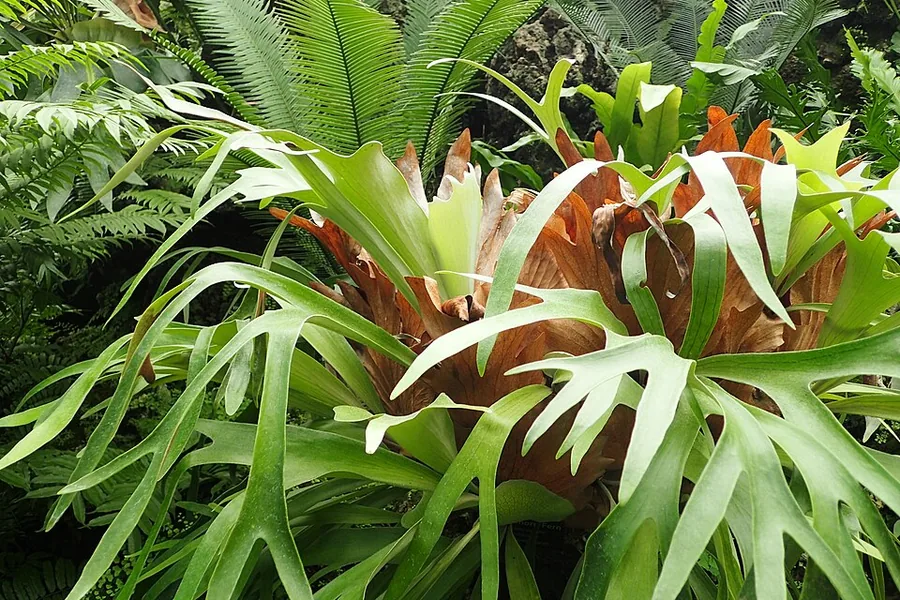
Part of its appeal is the interplay of two frond types that shape its whole look. The green antler fronds arch outward as the piece's living gesture, while the flat, papery shield fronds settle at the base and mellow to brown over time. That aging tone is no flaw to hide, since it is the plant quietly wrapping a protective collar around its roots, and it lends the mount an earthy, gallery-worthy patina.
This is a slow, self-possessed plant that prefers a considered setting to constant attention. Settle the light, the mounting, and an easy watering routine, and it holds its poise for years while unfurling fresh antlers. That makes it an elegant, low-effort anchor for a hallway, a bathroom wall, or a quiet corner of the living room.
Care
The short version: style it in bright indirect light, soak the mounted root ball on a rhythm and let it dry down between, keep the room warm, and surround it with humid, gently moving air.
Light
Position it in bright indirect light, the soft, luminous kind that fills a room without direct sun landing on the fronds. It accepts partial shade or gentle sun, so it settles happily on many walls and in many corners. Keep it away from harsh direct rays, which scorch the foliage, and from dim spots, where the look goes limp.
Water
Give it a soak every 7 to 14 days, letting the root ball dry a little between drinks but never go fully dry. The tidiest method is to immerse the mounted root ball, keeping the fertile fronds clear, for a few minutes and let it drain before it returns to the wall. Water more freely through warm, active growth and pare it back over winter.
Soil
This is not a potting-soil plant. It grows in an epiphytic mix of sphagnum moss and orchid bark, or mounted on a board with moss packed around the roots, which keeps the whole piece light enough to hang. A slightly acidic pH of 5.0 to 6.0 suits it, along with sharp drainage and freely moving air.
Temperature
Keep it in the comfortable 55°F to 75°F (13°C to 24°C) range that most living spaces already hold. It has no tolerance for frost, so keep it away from cold drafts and chilly winter glass.
Humidity
It looks its best in humid air, ideally 50% to 80%, which makes a bathroom or kitchen a natural home for it. Grouping plants or running a humidifier lifts drier rooms to the mark. Pair that moisture with steady airflow, since stagnant damp invites black spot and dulls the display.
Feeding
Feed monthly through spring and summer while it is growing, using a balanced diluted liquid fertilizer. There is no call to feed in the darker months, when growth eases to a standstill.
Pruning
Grooming it is almost effortless. Remove only the antler fronds that have gone fully dead, brown, and shriveled. Leave the brown shield fronds at the base untouched, since they are a living, protective part of the plant and a signature part of its look.
Repotting
Remounting is a rare event, perhaps once every few years when the plant truly outgrows its board. The cues are shield fronds spilling past the edges, a root ball easing the plant off its mount, or a top-heavy piece that no longer hangs square. Until then, it is content to stay on the wall.
Size & spacing
Indoors it reaches about 2 to 3 feet (61 to 91 cm) tall and roughly as wide, so give it a clear stretch of wall. Hang or set it where the antlers can fan out and cast their shape without crowding the space or a neighboring piece.
Troubleshooting
A staghorn stays looking its best when its watering and the air around it are in balance, and the fronds telegraph any drift early. Notice those cues and a quick adjustment keeps the display pristine. Match the look below to the fix and step in before it shows.
Dark spots spreading across the display
Those blemishes are black spot, a fungus that settles in where humid air stalls and water lingers on the fronds. Open up the space so air moves freely, water the root ball rather than the foliage, and remove any badly marked frond to restore the clean line. With airflow back, the plant recovers its looks.
Fix:
- Improve air circulation around the plant
- Reduce misting and avoid wetting the fronds when watering
- Remove badly affected fronds
Antler fronds drooping with browned tips
When the antlers go soft and lose their arch, the root ball has dried out entirely, the mark of underwatering once the mount feels weightless. Immerse the root ball for a few minutes, drain it well, and settle back into a steadier rhythm before it dries again. The shape returns as the plant rehydrates.
Fix:
- Immerse the root ball (not the fertile fronds) in water for several minutes
- Drain thoroughly and resume regular watering before it fully dries
Webbing, cottony flecks, or brown bumps on the fronds
These are the signatures of spider mites, mealybugs, aphids, and scale, which move in when dry air leaves the plant stressed. Wipe them away with a damp cloth, then treat with insecticidal soap, going light on the felt-covered fronds. Keep the piece apart from your other plants until it is clean.
Fix:
- Wipe pests off with a damp cloth
- Treat with insecticidal soap, avoiding heavy coating of the felt-covered fronds
- Isolate the plant until controlled
Toxicity
For a home shared with pets or children, the staghorn is an easy, worry-free choice: it is non-toxic through and through. The ASPCA clears it for cats, dogs, and horses, and nothing in the fronds threatens people or other animals. A large mouthful of any plant might unsettle a stomach, but that is the whole of the concern.
Safe for
People · Cats · Dogs · Horses · Rabbits · Livestock · Birds
Cats None
Cats are safe alongside this fern, with nothing in the fronds to harm a curious nibbler. A cat that eats a good deal might have a brief, mild stomach upset, no different from any houseplant.
Dogs None
Dogs come to no harm chewing a frond, as the plant holds no toxins. Overindulging in greenery could bring a passing bout of vomiting, but nothing more.
Horses Safe
Horses are untroubled by the fronds, which carry no harmful compounds. A stray taste is nothing to worry about.
Rabbits Safe
Rabbits can nibble the fronds without harm. A generous helping of unfamiliar greenery may loosen the gut for a day, so keep their tastes modest.
Livestock Safe
Grazing animals face no danger from this fern, since it lacks the toxins that make certain ornamentals a concern in pasture or barn.
Birds Safe
Pet birds are safe near the plant, its fronds free of anything poisonous. A curious peck does no harm.
People Safe
It is safe for adults and children to handle and live with. It is not grown to be eaten, but an accidental taste causes no trouble.
No special handling needed; non-toxic if nibbled, though eating large amounts of any plant may cause mild, temporary stomach upset.
Varieties
The plain species suits most rooms, though one named selection turns up often on shop shelves and styling lists.
Platycerium bifurcatum 'Netherlands'
The one to look for is 'Netherlands', a compact, sturdy form with broader, more upright forked fronds that has become the staghorn most people style indoors.
How to propagate
A staghorn grows into its display slowly, yet a mature plant offers one graceful way to raise a second for another wall.
Offsets & pupsModerate
Spring · Several months to about a year
The dependable way to raise another is from its offsets, the small pups that emerge from the rhizome. In spring, lift a pup with a few of its own roots and mount it on a board of its own, then give it time, since a new plant needs several months to about a year to establish. Spores are an option too, though the route is slow and finicky.
Myths
The papery brown shields at the base look dead and should be peeled off to neaten the piece.
Those browning shields are alive and earning their place. They clasp the root crown, gather water and fallen leaf litter, and shield the root ball from drying out. Leave them be, because pulling them away tears the roots beneath and spoils the plant.