Houseplant · Nepenthaceae
Tropical Pitcher Plant
Nepenthes
Give it warmth, high humidity, and rainwater, and this carnivorous curiosity hangs its own living, insect-trapping cups.
Bright indirect
Every 2–4 days
64–84°F · 18–29°C
USDA 10–12
Overview
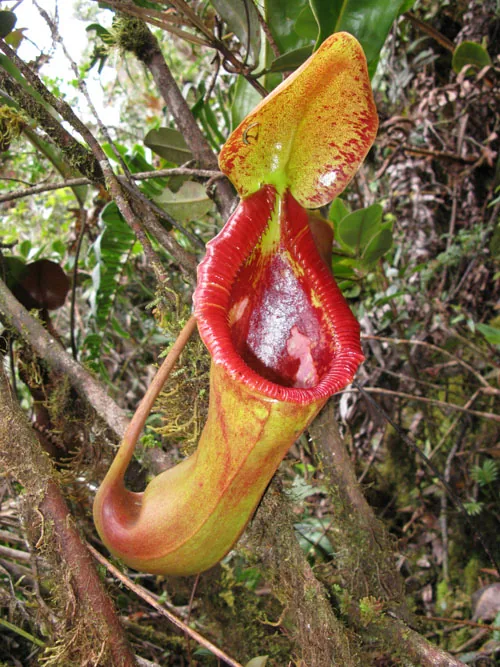
The tropical pitcher plant, or Nepenthes, brings a note of the exotic to a room, a climbing carnivore drawn from the warm, humid forests of Southeast Asia and the tropics beyond. Its leaves taper into slim tendrils that end in cups left to hang like small pendants, and those cups are the working traps. Insects lose their hold on the rim, drop into the fluid, and the plant makes its own meal of them, a quiet drama that unfolds on a shelf or sill. The way the cups swing has long earned it the name monkey cups.
As a houseplant it rewards a considered setting far more than fussy attention. Give it a spot with bright indirect light, steady warmth, and humid air, the mood of the forest edge it came from, and it repays you by climbing and hanging fresh cups. A sunroom, a bright bathroom, or a plant-filled corner near a humidifier all suit the daily rhythm it likes.
This is a piece for a grower ready to commit, not a casual windowsill filler. The care turns on water and air rather than feeding, since the roots resent tap-water minerals and the mix wants to stay loose and lean. Give it the bog-plant setting it asks for and it becomes one of the most quietly striking forms a collection can hold, an easy centerpiece for conversation.
Care
The short version: a spot with bright indirect light, warmth between 64°F and 84°F, and humid air around 60% to 80%. Set it in an airy, nutrient-poor carnivorous mix, water only with distilled or rainwater, and let the pitchers see to their own meals.
Light
Place it where bright, indirect light falls for most of the day, the glow of an east window or a gently shaded south one. It welcomes a little direct morning sun, but fierce midday light scorches the leaves, and a dim corner is the usual reason a plant stops offering cups.
Water
Keep the mix damp but never waterlogged, watering every 2 to 4 days, and let a little fluid rest in each cup. Reach only for low-mineral water such as distilled, reverse-osmosis, or rainwater, since tap-water minerals gather in the airy mix and slowly burn the roots.
Soil
Set it into an airy, nutrient-poor carnivorous mix of long-fiber sphagnum moss with perlite and orchid bark. Leave ordinary potting soil on the shelf, as it holds far more water and fertilizer than this lean-loving plant can take. Aim for a slightly acidic pH between 5.0 and 6.5.
Temperature
Warmth keeps the display going, ideally between 64°F and 84°F (18°C to 29°C). It has no tolerance for frost and turns sullen in a cold draft, so a settled indoor corner away from chilly windows suits it well.
Humidity
This is the detail that makes or breaks the look. Hold humidity in the 60% to 80% range with a humid room, a tray, or a glass enclosure, since dry air is the most common reason the cups never appear.
Feeding
Leave the roots unfed, since the cups gather their own insects across spring and summer. A plant set well away from any prey will accept an occasional very dilute foliar feed, and that is the most it ever calls for.
Pruning
Trim browned or spent cups and dead leaves right at the base to keep the piece looking composed. Shortening the longest, wandering vines also encourages the plant to branch and offer fresh cups.
Repotting
Refresh it every 1 to 2 years into a clean airy mix, since old sphagnum breaks down and starts holding water without air. Roots slipping through the drainage holes, a soggy spent mix, or smaller and fewer cups all signal the moment.
Size & spacing
Vines reach anywhere from 1 to 6 feet (30 to 180 cm) depending on the type and how you train them, spreading around 12 to 35 inches (30 to 90 cm). Give it clearance so the cups can hang free and read as the centerpiece, rather than pressing against a wall or a neighbor.
Troubleshooting
Most of what troubles a Nepenthes comes down to water, light, or humidity rather than pests, which makes it an easy plant to read. It shows its mood through the cups and leaf tips, so a glance now and then catches problems early. Match what you notice below and adjust the setting before any decline settles in.
Browning cups and crisp tips that dull the display
Crisp brown edges that spoil the look usually trace to mineral burn from tap water, which gathers quickly in the lean carnivorous mix. A dry room and any fertilizer near the roots only deepen it. Move to distilled, reverse-osmosis, or rainwater, flush the pot to carry the salts away, and lift the humidity around the plant so the display recovers.
Fix:
- Switch to distilled, RO, or rainwater
- Flush the mix with low-mineral water to leach salts
- Increase humidity and stop any root fertilizing
A slumping plant in tired, waterlogged mix
A plant that slumps in a wet, packed pot is showing root rot from a mix that has lost its openness. As sphagnum breaks down it clings to water and shuts out air, and everyday potting soil behaves that way from the first watering. Ease the plant out, trim away the dark mushy roots, and settle it into fresh airy sphagnum with perlite and bark.
Fix:
- Repot into fresh airy sphagnum and perlite/bark mix
- Trim mushy roots
- Keep the mix damp but never waterlogged
A leafy plant that never delivers the signature cups
When a Nepenthes fills out with leaves yet withholds the sculptural cups that make it a talking point, dry air or thin light is usually behind it. The cups arrive only when humidity settles into the 60% to 80% range and the plant holds a spot with strong indirect light for most of the day. Keep the room warm and the water low in minerals, and the display returns.
Fix:
- Raise humidity around the plant
- Move to a brighter spot with strong indirect light
- Maintain stable warm temperatures and keep watering with low-mineral water
Toxicity
For a home with pets, the verdict is welcome: the tropical pitcher plant is not toxic to cats, dogs, or any other household animal. The fluid held in the cups is mild rather than dangerous, and though it is not for drinking, steering curious pets away from the traps mostly keeps the display looking its best.
Safe for
People · Cats · Dogs · Horses · Rabbits · Livestock · Birds
Cats None
A household cat can share the room without concern. Should one bat at a hanging cup or taste a little fluid, no harm follows, though placing the traps beyond reach keeps the display intact.
Dogs None
Dogs are welcome in the same space. A dog that mouths a leaf or samples the pitcher liquid might feel briefly unsettled by the novelty, and nothing more comes of it.
Horses Safe
Horses run no poisoning risk from this plant, and as a compact indoor piece it never appears anywhere near a pasture they would graze.
Rabbits Safe
A rabbit may nibble it without harm. The plant carries no toxin, so an idle bite is fine, even though it rarely tempts one in the first place.
Livestock Safe
Cattle, goats, and sheep face no danger here. Neither the foliage nor the trap fluid holds anything for them to react to.
Birds Safe
Pet birds are at ease beside it. The plant holds no poison for them, though a small bird is likelier to be caught by a cup than troubled by it.
People Safe
It sits gently in a household with people, too. The pitcher fluid is not for sipping, yet the plant carries no poison, so a hands-on moment or a child's stray taste poses no real danger.
The digestive fluid in the pitchers is mild but it is sensible to keep pets from drinking it or chewing the traps.
Varieties
The genus runs to hundreds of species and hybrids, from easygoing plants for a first shelf to the giants that collectors prize as showpieces. These are the ones most likely to find their way into a home.
Nepenthes ventricosa
A highland grower that settles happily into ordinary rooms and hangs elegant hourglass-shaped cups, which is why it so often becomes a first pick for beginners.
Nepenthes × ventrata
A dependable cross of ventricosa and alata that asks little of a home, making it one of the most livable tropical pitcher plants to keep indoors.
Nepenthes alata
An adaptable, far-ranging species dressed in slender winged cups that reaches more homes as a houseplant than nearly any relative.
Nepenthes rajah
A statement piece from Borneo, celebrated for some of the largest cups in the genus, generous enough to hold well over a quart of fluid.
How to propagate
More pitcher plants come either the quick way from cuttings or the slow way from seed, and each has its own appeal for a grower. Both simply ask for the same warm, humid setting the parent already enjoys at home.
Stem cuttingsModerate
Active growth in spring to summer · 6 to 12 weeks to root in warm, humid conditions
Cuttings are the graceful way to bring on more plants, best attempted while growth is active in spring and summer. Set a vine cutting of two or three nodes into damp sphagnum in a warm, humid spot, and it settles in and roots over roughly 6 to 12 weeks.
SeedDemanding
Fresh seed sown any time under warm, humid conditions · Several months to germinate and a few years to reach mature size
Seed is the unhurried, long-game approach for the patient grower. It asks for fresh, viable seed and steady warmth and humidity, and it may rest for several months before sprouting and then take a few years to reach mature size.
Myths
You have to feed pitcher plants meat or fertilizer to keep them alive.
There is no need to play host with scraps, since these light feeders quietly gather their own insects in the cups and want nothing added at the roots. A well-lit, humid corner and low-mineral water do far more for the plant than any feeding, while offered meat or houseplant fertilizer tends only to rot the cups.
Pitcher plants need rich, fertile potting soil like other houseplants.
They come from thin, hungry ground and prefer an open blend of long-fiber sphagnum and perlite. A rich potting soil simply holds too much fertilizer and moisture, and it can bring the plant down.